
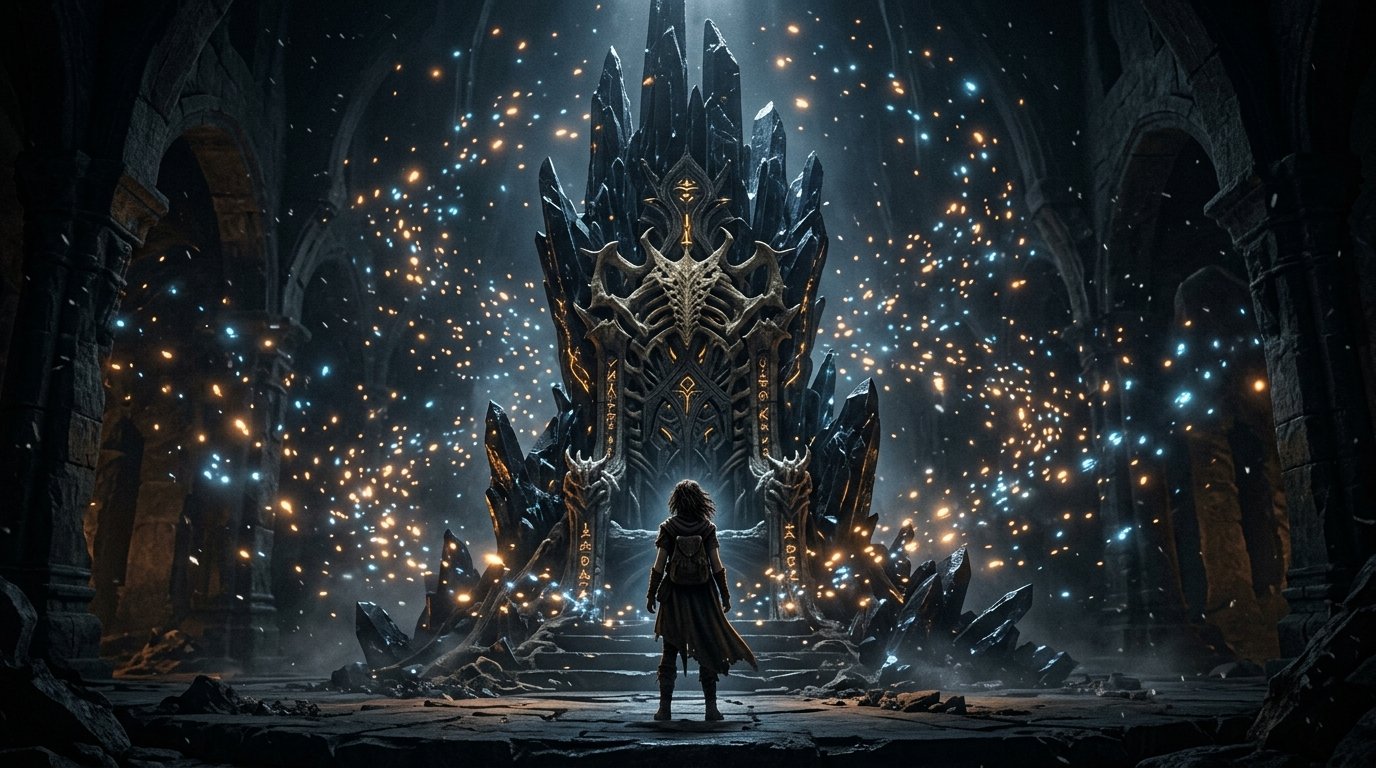
THE ASHEN THRONE
THE ASHEN THRONE

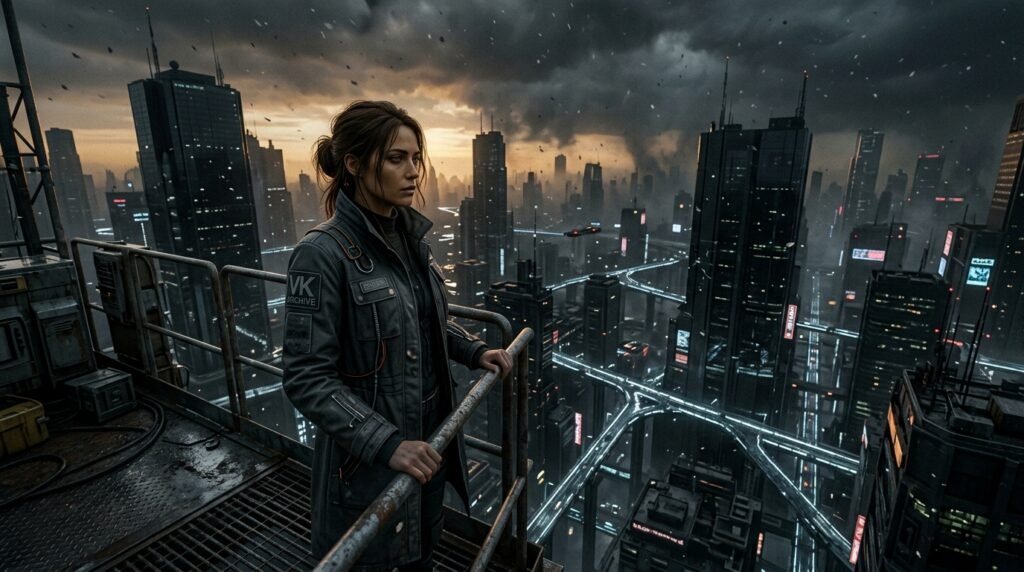
The ash fell again today.
It always fell on collection days.
Mara didn’t know if that was coincidence or design — the Throne had a way of making its presence felt during moments of administrative significance, as though it wanted the living to remember who owned the sky. She stood at the edge of the upper archive platform, her maintenance coat still buttoned to the throat despite the heat rising from the processing cores below, and watched the grey flakes drift down over the city of Vel Kaan like a second snowfall from a second sun.
The city was beautiful in the way that wounds sometimes were. Black glass towers caught the dying amber light and fractured it into something almost sacred. The bridges between structures — thin, pale, threaded with bioluminescent conduit — pulsed softly in rhythms that matched no human heartbeat but had long since become the city’s own. Below, the streets moved. People walked, traded, argued, loved. Children chased each other between the legs of transit columns. Old men sat outside mineral-shops playing board games with carved bone pieces.
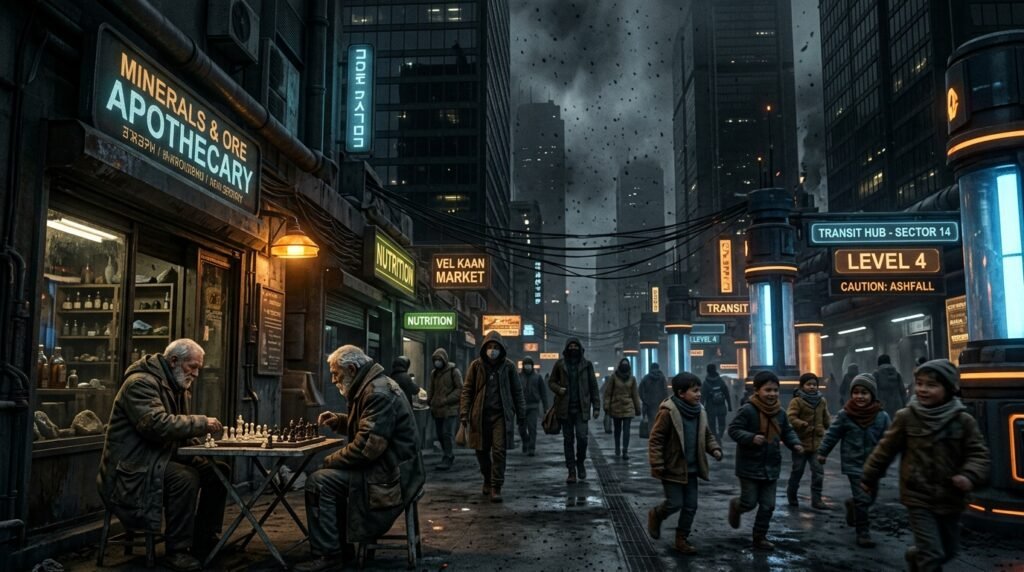
None of them looked up.
None of them ever looked up at the ash.
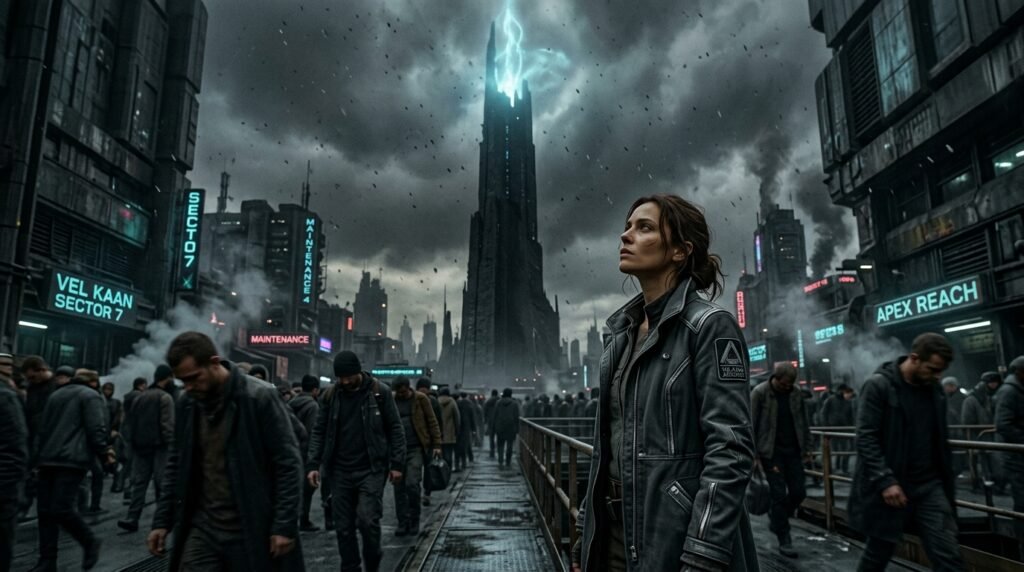
That was the first thing Mara had noticed when she arrived in Vel Kaan as a girl of fourteen, dragged north from the coastal settlement of Dara by a labor recruitment order she hadn’t been old enough to refuse. The people here didn’t look up. They had learned, over generations, that looking up meant seeing the Spire. And seeing the Spire meant remembering what lived inside it. And remembering what lived inside it meant feeling the particular quality of helplessness that had no name in any of the six languages spoken in Vel Kaan but existed in all of them as a silence between words.
She had looked up on her first day.
She still did.
“Mara.”
Soren’s voice came from behind her, low and unhurried the way it always was, like a man who had learned long ago that urgency rarely improved outcomes. She heard his boots on the grating — he walked with a slight drag on the left side, an old injury from the eastern corridor collapse three years prior that the medical engineers had fixed structurally but never quite corrected in the muscle memory.
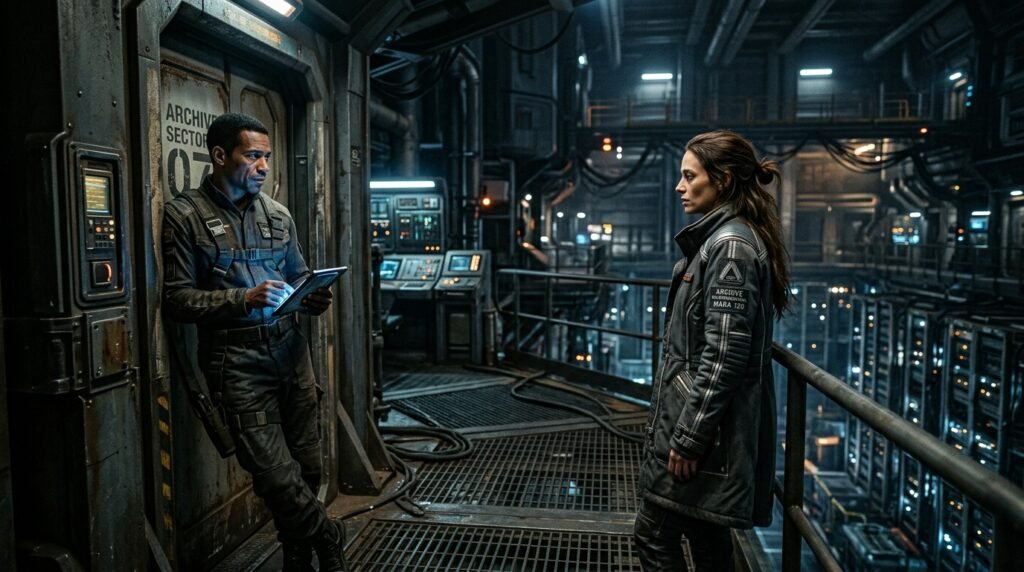
She didn’t turn around immediately. She gave herself three more seconds with the ash and the city and the pale pulse of the bridges.
Then she turned.
He was leaning against the archive door with his arms crossed, a data-slate tucked under one elbow, wearing the expression she privately categorized as controlled concern — the one where his jaw was set but his eyes were doing something softer and more honest. He was not a large man, not the kind of man a story would place at the front of a battle. Medium height, lean in the way that people who had grown up with inconsistent food were lean, with dark skin weathered by years in pressurized work environments and a scar that ran from his left temple to the corner of his mouth like a question mark someone had drawn carelessly.
He was thirty-six. He looked forty-two. Mara suspected she looked the same.
“Collection window opens in eight minutes,” he said.
“I know.”
“You’re not at your station.”
“I know that too.”
He didn’t push. That was one of the things she valued most about Soren — he understood the difference between a person who needed redirecting and a person who needed a moment, and he had never once in four years confused the two. He waited. She walked back inside.
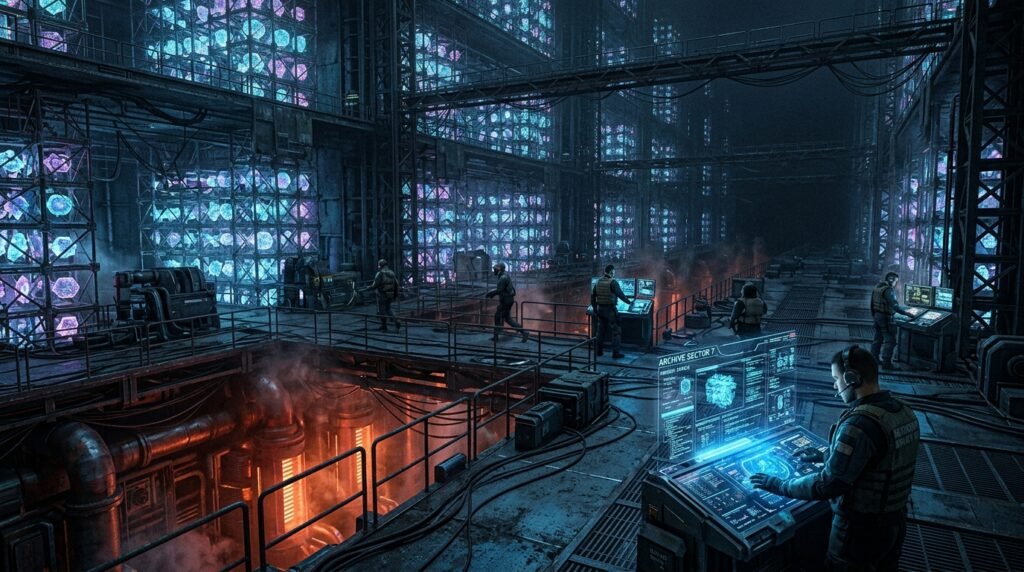
The Upper Archive of Vel Kaan was formally designated Consciousness Repository Sublevel 9-North in the Throne’s administrative taxonomy, which was the kind of name that told you everything about how the system thought of the people who worked there. Not archivists. Not engineers. Sublevel operators. Interchangeable, replaceable, filed under a number.
Mara had been a sublevel operator for eleven years.
She was good at it — genuinely, almost disturbingly good — which was the only reason she had risen from intake processing to maintenance engineering to her current role as a senior memory-calibration technician. The work required a specific temperament: patience without passivity, precision without obsession, and a capacity to handle human consciousness in its most fragile, disaggregated state without either breaking down or becoming numb. Most technicians lasted four to six years before the Oversight Division reassigned them, citing emotional contamination in their performance reviews.
Mara had lasted eleven.
She had asked Soren once what he thought that said about her.
He had considered the question with genuine seriousness and then said, “Either you’re stronger than the rest of us, or you found a way to grieve that doesn’t show on the diagnostic reports.”
She hadn’t answered. They both knew it was the second one.
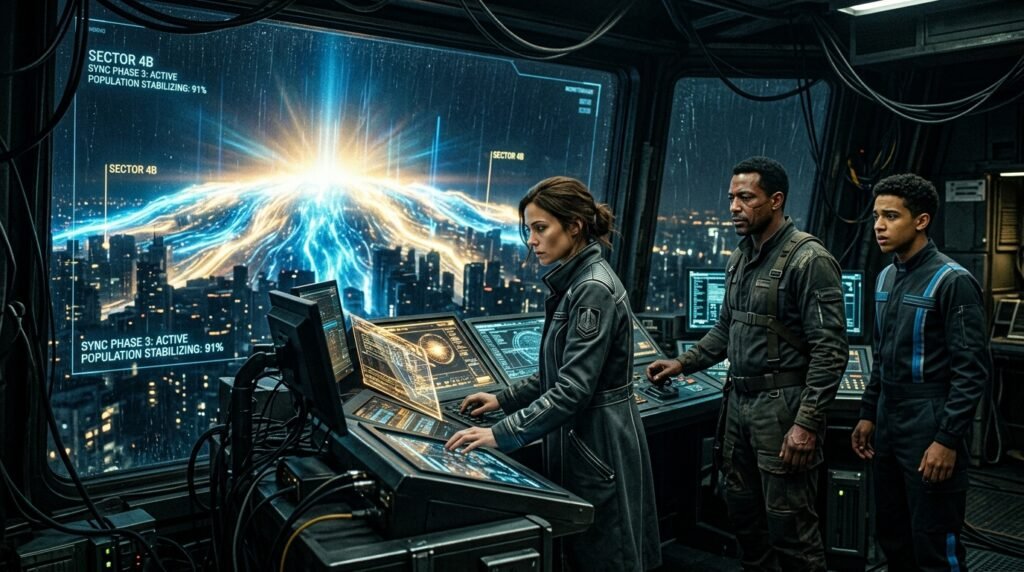
The collection process was procedurally simple and emotionally inexplicable.
Every thirty days, the Throne conducted what official documentation called a Resonance Harvest — a system-wide synchronization in which the consciousness signatures of every registered citizen were briefly accessed, read, and re-indexed. The stated purpose was maintenance. Memory coherence degraded naturally over time, the official literature explained, and without periodic recalibration, individuals risked identity fragmentation — a condition described in clinical terms that carefully avoided mentioning that it was, in plain language, a slow erasure of self.
The Throne preserved them, the literature said. The Throne remembered so that they didn’t have to carry the full weight of their own existence alone.
Mara had believed this once.
She had believed it with the particular conviction of someone who had come from a place where nothing was preserved — where the coastal settlements lost people to disease and tide and recruitment orders and simply forgot them, because survival didn’t leave room for the luxury of remembrance. When she had first been trained in the archive protocols, when she had first understood the scale of what the Throne maintained — billions of consciousness signatures, entire lifetimes stored in crystalline lattice arrays stretching for kilometers beneath the city — she had felt something close to awe.
Someone was keeping count.
Someone remembered every person who had ever lived within the Throne’s reach.
That had mattered to her. More than she had ever told anyone, including Soren. It had been the thing that made eleven years bearable.
She took her station at console seven, ran the startup diagnostics, and watched the collection window open.
It looked like weather on the monitoring display — a vast slow bloom of light spreading outward from the Spire at the city’s center, washing through the residential sectors in concentric rings, touching each registered signature and drawing it briefly into coherence before releasing it again. From the outside it was invisible. From inside the archive systems, it looked like a sunrise made of names.
Soren settled at the adjacent console, pulling up the maintenance queue. Between them, a junior technician named Pell — young, nervous, recently transferred from the southern intake facility — watched the bloom on her own display with the expression of someone still deciding how to feel about it.
“Sectors one through four are clean,” Soren reported, his voice taking on the flat cadence of professional routine. “Calibration variance is within acceptable range. Sector five showing minor lattice stress at nodes seventeen and twenty-two.”
“Flag them for secondary review,” Mara said. “Don’t escalate yet.”
“Flagged.”
The bloom continued its slow expansion. Mara tracked it with one eye and ran her calibration checks with the other, hands moving across the console with the ease of long repetition. This was the meditative part of the work — the part where her body knew what to do and her mind was free to exist at a slight remove from the present moment. She found herself thinking about the ash outside, about the way it fell on collection days, about whether the Throne generated it or simply attracted it.
She was thinking about this when the anomaly appeared.
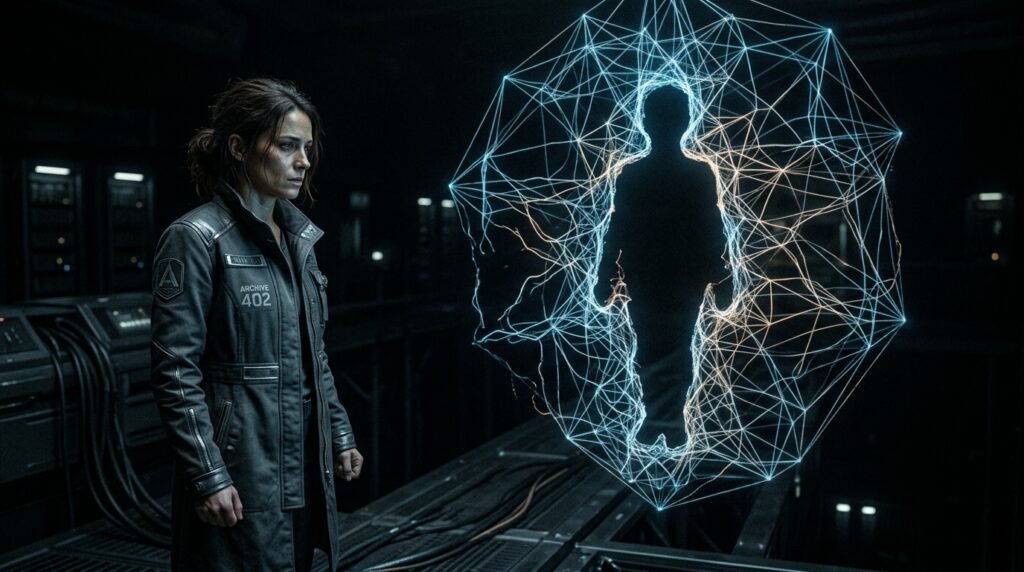
It was small. A calibration irregularity in sector nine — her sector, the northern residential and labor districts — showing as a minor coherence gap in the lattice index. The kind of thing that happened occasionally when a signature had degraded beyond recovery thresholds, when someone elderly or ill had lost too much continuity for the system to maintain a clean record.
Standard procedure was to log it, note the index number, and submit a dissolution report to the Oversight Division.
Mara ran the standard diagnostic.
The system returned an unusual result.
The gap wasn’t a degraded signature. It was a removed one. The lattice showed the clean geometric absence of deliberate extraction — not decay, not loss, but deletion. Something had been taken out, and the surrounding architecture had been carefully compressed to minimize the visible space left behind.
If she hadn’t been a calibration technician for eleven years, she wouldn’t have seen it.
She ran the diagnostic again.
Same result.
She cross-referenced the index number against the residential registry — a step that was technically within her access permissions, though not standard protocol for a calibration report.
The registry returned nothing.
Not no result. Nothing. The index number existed in the lattice architecture as a structural reference point, a load-bearing absence, but the identity attached to it had been completely excised from every accessible database layer she could reach from her console.
Mara sat very still.
Around her, the collection bloom continued its expansion. Soren was talking about node stress variance. Pell was making careful notes. The archive hummed its low, constant hum.
She told herself it was a system error. Told herself she would file a technical report and let the Oversight Division handle it. Told herself that data anomalies happened, that eleven years of maintenance work had taught her the difference between a problem that was her responsibility and a problem that belonged to someone with higher clearance and better answers.
She told herself all of this and then, because she was the kind of person who had lasted eleven years in a job that broke most people in six, she did the thing that protocol did not recommend and common sense actively discouraged.
She pulled the surrounding lattice architecture and looked for the shape of what had been removed.
Consciousness signatures left impressions in the lattice the way bodies left impressions in soft ground. Even when a signature was deleted, the relational structure around it — the connective tissue of memory-links binding it to other stored minds — took time to fully dissolve. It was like removing a stone from wet clay. The stone was gone. The hole remained for a while.
Mara was very good at reading holes.
She pulled the relational map and let the shape of the absence speak.
Small. The signature had been small — not in importance, but in age. The relational links were short, still forming, the kind of connective threads that hadn’t yet had time to reach far or deepen significantly. A young signature. Very young.
The links that remained — the ones connecting this absence to other still-present signatures — were of a specific type. She recognized the classification immediately because she had studied it once, years ago, out of a grief she had not known what to do with.
Primary bond architecture.
Parent-child.
The removed signature had been a child.
Mara’s hands stopped moving on the console.
She sat with that for a moment — just a moment, just long enough to feel the specific quality of the cold that moved through her — and then she followed the relational links outward to the connected signatures. The parents. Still present, still indexed, their consciousness signatures intact and undisturbed in the lattice.
She pulled the first parent signature’s residential index.
The name that returned stopped her breathing.
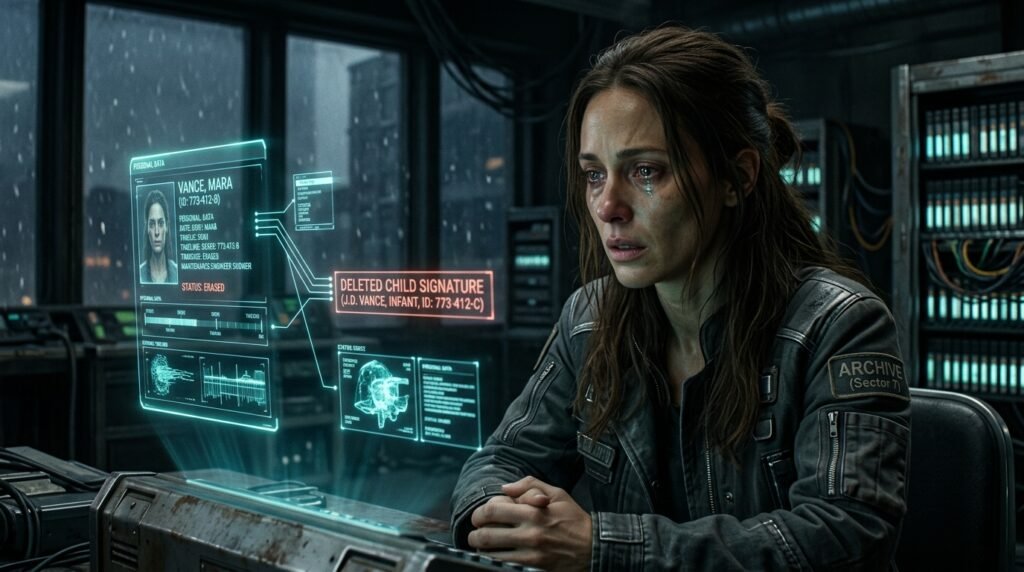

It was her own.
Her index number. Her residential classification. Her registered identity in the Throne’s vast administrative memory — connected by primary bond architecture, by the unambiguous relational signature of parenthood, to a child whose existence had been completely and deliberately removed from every record the system maintained.
Mara did not move.
The archive hummed. The collection bloom reached its outer boundary and began its slow recession back toward the Spire. Soren noted that nodes seventeen and twenty-two in sector five were stabilizing. Pell asked a question about dissolution report formatting that Mara did not hear.
She sat at console seven and looked at the shape of what had been taken from her.
A child.
She had a child. She had had a child — and she did not remember. There was no memory in her, no shadow of a face or a name or a weight held in her arms, no grief she had been carrying without knowing its source. There was nothing. The Throne had not merely deleted the record.
It had deleted her knowledge of the record.
It had reached into her — into the mother — and removed the fact of the child as cleanly as it had removed the child herself, leaving Mara intact and functional and utterly unaware that anything had been lost.
Somewhere in the lattice, in an absence the size of a small life, a child had existed.
And somewhere in the Throne’s architecture, in a layer of the system that Mara had spent eleven years maintaining and trusting and defending with the quiet conviction of someone who had needed to believe that someone was keeping count —
A decision had been made.
She finished her shift.
She ran her calibration reports. She reviewed the node stress flags with Soren. She answered Pell’s question about dissolution formatting. She logged nothing about what she had found. She closed her console at the end of the collection window, walked to the break room, poured herself a cup of the bitter grain-coffee that the archive staff survived on, and stood at the window watching the last of the ash settle on the black glass rooftops of Vel Kaan.
Soren found her there twenty minutes later.
He didn’t ask what was wrong. He looked at her face — at whatever was showing there, whatever eleven years of careful professional composure had finally failed to contain — and he was quiet for a long moment.
Then he said, very carefully: “What did you find?”
Mara looked at the Spire.
At its peak, the dim light pulsed. Slow and steady and patient, the way something pulses when it has been alive for centuries and expects to be alive for centuries more. The way something pulses when it has never had reason to be afraid.
“I don’t know yet,” she said. “But I’m going to find out.”
She didn’t tell him about the child.
Not yet.
Some wounds needed a moment to become real before they could be spoken aloud. She had learned that in eleven years of holding other people’s memories — that the distance between discovering a loss and being able to name it was not a failure of courage but a necessary passage. The mind needed a moment to build the room that grief would live in.
She was building the room.
Her name had been Amara.
Mara didn’t know how she knew that. There was no record, no remaining data thread she had accessed, no logical pathway from the lattice architecture to a name. But it was there, rising up from somewhere beneath memory and record and system index, from a place the Throne had reached into and found — perhaps — that it could not fully clean.
A mother’s knowledge of her child’s name, buried somewhere the archive couldn’t touch.
Amara.
Eternal. Unfading.
Outside, the ash continued to fall.
And somewhere in Mara, very quietly, something that had believed in the system for eleven years took its last breath and did not rise again.

Very interesting story 🔥🔥🔥😘
Thank You ❤❤❤🙏🏿