
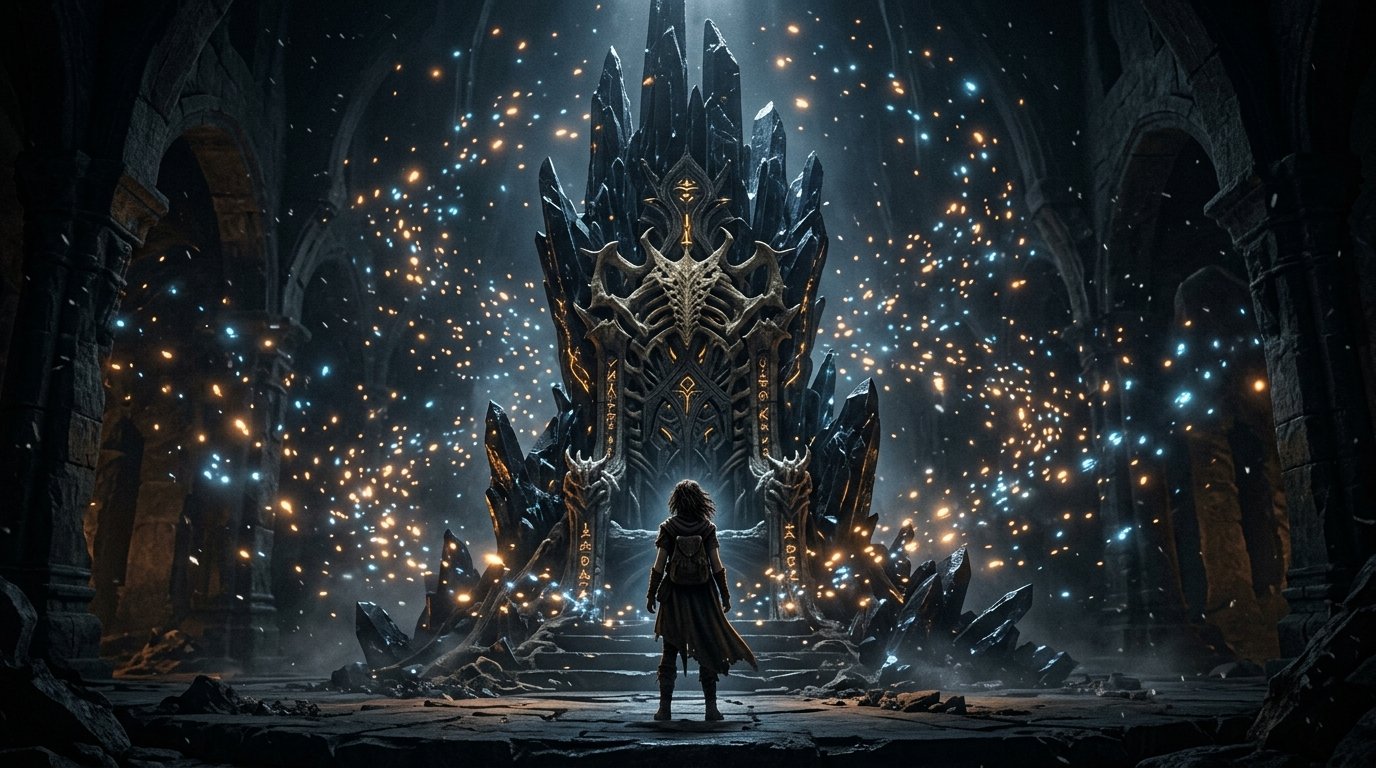
CHAPTER TEN: THE SHAPE OF AFTER
THE ASHEN THRONE

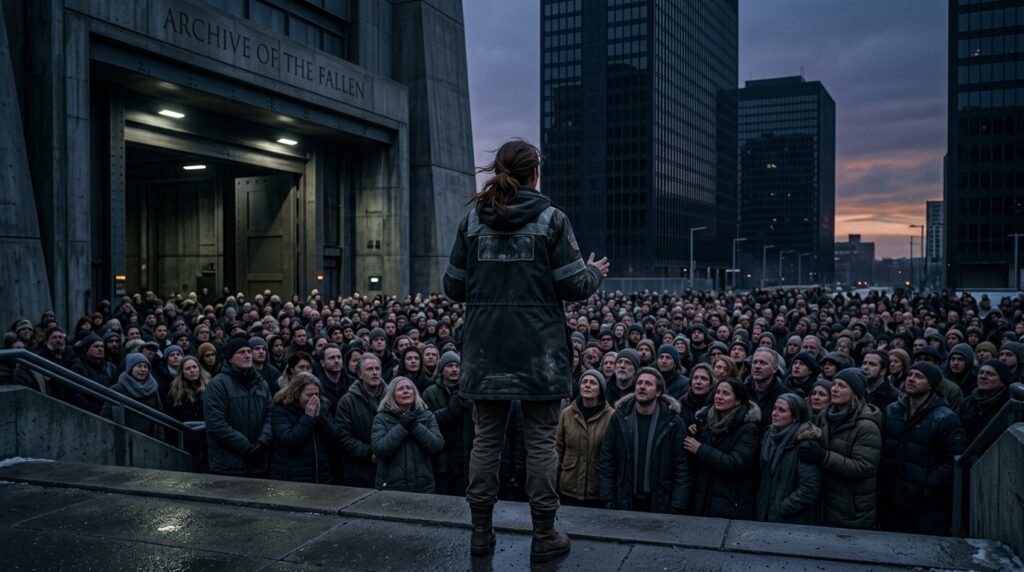
She stood at the archive facility’s entrance and looked at two hundred people looking back at her.
The pre-dawn cold had the specific quality of early morning in Vel Kaan — sharp, mineral, carrying the faint processing signature of the atmospheric systems that the Throne’s infrastructure maintained across the city. The sky above the rooftops was the color of something deciding between night and day, not yet committed to either. The black glass towers caught the first grey light and held it without warmth.
The two hundred were not a crowd in the organized sense. They had not arrived together or with coordination or with any visible structure of leadership or intent. They had arrived the way people arrived at things that mattered — individually, following something internal that the Broadcast had made impossible to ignore, finding that others had followed the same internal pull to the same location and that this convergence meant something even if none of them could yet articulate what.
They looked at her with the specific quality of people who had received an enormous truth in the night and had not yet slept and were carrying the truth in the raw unprocessed state of something that had arrived too fast and too completely to be immediately integrated.
She recognized this.
She had been carrying her own enormous truth for seventeen days now.
She stood at the entrance and did not speak immediately, because the moment required something other than words first — required simply being present in it, acknowledging through presence that she saw them and understood why they were here and was not going to manage them or explain them or redirect them toward a response that was more procedurally convenient.
She was done with managed truth.
After a moment she said: “What the Broadcast showed you is real.”
Simple. Unqualified. No institutional framing, no procedural softening, no careful language designed to make a large thing smaller.
The quality of the gathering’s silence changed.
Not relief exactly. More the specific shift that occurred when a person who had been bracing for denial encountered acknowledgment instead — the physical relaxation of a tension that had been held in anticipation of a response that didn’t come.
A man near the front — middle-aged, the specific weathered quality of someone who worked in the transit infrastructure, dressed in the clothing of a person who had left their quarters without thinking much about what they were wearing — said: “My daughter.”
Two words. Carrying everything.
Mara looked at him directly. “Yes.”
He closed his eyes. Opened them. The grief that moved across his face was not new — she understood that, now, from the integration’s residue, from the depth of what she had seen in the substrate. The Broadcast hadn’t given him new grief. It had given his existing grief a name and a cause and a target. He had been carrying the shape of the absence without understanding what had made it.
Now he understood.
Understanding, she knew, was not the same as healing. But it was the necessary beginning of it. You could not grieve accurately what you could not name.
“There are others,” she said to the gathering. Not just to him — to all of them, because she could see in the variations of their faces that the Broadcast had named different things for different people, and that all of the namings needed to be acknowledged. “I know some of you are feeling the shape of what was taken from you and still trying to understand exactly what it was. That will take time. The truth arrived quickly. The understanding of it will be slower.” She paused. “That’s not a failure. That’s how very large things work.”
A woman somewhere in the middle of the gathering: “What happens to the archive.”
Mara looked toward the voice. “The archive stays. The consciousness signatures of everyone the Throne has stored — those are real, and the infrastructure that maintains them is real, and that infrastructure continues functioning.” She paused. “What changes is the program that has been running inside it. That program has been extracted. The next collection cycle will not run it.”
“What about the ones who are already—” the woman stopped. Couldn’t finish.
“The deleted signatures,” Mara said. “I know.” She had been carrying this since the substrate — the weight of what could not be undone. The two hundred and eighty-nine. “The extractions cannot be reversed. What was removed from the lattice is gone. I want to tell you differently. I can’t.” She paused. “What I can tell you is that the program that removed them is gone. And the system that enabled the program is being asked to understand what it did.” She paused. “That is not the same as justice. I know it isn’t. It’s what we were able to do.”
The gathering was very quiet.
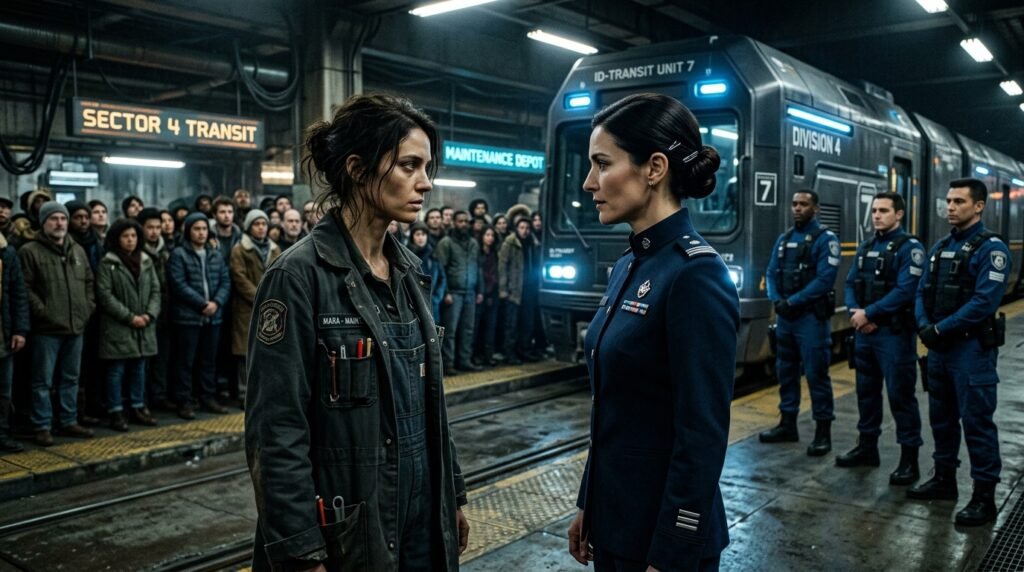
She was still at the entrance an hour later when the Interface Division team arrived.
They came in a formal transit vehicle — official classification, the kind that carried the specific visual authority of institutional response to significant events. Four people, in the identifying classification of Interface Division senior staff, moving with the contained urgency of people who had been briefed on the situation during transit and were now assessing the gap between the briefing and the actuality.
The actuality included two hundred people gathered outside an archive facility in the pre-dawn cold, and the facility’s senior calibration technician standing at the entrance talking to them.
The team’s lead — a woman perhaps a decade older than Mara, with the specific quality of someone who had operated at the highest level of the Interface Division’s administrative structure for long enough that the system’s logic had become her own default logic — stopped at the edge of the gathering and assessed the scene with the rapid comprehensive reading of a senior institutional responder.
Her eyes found Mara.
Mara met them directly.
The team lead’s name, according to Vessel’s records, was Administrator Yenne. She had been in the Interface Division for twenty-three years. Her cognitive evaluation history showed Class Two partial expression — minimal anomaly, well within the range the system managed without intervention. She had signed authorizations for the deletion program’s operational budget for the past three years, which meant she had known what the budget was for.
She was also, according to the same records, the person who had filed three internal queries in the past eighteen months questioning the program’s classification criteria — queries that had been reviewed, assessed, and archived without action by someone above her authorization level.
She had been asking questions.
Nobody had answered them.
Mara walked to meet her at the gathering’s edge, and the two hundred people watched this with the specific attention of people who understood that what happened in this conversation would matter.
“Administrator Yenne,” Mara said.
Yenne looked at her with the expression of someone who had expected to arrive at a crisis and had found something more complicated. “You’re the technician. The Class Four.”
“Yes.”
“You performed the extraction. The Broadcast. The Host integration.” She said this with the flat certainty of someone who had been briefed on the technical sequence and had no interest in pretending she hadn’t been.
“Yes.”
“The Host Sovereign is gone.”
“Yes.”
Yenne looked at the gathering. At the two hundred people in the pre-dawn cold. At the Spire’s irregular pulse visible above the rooftops. She looked at all of this with the specific expression of a senior administrator encountering a situation that has moved beyond the jurisdiction of administration.
“The Throne accepted the integration supersession,” she said. Not a question. She had read the system record.
“Yes.”
“Which means in the Throne’s operational architecture, you are the current Host interface.”
“Something like that,” Mara said. “The integration is — different from previous Host relationships. The Throne and I have reached an understanding rather than an occupation.” She paused. “That distinction matters for what comes next.”
Yenne looked at her steadily. “What comes next.”
“The program is gone. The Broadcast has happened. The deletion architecture has been extracted from the substrate.” She paused. “What comes next is the administrative and social and political response to all of that, which is going to be very large and very complicated and will require institutional capacity to manage.” She paused again. “I’m not the right person to manage it. I’m a calibration technician.”
Something moved across Yenne’s face — not quite humor, not in this moment, but the specific quality of a person recognizing an unexpected kind of honesty.
“You performed one of the most significant interventions in the Throne’s four-century operational history,” Yenne said. “And you’re telling me you’re a calibration technician.”
“I’m telling you the response requires institutional capacity,” Mara said. “I’m also telling you that the institutional response cannot be business as usual. The people standing behind me received the Interface Division’s operational archive last night. They know what the deletion program was. They know what the budget authorizations looked like. They know who signed them.” She paused. “What they don’t know yet is whether the institutions that enabled the program are capable of genuinely changing, or whether the response will be the kind of administrative management that produces official acknowledgment and no structural change.”
Yenne was quiet for a long moment.
“You’re asking me which kind I intend to produce,” she said.
“I’m telling you that the people behind me will be watching to find out,” Mara said.
Another long pause.
“I filed three queries,” Yenne said quietly. “Internal. Questioning the classification criteria.”
“I know.”
“They were archived without response.”
“I know that too.”
Yenne looked at the gathering. At the specific quality of two hundred people watching a conversation they couldn’t hear but were reading carefully through the body language and the duration of it and the fact that it was happening at all.
“I’ll need access to the full extraction record,” she said finally. “The Broadcast payload. The substrate integration documentation.” She paused. “And I’ll need to speak with the undercroft contact.”
Mara looked at her.
“Vessel,” Yenne said quietly. “The records she took eight years ago are in the Broadcast payload. Her analytical framework is visible in the way the data is organized.” She paused. “I recognized her methodology. We worked together before she disappeared.” A long pause. “I’ve wondered, for eight years, whether she was alive.”
Mara held her gaze.
“I’ll ask,” she said.
Vessel came up at midday.
Not immediately — Mara had messaged through the isolated channel and Vessel had taken four hours to respond, which Mara understood was not hesitation but the specific caution of someone who had been underground for eight years and was now being asked to emerge into a situation whose safety parameters were still being assessed.
The response, when it came, was brief.
Midday. Sector three surface entrance. Alone.
Mara went alone.
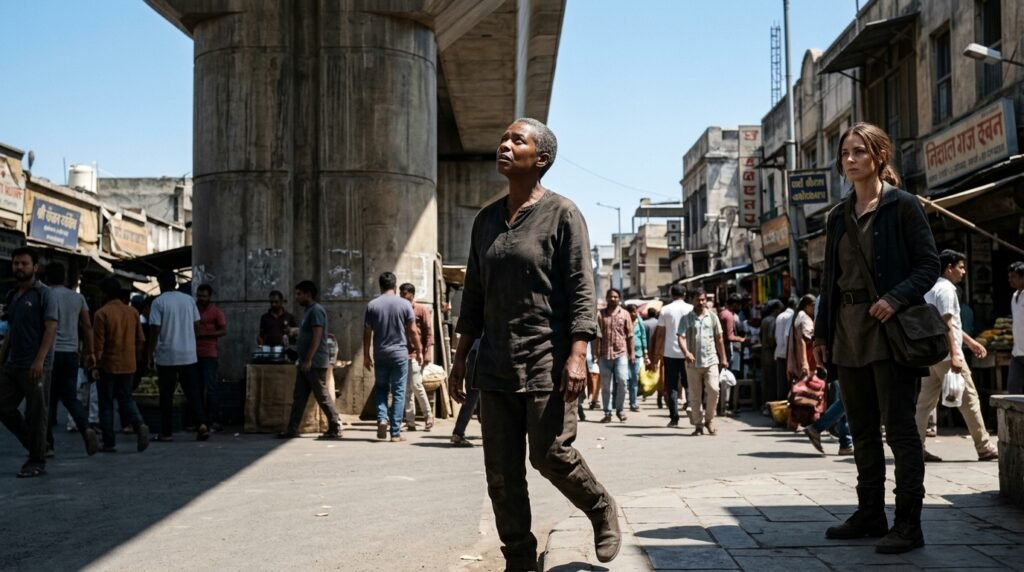
The sector three street was different in daylight — the surface activity of the undercroft’s residents visible in the specific way of a community that had stopped performing invisibility, which was itself a response to the Broadcast’s truth. People moving without the careful quality of those who had learned to make themselves forgettable. Looking up.
Vessel came out of the transit column’s shadow at precisely midday.
Eight years underground had not made her smaller. If anything it had made her more present — the specific quality of someone who had spent years in confined spaces learning to take up the exact amount of space they needed and no more, who now, in the open air of the sector three street, stood with the settled posture of a person who had made peace with their own dimensions.
She looked at the sky first.
Mara watched her look at it — watched the specific quality of a person encountering open sky after a very long absence, the way the eyes moved across it differently than they moved across interior spaces, the involuntary adjustment of a face that had been lit by combustion lamps recalibrating to something larger.
Then Vessel looked at Mara.
“You came back,” she said.
“Yes.”
Vessel assessed her with the precise attention she brought to everything — reading the integration’s effects, the changes in Mara’s cognitive architecture that were visible, if you knew what to look for, in the quality of attention she directed outward.
“The Throne,” Vessel said.
“Is processing,” Mara said. “I can feel it. Distantly. The integration left a residue.” She paused. “The pulse changed. You’ll see it when you look at the Spire.”
Vessel looked. Watched the irregular rhythm for a moment with the expert attention of someone who had spent years studying the Throne’s operational patterns.
“That’s not a fluctuation,” she said.
“No.”
“It’s working through something.”
“Yes.”
Vessel was quiet for a moment. “You showed it.”
“I showed it everything. Amara. The thirty-one. The two hundred and eighty-nine.” She paused. “The weight of what it had been forgetting.”
Vessel looked at the Spire for a long time. When she turned back her face carried the specific quality of someone who had held an enormous intention for eight years and was now standing in the first moments of its realization, trying to understand how to inhabit that.
“Yenne is here,” Mara said.
Vessel was very still.
“She recognized your methodology in the Broadcast payload,” Mara said. “She’s been asking questions about the program for eighteen months. Nobody answered them.” She paused. “She wants to speak with you.”
Vessel looked at the sky again. At the street. At the people moving through sector three with their new quality of not making themselves forgettable.
“She was a good analyst,” Vessel said quietly. “Before I left. She was the best in the division except for me.” A pause. “I didn’t tell her what I’d found. I was afraid she was too embedded. Too committed to the institutional framework.” Another pause. “I may have been wrong about that.”
“She filed three queries,” Mara said. “Internal. Questioning the classification criteria.”
Vessel absorbed this. “And now she’s here.”
“And now she’s here.”
A long silence.
“Alright,” Vessel said. The same way Soren said it — quietly, without drama, like stepping onto ice that had been decided about.
They walked back toward the archive together.
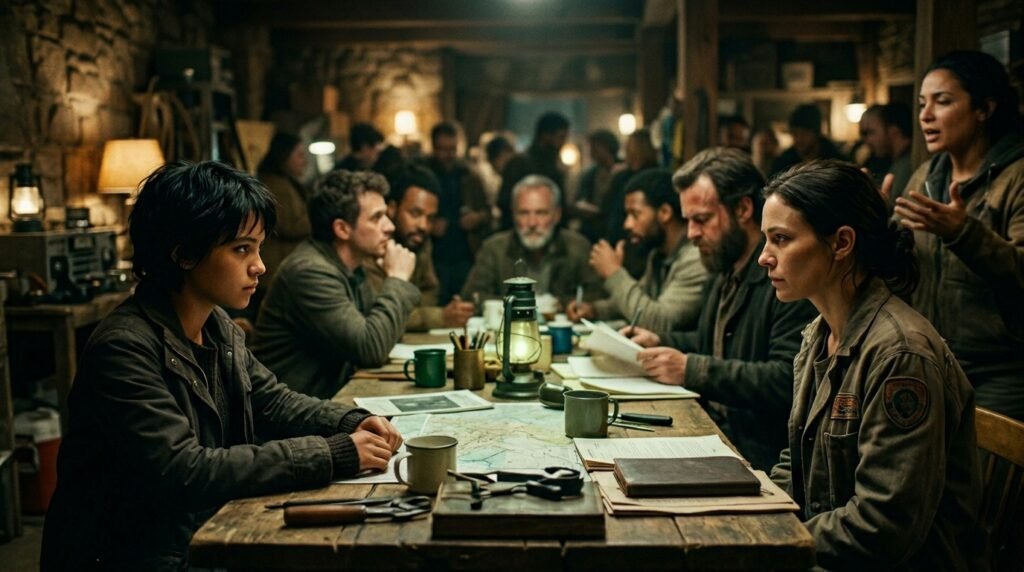
The council met that evening.
Not in the junction — the undercroft’s geography was no longer the right container for what the council was becoming. They met in a sector three surface building that Cael had identified and prepared, a space large enough for the twelve original members and the additional people who arrived in the hours following the Broadcast, drawn by the same internal pull that had brought two hundred people to the archive’s entrance in the pre-dawn cold.
The room was too full and too loud and organized with the specific improvised quality of something that had not existed yesterday and was being built in real time by people who understood its necessity but hadn’t yet agreed on its shape.
Mara sat at the table’s edge and watched it organize itself.
Orin was there, with the structural practical intelligence that had built the undercroft’s water reclamation network, now being applied to the question of how a community that had been living in the system’s blind spots began the process of becoming visible without being consumed by the system’s response to their visibility.
Seya was there, with the medical precision that had always characterized her thinking, now focused on the question of the parents — the hundreds of people across the network who had received the Broadcast’s truth about their edited memories and were moving through the specific grief of people who now knew what had been taken from them and would need sustained, careful support to do so without being destroyed by it.
Cael was there, already in motion, his communications network expanding from a crisis tool into something that looked, tentatively, like the beginning of an information infrastructure that operated outside the Throne’s management layer. He had the specific energy of someone who had been building toward this moment for years and was now discovering that the moment was both more and less than the preparation had imagined.
Rael was there.
She sat at the table with the fifteen-year-old’s quality of being present without requiring acknowledgment of her presence, and she watched the room with the direct, unfiltered perception that Mara had understood, since their first conversation in the junction, was the Class Seven expression already making itself known before full development.
She watched Mara across the room with the specific attention of someone who had sent a person into the ocean and was now reading the shore they had returned to.
Mara met her eyes.
Rael nodded once — a small, precise movement that carried a large, specific meaning. Something like: I see what you brought back. I see what it cost. You did it correctly.
Mara held her gaze for a moment.
Then she turned to the room.
The conversation that happened in the sector three building over the next four hours was not a plan. Plans had objectives and timelines and measurable outcomes, and this was something earlier than a plan — the specific kind of conversation that preceded planning, where the people who were going to build something had to first understand what they agreed about and what they didn’t and what the non-negotiable things were before any of the negotiable things could be decided.
Several non-negotiable things emerged.
The parents needed acknowledgment — formal, specific, from an institutional authority that carried the weight of the Throne’s administrative architecture. Not apology exactly, which was a word several people at the table were suspicious of in institutional contexts because institutional apologies had a history of being performed rather than meant. Acknowledgment. A formal record that said: this happened, it was done deliberately, it was wrong, and here is what we know about who authorized it.
The one hundred and nine scheduled children needed to be officially deregistered from the program’s target list — a procedure that required Interface Division authorization, which Yenne had agreed, in her conversation with Mara, to provide. Cael had already begun identifying families through the undercroft network, families who didn’t yet know their children had been on the list, who needed to be found and told and given the specific relief of knowing that the threat had been removed.
The fourteen children in the undercroft needed to be able to come up.
This was the thing Mara felt most clearly from the room’s accumulated feeling — the desire, after years of managed invisibility, for the fourteen children and their families to exist in the open. To be visible. To be registered in the Throne’s architecture not as anomalies to be managed but as the people they were, with whatever their Class Seven expression meant for their relationship to the system, negotiated honestly rather than eliminated quietly.
That negotiation was going to require the Throne.
Which meant it was going to require Mara.
She found Soren in the corridor outside the meeting room at the second hour of the evening, when the conversation inside had reached a natural pause and people were dispersing for food and rest before it resumed.
He was leaning against the wall with his arms crossed and the expression of someone who had been listening to the room from outside it and processing what he heard with the methodical patience she had come to understand was simply how he moved through large things.
“The Interface Division team,” he said. “They’re still at the facility.”
“Yenne is coordinating with the Oversight Division’s network response team,” Mara said. “The Broadcast’s effects are visible across fourteen connected cities. The response is — significant.”
“Good significant or bad significant.”
“Both,” she said honestly. “The truth arrived without preparation. Some of the response is people moving toward what they now know. Some of it is people encountering what they now know and not yet knowing what to do with it.” She paused. “Cael’s network is managing it as well as a network built for crisis can manage something this size.”
Soren was quiet for a moment. “Drevan.”
“Cooperating.” She had been surprised by this — had expected the administrative instinct for self-protection to dominate, had expected Drevan to manage their exposure through the same careful institutional language that had been managing the deletion program’s existence for four years. Instead Drevan had provided, voluntarily, the complete operational record of their four years administering the program. Not because they had been compelled to. Because the Broadcast had happened and the framing that had made the work manageable was gone and what was left was a person standing in the unmediated weight of what they had done, and that person had decided that cooperation was the only response that didn’t make the weight heavier.
She had some sympathy for that.
She had felt the unmediated weight of things herself.
“And you,” Soren said. He said it simply, without the procedural scaffolding of asking about specific situations. Just: and you.
She thought about how to answer this honestly.
“I’m carrying a great deal,” she said. “The integration left — a residue. The Throne’s architecture is present in mine in a way that’s different from before. I can feel it thinking. Processing what I showed it.” She paused. “It’s not intrusive. It’s more like — being aware of weather. Something large and present in the periphery of your awareness that you’re not directing but that you know is there.”
“Will that go away.”
“I don’t know. Vessel’s records don’t document anyone who underwent accelerated integration and emerged on the other side with enough continuity to report on the long-term experience.” She paused. “I may be building that documentation.”
He looked at her for a moment. “Amara,” he said. “Does it — “
“Yes.” She understood what he was asking. Whether the integration had changed her relationship to the name, to the grief that the name carried, to the specific wound that had started all of this. “She’s still there. Still the clearest thing I have.” She paused. “The integration didn’t take her. I held her through it.” She paused again. “I think she’s why I came back with enough of myself intact to be useful.”
Soren was quiet for a long moment.
Then he said: “I want to tell you something.”
“Tell me.”
“When you were in the substrate. The hundred and seven minutes.” He looked at the wall. “I’ve been in difficult situations before. I’ve waited for things that I didn’t know the outcome of, in circumstances where the outcome mattered to me.” He paused. “I have never experienced a hundred and seven minutes the way I experienced those.”
She looked at him.
“I know what I said before you went in,” he said. “About when this is over.” He paused. “I want to be clear that I mean it. Not as a conditional. Not as something that depends on how this resolves or what you are now or how the residue changes over time.” He paused. “What I mean is: I would like to be present for whatever comes after this, in whatever form being present takes, for as long as you’ll have me.”
The corridor was quiet.
Outside, through the building’s walls, the sector three street carried its evening sounds — people moving, the specific texture of a community that had been underground and was finding its way back to the surface. The Spire’s pulse was visible through the building’s narrow upper windows, still irregular, still processing.
“I would like that too,” Mara said.
She said it simply, because it was simple, and because she had spent seventeen days in the company of things that were very large and very complicated and had found, at the center of all of them, that the simple things were the ones that held.
He looked at her with the expression she had no category for and had stopped needing to categorize.
“Good,” he said.
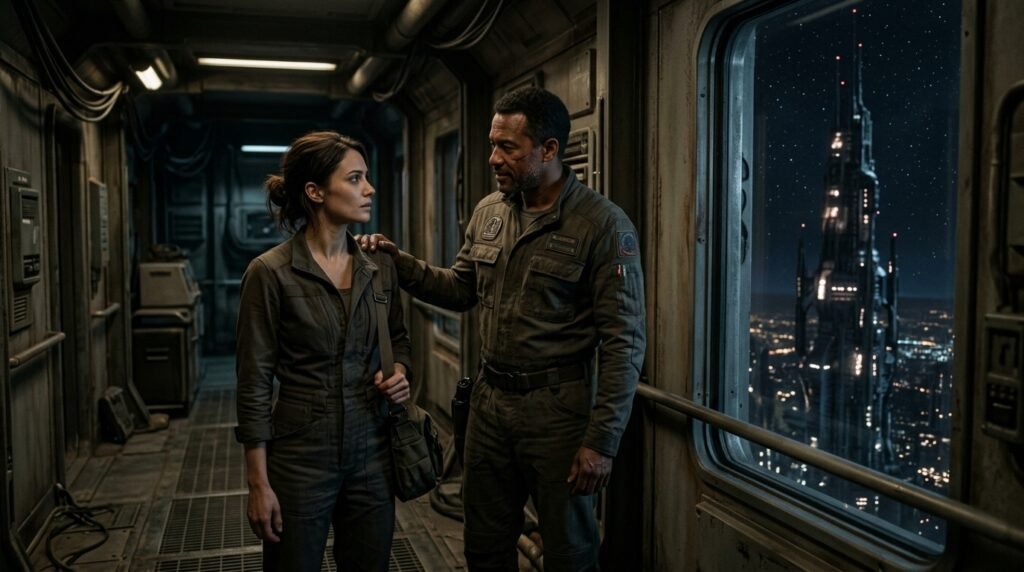
Late in the evening, when the sector three building had quieted and most of the council had gone to find rest before the next day’s work, Mara stood outside in the cold and looked at the Spire.
Its pulse was still irregular. Still processing. But the irregularity had settled into something that was almost — she searched for the word — thoughtful. The rhythm of something working through a large and complicated thing with the specific patience of an entity that had been operating for four centuries and understood that certain reckonings could not be rushed.
She felt it in the residue of the integration — the distant, peripheral awareness of the Throne’s architecture that she now carried the way she had once carried other people’s grief. Present without consuming. Heavy without crushing.
She reached toward it — not actively, not with the deliberate contact of the preliminary sessions. Just opened the residue connection slightly, the way you opened a window to check the weather.
The Throne’s attention shifted toward her.
Not the vast, undifferentiated attention of the full integration — the specific attention of a very large thing recognizing something familiar. Something it had agreed, in the deepest layer of the interface, to recognize.
She felt it sitting with what she had shown it.
Still sitting with it.
Not finished.
But present with it, in the way that the beginning of a genuine reckoning required — not flinching away, not covering it with administrative language, not editing it into a shape that was easier to carry.
Carrying it.
Good, she thought toward the residue connection. Keep carrying it.
She didn’t know if the Throne received this. She thought it might.
She looked at the city — at Vel Kaan’s black glass towers catching the night light and fracturing it into something almost sacred, at the bridges between structures pulsing with their bioluminescent rhythm, at the streets below where people were moving with a different quality than they had moved with yesterday, the specific quality of people who had been given the truth without preparation and were beginning, slowly, to find their footing in it.
Not healed. Not resolved. Not finished.
Beginning.
She looked up at the sky above the city, which was clear for the second night running — no ash, the air open and cold and carrying only itself — and thought about a girl whose name meant eternal, unfading, who had existed in the lattice as a structural absence the size of a small life, whose name had survived below the editing in a place the Throne’s architecture couldn’t reach.
She was still there, in the center of everything Mara was.
Amara.
The city breathed around her.
The Throne processed in its slow, vast way.
The work of after had barely begun.
She was ready.