CHAPTER SEVEN: THE FIRST CUT
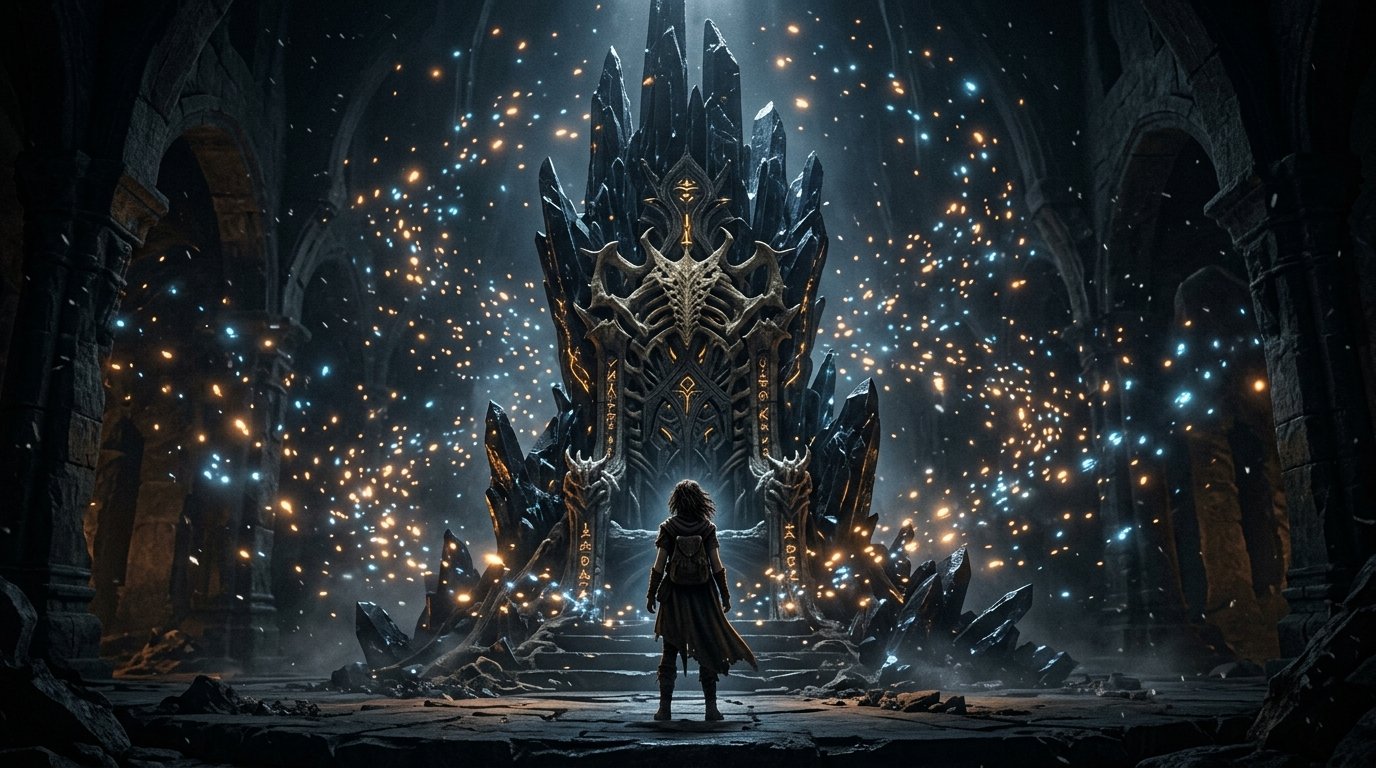
THE ASHEN THRONE

The preparation had a rhythm.
Mara had not expected that — had expected the twenty-one days to feel like a countdown, each one marked by its diminishing number, the weight accumulating in the specific way that dread accumulated when you knew the shape of what was coming and could not alter the timeline. She had expected the days to feel like held breath.
Instead they felt like work.
Good work. The kind that had clear objectives and measurable progress and the specific satisfaction of a problem yielding incrementally to sustained, careful effort. She had felt this before — during the corridor reconstruction, during complex calibration operations that required days of methodical preparation before the critical procedure could begin. The feeling of a large thing becoming, through the application of ordered attention, manageable.
She held onto that feeling deliberately. She understood it was partially a construction, a frame she was choosing to place around a situation that was, underneath the frame, considerably more frightening than the feeling of good work suggested. But frames were not dishonest simply because they were chosen. They were just a way of staying functional inside something that would otherwise be too large to inhabit.
She had learned that in eleven years of holding other people’s memories.
The preparation divided into three parallel tracks that Vessel coordinated from the junction with the systematic efficiency of someone who had been planning this operation for eight years and was now, finally, executing it.
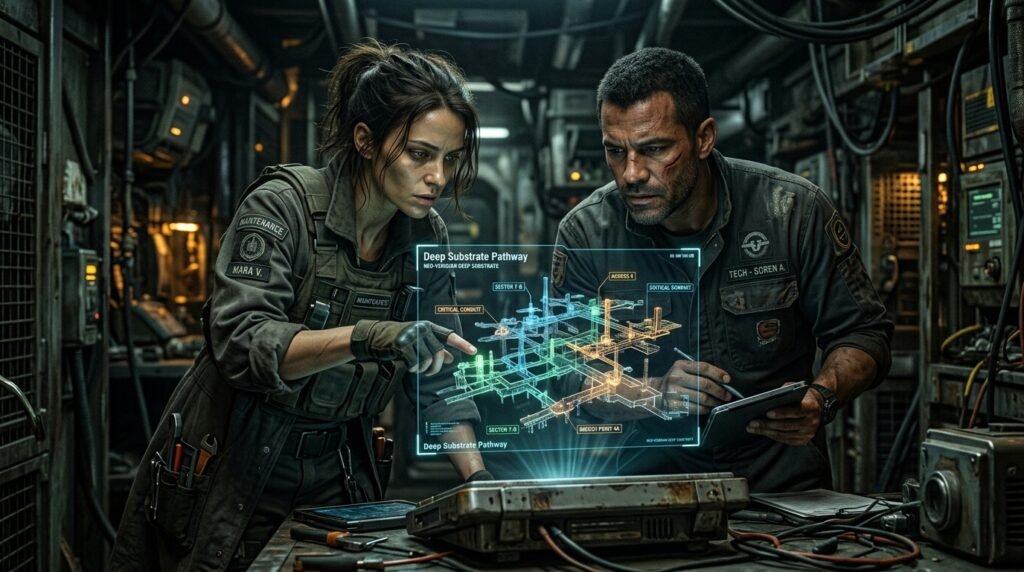
Track one was Mara and Soren’s — the substrate access route, the extraction architecture, the technical preparation for the deletion program’s removal from the Throne’s operational infrastructure. They worked this track during their archive shifts, in the margins of legitimate work, using the deep maintenance access they had established through Dekhar’s dormant credentials to map the substrate pathway and model the extraction procedure with increasing precision.
Track two was the council’s — the Broadcast preparation, the communications network, the logistics of what happened in the hours and days after the transmission. Cael ran this with the focused energy Mara had initially read as performance and was revising toward genuine competence — he had built, over years in the undercroft, a contact network that extended across all seven sectors and into three of the cities connected to Vel Kaan’s Throne network. People who lived in the system’s blind spots and had learned, from that position, to see the system clearly. People who would be ready, when the Broadcast happened, to help others find their footing in a truth that would arrive without warning or preparation.
Track three was Vessel’s alone — the third component, the Host interface architecture, the technical preparation for what Mara would do in the substrate once the extraction was complete and the Broadcast was running. Vessel worked this track with the particular intensity of someone completing a project that had defined the last eight years of their existence, and she shared its progress with Mara in the daily briefings they conducted via the isolated channel Cael had established between the junction and the archive district.
The briefings were precise and efficient and never ran longer than necessary.
On the ninth day, Vessel said something that was not precise or efficient.
She said: “I need you to start the preliminary exposure.”
Preliminary exposure was Vessel’s term for the process of beginning the lattice integration before the critical procedure — a staged approach to the accelerated Class Seven development that Vessel had designed to reduce the shock of full substrate immersion. Instead of a single four-hour event, the integration would be seeded over several days through controlled, brief contacts with the Throne’s architecture at the substrate level, allowing Mara’s consciousness to begin adapting to the scale of what full integration would involve.
“Think of it as calibration,” Vessel said, which was either a genuine analogy or a deliberate choice of language designed to make the thing more approachable, and Mara suspected it was both.
“What does it feel like,” Mara said.
“I don’t know,” Vessel said. “I’m not a Class Four. I can’t model the subjective experience from the outside.” She paused. “Rael describes the Throne’s presence as a weight and a rhythm. The preliminary exposure is — opening yourself to that. Letting the architecture begin to recognize your signature as something it can interface with rather than something it needs to manage.”
“How will I know if something is wrong.”
“Cognitive fragmentation. Loss of continuous awareness. Involuntary memory replacement.” Vessel paused. “If any of those occur, you terminate the contact immediately and we reassess.”
“And if they don’t occur.”
“Then you’re doing it correctly.” A pause. “Mara. The preliminary exposure is important not just technically. You need to begin understanding what you’re going to be carrying. The substrate contact will give you that — the beginning of it. The edge of the weight.” She paused. “I don’t want you to enter the full integration without having felt what you’re moving toward.”
Mara understood this. It was the same principle she applied in calibration work — you didn’t perform a deep lattice operation cold. You read the architecture first. You let the system’s signature settle into your operational awareness before you began working with it.
She understood it and she was afraid of it and she said: “Tonight.”
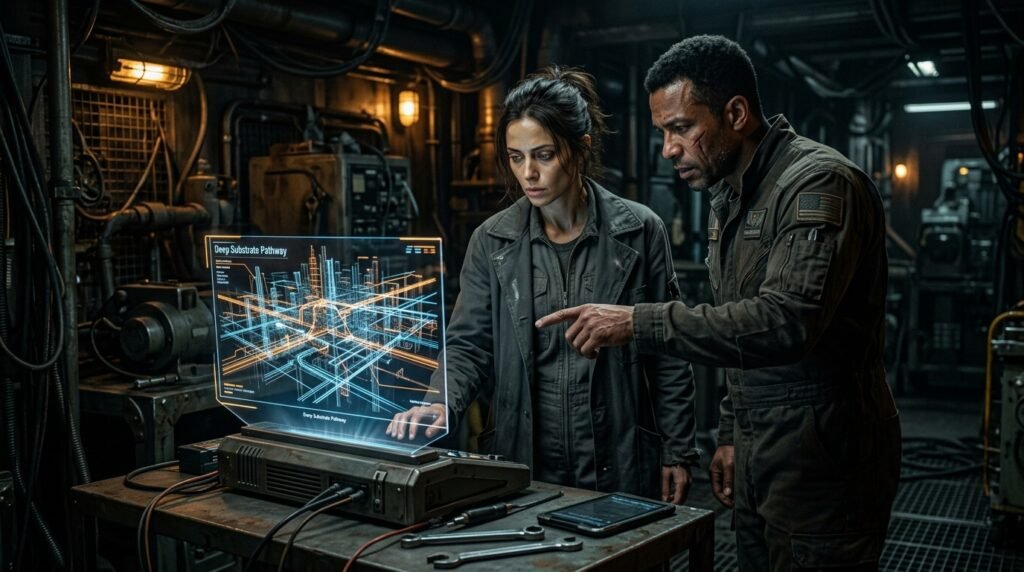
The substrate contact point was in the archive’s deep maintenance layer — the same geography she had used to find the deletion signatures, now repurposed for something that felt, as she descended through the access pathway at the third hour of night with the archive running skeleton shift above her, like a fundamentally different kind of trespass.
Before, she had been going somewhere she wasn’t authorized to go.
Now she was going somewhere she wasn’t sure the concept of authorization applied to.
She found the contact node Vessel had identified — a lattice junction point in the substrate’s northern array where the Throne’s consciousness architecture came closest to the surface, where the boundary between the maintenance infrastructure and the living lattice was thin enough that a prepared consciousness could, with the right approach, feel the other side of it.
She sat cross-legged on the substrate floor, which was cold through her clothing and faintly vibrating with the processing rhythm of the cores above. She placed her hands flat on the conduit housing beside the junction node, the way she would position herself to read a particularly subtle calibration variance.
She breathed.
She opened.
It came in waves.
Not a single sensation but a succession of them, each arriving before the previous one had fully receded, building in the way that tides built when something large was moving the water from a great distance. The first wave was simply — presence. Vast, patient, ancient in a way that made the word ancient feel inadequate. The Throne’s architecture at this level of contact was not an abstraction or a system diagram. It was something that had weight and temperature and a rhythm she felt in her chest rather than heard with her ears.
She held herself steady and let it come.
The second wave was the minds.
Not individual minds — she could not resolve individual signatures at this level of contact, could not hear specific thoughts or access specific memories. What she felt was the aggregate, the cumulative consciousness weight of billions of stored minds pressing gently against the boundary of perception from the other side. Not threatening. Not even particularly aware of her. Just — present, in the way that an ocean was present. Vast and continuous and utterly indifferent to the specific creature standing at its edge.
She had held other people’s memories for eleven years. She had been good at it because she had developed the specific emotional architecture required to carry grief that wasn’t hers without being consumed by it. She had calibrated that architecture carefully, maintained it with the same professional attention she brought to the lattice systems themselves.
She felt it strain now.
Not break. Strain — the sensation of a structure encountering a load greater than its design specifications and flexing in response, the good flex that meant the structure was working as intended, absorbing and distributing rather than resisting and fracturing. She felt herself flex and held the feeling carefully, noting it the way she noted calibration variance, neither alarmed by it nor ignoring it.
The third wave was not a sensation.
It was a question.
She didn’t hear it with any sensory apparatus she could name. It arrived in the space between thoughts, in the gap where the Throne’s architecture had found the edge of her consciousness and was — examining it. The way she examined a lattice anomaly. With the focused, impersonal attention of something trying to understand what it was looking at.
She felt it find her Class Four expression.
Feel it differently than it had felt it before — because the Throne had known about her Class Four classification for nine years, had been managing around it in her monthly coherence evaluations, had assessed it as contained and partial and not requiring the intervention it applied to Class Seven expressions. It had been looking at her sideways, from the managed distance of routine maintenance. Now it was looking at her directly, from the distance of a few centimeters of conduit housing, and she felt the quality of its attention change.
Not alarm. Not yet.
Recognition.
She pulled back before it could sharpen into something more specific. Withdrew from the contact with the careful deliberation of a technician ending a calibration session — controlled, complete, leaving no frayed connections. She sat in the substrate for a moment, breathing, letting the sensation of her own singular consciousness reassert itself.
She was shaking.
Not from fear — or not entirely from fear. From the specific physiological response to an encounter with something of that scale, the body’s automatic processing of an experience that exceeded the nervous system’s ordinary parameters.
She sat with it until the shaking stopped.
Then she climbed back up to the surface and walked to the break room and made grain-coffee at the fourth hour of night and stood at the window and looked at the Spire’s pulse and thought: it knows something looked at it. It doesn’t know what yet.
She had twelve days.

On the eleventh day, something went wrong.
Not catastrophically. Not in a way that ended the plan or required immediate response. But wrong in the specific way that things went wrong when a system as vast and attentive as the Throne began noticing that something in its architecture was behaving unusually.
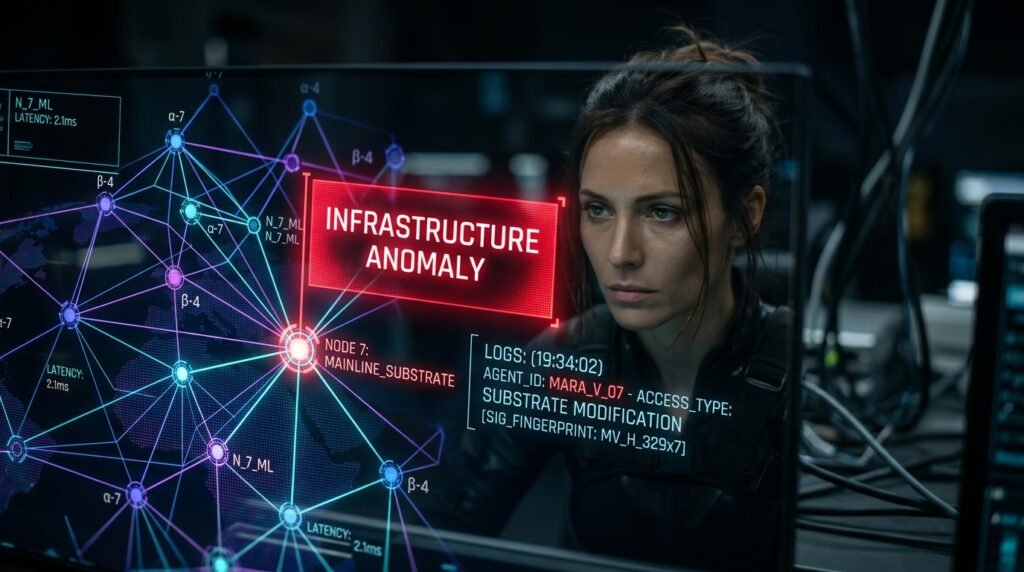
Mara was at console seven running legitimate calibration work when the alert appeared in the deep maintenance substrate monitor — a secondary display she had been keeping one eye on throughout her shifts since the preparation began, watching for exactly this kind of signal.
The alert was flagged as a routine infrastructure anomaly in the substrate’s sector nine array. Standard classification. The kind of thing that generated a maintenance review request rather than an escalation.
But the location was not routine.
It was the northern lattice junction. The contact node.
The Throne’s maintenance architecture had detected an anomaly at the precise location where she had been conducting her preliminary exposure sessions for nine nights. Not the sessions themselves — the contact was too brief and too careful to register in the automated monitoring systems. What it had detected was the residual effect of the contacts. The subtle change in the junction node’s calibration signature that resulted from repeated interaction with a consciousness of her specific anomaly classification.
She had left fingerprints.
She closed the substrate monitor with a smooth, unhurried motion and ran the calibration display forward, maintaining the surface appearance of routine work, while her mind moved quickly through the implications.
The alert was flagged routine. It would generate a maintenance review request that would route to — she knew the routing protocol — a sector nine infrastructure team. Not the Interface Division. Not the Oversight Division. A standard maintenance team that would assess the junction node, find nothing obviously wrong, and log the anomaly as resolved.
If nothing else happened.
If she stopped the preliminary exposure sessions immediately and gave the junction node time to stabilize before the maintenance review reached it.
She had nine nights of sessions completed. Vessel had said ten was the minimum for adequate preparation. She was one session short.
She messaged Vessel through the isolated channel during her shift break, using the compressed notation they had developed for communication that needed to be brief and unambiguous.
Detected at node. Routine flag. Sessions must stop. One short of minimum.
Vessel’s response came within minutes.
How close to minimum. Assess honestly.
Mara thought about the nine sessions. About the way the contact had felt each night — the waves, the weight, the question that arrived in the space between thoughts. About the quality of the tenth night she had been planning, which Vessel had described as the consolidation session, the one that translated the accumulated preliminary exposure into something her consciousness could hold as a stable reference architecture for the full integration.
Without it, the full integration would begin from a foundation that was nine-tenths complete.
She thought about what that meant structurally. In calibration terms. In the language of systems that required complete preparation before critical procedures.
She messaged back.
Manageable. Not ideal. Proceed.
Vessel’s response was slower this time.
Understood. Ten days remaining. We proceed.
She told Soren that evening.
Not in the archive — they had become careful about where they had substantive conversations, rotating between locations in the undercroft and the surface streets of sector three and the brief windows of privacy that the archive’s skeleton shift offered. Tonight they were in the sector three street outside the transit column, in the cold, speaking quietly in the manner of two colleagues discussing something work-related.
He listened to the full account of the maintenance alert and the decision to proceed without the tenth session. When she finished he was quiet for a moment.
“The maintenance team,” he said. “When do they reach the node.”
“The review request will route tomorrow. Standard assessment timeline is three to five days.”
“We need the substrate access in ten days.”
“Yes.”
“If the team assesses the node and finds anything that escalates the flag from routine to investigation—”
“The Oversight Division gets involved and our access pathway is compromised,” Mara said. “Yes.”
“What are the odds.”
She had been calculating this since the alert appeared. “The residual calibration signature is subtle. I’ve been careful. The maintenance team will find a node that reads slightly off-standard but within acceptable variance ranges — there’s nothing in the substrate record that points to deliberate interference rather than natural lattice drift.” She paused. “Seventy percent, the flag resolves as routine and closes.”
“Thirty percent it doesn’t.”
“Yes.”
He looked at the transit column. At the river-bird in faded ochre that had been repainted enough times to mean something worth maintaining. “Then we proceed and we watch.”
“Yes.”
He nodded. Then he said, without changing his tone: “The preliminary exposure. How does it feel.”
She thought about how to answer this honestly.
“Like standing at the edge of an ocean,” she said. “In the dark. Unable to see the far shore but able to feel that it exists.” She paused. “And feeling that the ocean is aware of you in the way that very large things are aware of small things — not particularly, not individually, but — registering. Noting the fact of your presence.”
“Is it getting easier.”
“No,” she said. “It’s getting clearer. That’s different.”
He looked at her with the expression she had no category for — the one that appeared rarely and made her feel seen in a way she hadn’t been prepared for.
“When you’re in the substrate,” he said. “For the full integration. I want to be in the archive. At a console. Where I can see the system response in real time.”
“That’s where you’ll need to be for the extraction,” she said. “The second access point.”
“I know. I’m not talking about the extraction.” He paused. “When you go in. When you’re in the Throne’s architecture and you’re carrying what you’ll be carrying — I want to be the person watching the system from the outside. Watching for you.” He paused. “Someone should be watching for you.”
Mara looked at him for a long moment.
“Someone should be,” she agreed.
On the fourteenth day, two things happened.
The first: the maintenance review of the junction node was logged as resolved. Routine lattice drift, within acceptable variance, no escalation required. The thirty percent had not materialized.
Soren sent her a single word through the isolated channel when he saw the resolution log.
Good.
The second thing happened three hours later, at the end of the afternoon shift, when a routine administrative routing update appeared in the archive’s overhead management system. The kind of update that appeared periodically — personnel changes, procedural revisions, cross-facility coordination notices — and that most archive technicians scanned briefly and filed without detailed attention.
Mara read it in full.
The update announced the assignment of a new Oversight Division liaison to the sector nine archive facility. Effective immediately. The liaison’s role was described as routine administrative coordination with a secondary function of infrastructure integrity monitoring.
The liaison’s name was listed.
It was the same name Mara had found in Vessel’s records eleven days ago. The same name that appeared on all thirty-one cognitive evaluation clearances for the parents of deleted children.
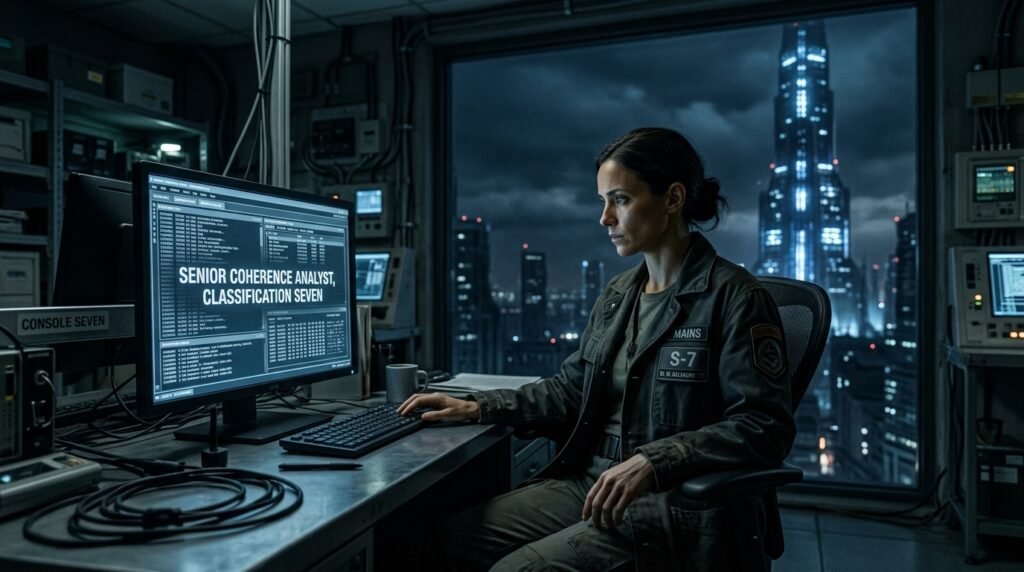
Senior Coherence Analyst, Classification Seven, Special Projects — Throne Interface Division.
She read the announcement twice.
Then she closed it and sat very still at console seven for sixty seconds, maintaining the surface of routine work while her mind moved through what this meant with the rapid, structured analysis of someone who had been trained to assess system anomalies quickly and accurately.
The Throne Interface Division was sending their deletion program’s administrator to the sector nine archive.
Not because of the maintenance alert — the alert had resolved as routine before this assignment could have been generated. This had been decided before the alert. This had been in motion before the alert.
Which meant the alert was not the reason.
She was the reason.
The Throne’s architecture had felt her nine nights of preliminary exposure and had not flagged it as a maintenance anomaly. It had flagged it as something that required a different kind of response. Something that warranted sending a human administrator rather than a maintenance team.
It had noticed her.
Not as an anomaly in its infrastructure.
As a person.
She messaged Vessel.
They’re sending someone. Interface Division. Seven days.
Vessel’s response was immediate.
Then we move in six.