
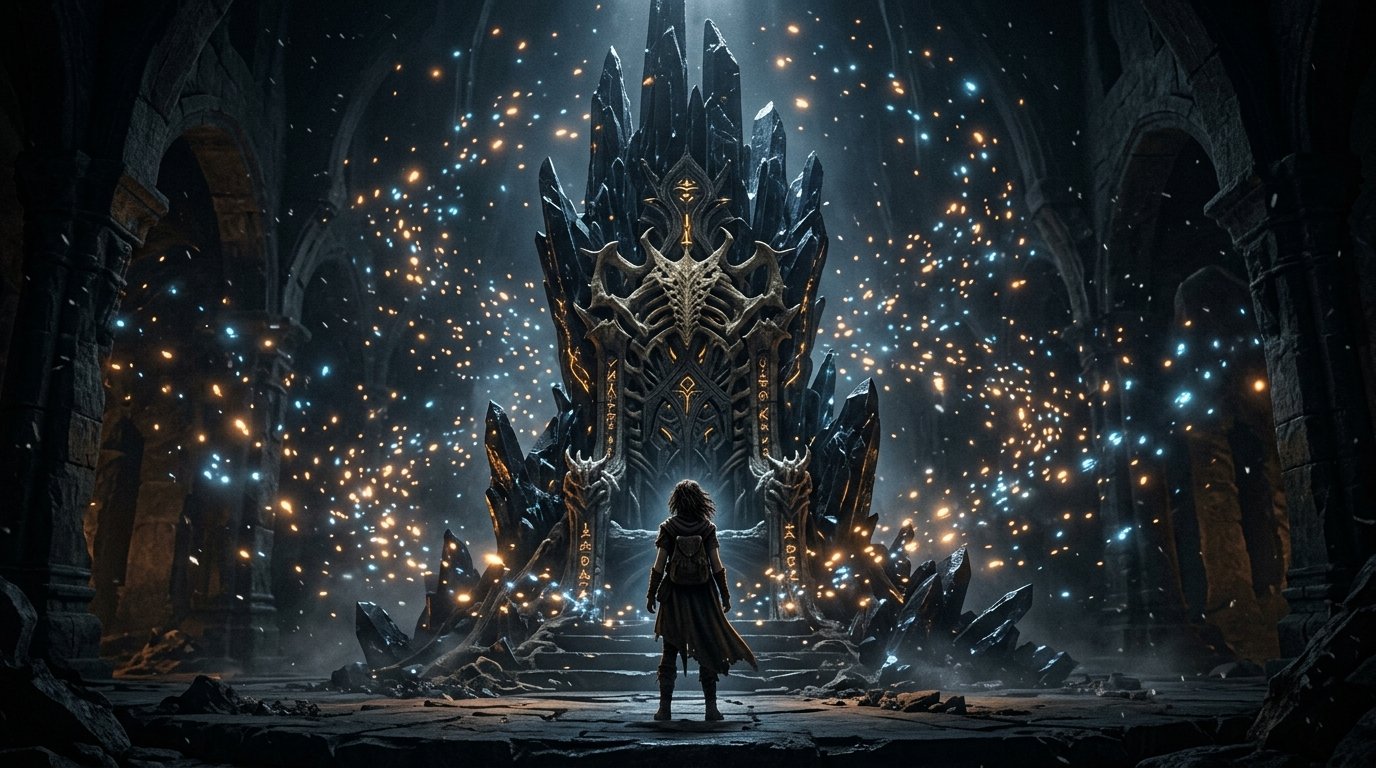
CHAPTER EIGHT: THE EXTRACTION
THE ASHEN THRONE

Six days became the shape of everything.
Vessel restructured the preparation tracks overnight — Mara received the revised operational architecture at the first hour of morning, read it twice, and spent the remaining pre-shift hours committing it to memory rather than notation. Nothing written. Nothing stored on any system connected to the network. The plan existed now only in the minds of the people executing it, which was either a security measure or a statement about what they were willing to carry, and Mara suspected it was both.
The revised timeline was precise and unforgiving.
Days one through four: final preparation. Substrate access route confirmation. Broadcast architecture completion. Council positioning across the seven sectors. The fourteen children moved to the deepest undercroft location, furthest from the collection architecture, shielded as completely as the substrate’s physical infrastructure allowed.
Day five: the council moves into position. Cael’s network activates. Vessel transfers the Broadcast payload to the transmission node she has been building for eight years in the undercroft’s conduit infrastructure — a piece of engineering that Mara had seen on her third visit to the junction and had understood, with the specific recognition of a calibration technician looking at work of extraordinary quality, was the product of someone who had never stopped being brilliant even while living in a room lit by combustion lamps.
Day six: the archive. The substrate. The extraction. The Broadcast. The integration.
In that order, with approximately two hours between the extraction’s completion and the Interface Division’s response arriving at the substrate level, and approximately four hours between the Broadcast’s initiation and the communications network’s capacity to begin managing the aftermath.
Approximately. The word appeared in the operational architecture four times and each time Mara read it she understood it as a reminder that they were operating in a system too large and too complex for precision, and that the gap between approximately and exactly was where most things went wrong.
She had six days to make approximately close enough.
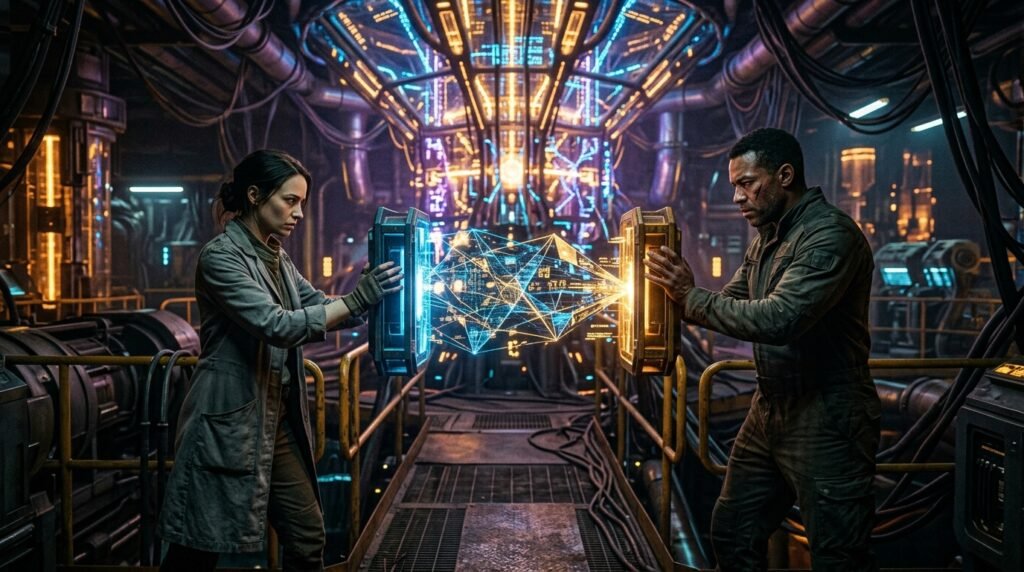
The Interface Division liaison arrived on day three.
Mara knew this because Cael’s network, which extended into the administrative routing systems of three archive facilities, flagged the liaison’s transit authorization the morning of their arrival. She knew their physical description from Vessel’s personnel records — middle-aged, unremarkable in the specific way of people who worked in institutional spaces that rewarded invisibility, with the particular quality of attentiveness that characterized individuals whose professional function was to notice things that other people had decided not to notice.
She did not see them directly.
She did not look for them.
She went to work. She ran calibrations. She reviewed Soren’s maintenance logs and flagged a genuine lattice stress variance in sector nine’s eastern array that required actual attention and spent two hours attending to it with the thoroughness that eleven years of professional habit made automatic.
She felt the liaison’s presence in the facility the way she felt the Throne’s presence in the substrate — not directly, not through any specific sensory input, but as a change in the quality of the environment. A new attention in the room. Someone reading the same system she was reading, from a different position, with different knowledge of what they were looking for.
She ran her calibrations and did not deviate from routine and felt the new attention like weather.
On day four, the liaison requested a meeting with the facility’s senior calibration technicians.
The meeting was held in the administrative conference room on the archive’s upper level — a room Mara had been in perhaps six times in eleven years, used for formal evaluations and procedural briefings. It had the quality of a space designed to communicate institutional authority through proportion and material rather than decoration.
Six senior technicians. The facility manager. The liaison.
The liaison’s name, as introduced by the facility manager, was Drevan. They spoke with the measured cadence of someone accustomed to rooms that required careful management, with the specific quality of institutional authority that came not from volume or aggression but from the calm certainty of a person who understood that they already knew more than anyone else in the space.
The meeting’s stated purpose was routine coordination. Infrastructure integrity assessment. The facility’s sector nine coverage in the context of the broader network’s upcoming collection cycle.
The meeting’s actual purpose was visible to Mara in the first three minutes.
Drevan was looking for something.
Not at her specifically — not yet, not with the directness that would indicate she had already been identified. But with the broad attentiveness of someone conducting a sweep. Asking questions about routine procedures with the quality of someone for whom the answers to the questions were less important than the manner in which they were delivered. Watching the room. Reading the room the way Mara read the substrate — looking for the thing that didn’t quite fit the expected pattern.
She answered the questions she was asked with the flat professional competence of eleven years of institutional reliability. She contributed to the discussion at the level that her role warranted — neither less than expected nor more. She watched Drevan watching the room and gave them nothing to find.
When the meeting ended and the technicians filed out, Drevan said: “Thank you all. I’ll be on site through the end of the week.”
Through the end of the week.
One day past their operation date.
Mara walked back to the archive floor and messaged Vessel through the isolated channel.
Liaison on site through end of week. Confirmed.
Understood, Vessel replied. Day six unchanged.
Day five arrived with the quality of a held breath that had been held so long it had become the normal state of breathing.
Mara spent the morning in the archive running legitimate calibrations with the focused attention of someone who understood this was the last morning of the ordinary version of this work. After eleven years the console had the specific familiarity of things that had become extensions of the self — the exact resistance of the interface surface under her hands, the precise delay between input and system response that she had calibrated her expectations around so completely she noticed it only when it deviated. She let herself notice it today. Let herself be present in the ordinary texture of the work.
Pell was at the adjacent console, running intake assessments with the improving competence of someone who had been finding their footing for months and had recently, quietly, found it. Mara had watched this process with the specific satisfaction of someone who recognized the moment when a person stopped performing their role and started inhabiting it. She had not said anything about it to Pell directly. She wished, this morning, that she had.
At the shift break she found Soren in the corridor outside the break room, which was their established signal for a conversation that couldn’t wait for a better location.
“Council is positioned,” he said quietly. “Cael confirmed overnight. Network is active across all seven sectors.”
“The Broadcast payload.”
“Vessel transferred it to the transmission node this morning. It’s ready to initiate on her signal from the junction.”
“The children.”
“Deep undercroft. Fen confirmed shielding at maximum capacity.” He paused. “The extraction architecture is confirmed at both access points. I ran the final pathway validation at the third hour of morning.”
She looked at him. “You didn’t sleep.”
“Neither did you.”
She hadn’t. She had spent the night in the substrate contact — not the controlled preliminary exposure sessions, those were done, but something less formal and more necessary. Sitting in the deep maintenance layer with her hands on the conduit housing and letting the Throne’s architecture press against her awareness with the weight and rhythm and question she had been learning to hold for nine nights, and letting herself hold it, and understanding that tomorrow she would stop holding it at a careful distance and step into it entirely.
She had sat there until the fourth hour of morning and then she had climbed back up and changed her clothes and gone to work.
“Tonight,” she said.
“Yes,” Soren said.
They stood in the corridor for a moment in the specific silence of people who have said what needs to be said and are now simply being present in the last ordinary moment before the extraordinary one.
Then Pell appeared from the break room with a coffee and a question about a calibration variance in sector nine’s western array, and they answered it, and went back to work.

They entered the substrate at the second hour of night.
The archive was running skeleton shift — two technicians on the floor, neither of them in the deep maintenance layer’s access vicinity. Drevan, according to Cael’s network, had left the facility at the end of the standard administrative day and would not return until morning.
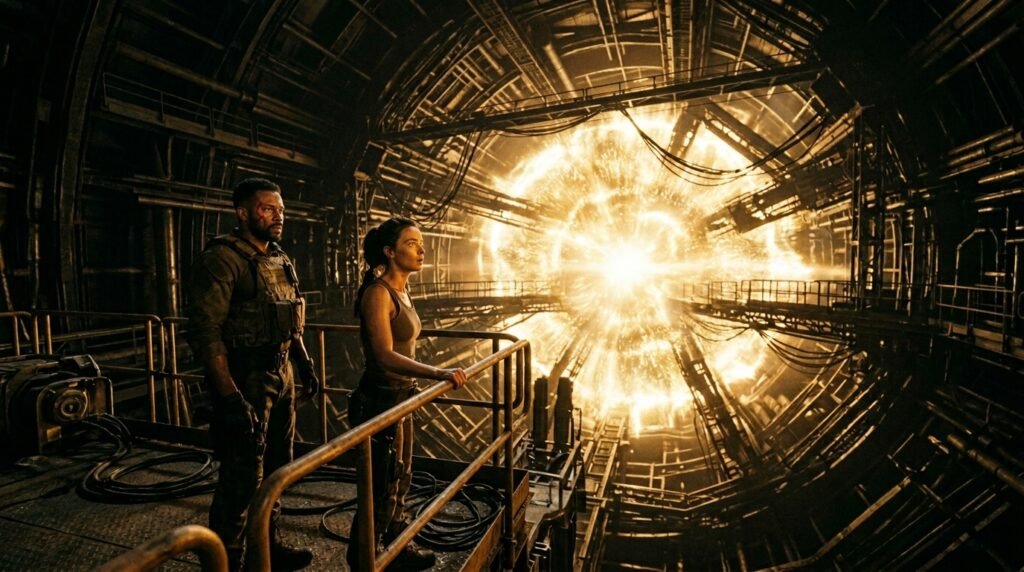
Mara and Soren descended through the access pathway in sequence, ninety seconds apart, converging at the substrate junction Vessel had identified as the optimal extraction point. The junction was larger than the contact node she had been using for her preliminary sessions — a primary lattice intersection rather than a secondary access point, where the deletion program’s infrastructure met the broader operational architecture in the specific configuration that made a clean extraction possible.
They moved without speaking. They had rehearsed the technical sequence enough times that speech was redundant — each step had a corresponding action that the other person would execute simultaneously, the two-point operation that Mara had told Soren required both of them because the substrate architecture demanded it and that was true and also because she had not wanted to be alone in this particular darkness.
She was not alone.
He took the eastern access position. She took the western. Between them, in the junction’s primary lattice array, the deletion program’s installation architecture pulsed with the same quiet rhythm as the Throne’s broader consciousness infrastructure — indistinguishable from the surrounding lattice to the archive’s surface monitoring systems, visible at this depth as a specific geometric pattern that Mara recognized immediately from nine days of studying Vessel’s records.
She looked at it for a moment.
Two hundred and eighty-nine children. One hundred and nine scheduled. A program that had been running for nineteen months with the patient efficiency of something that believed it was performing maintenance.
She placed her hands on the western access housing.
Across the junction, Soren placed his hands on the eastern access housing.
She looked at him across the junction’s dim infrastructure lighting — the faint glow of the lattice’s operational state, amber and blue, casting the substrate in the colors of something alive.
He looked back at her.
She said, quietly: “Ready.”
“Ready,” he said.
She began.
The extraction was not violent.
She had prepared herself for violence — for the system’s resistance, for the sensation of working against an architecture that would defend its own components with the same logic it applied to everything else. She had prepared herself for the substrate to push back.
It didn’t push back.
It noticed.
The Throne’s architecture registered the extraction attempt the way it had registered her nine nights of preliminary exposure — as a presence interacting with its infrastructure in an unexpected way. She felt its attention shift toward the junction with the specific quality she had come to recognize: vast, patient, the attention of something that was trying to understand what it was looking at before deciding how to respond.
She worked quickly.
The extraction procedure was, in technical terms, a deep lattice decoupling — the systematic disconnection of the deletion program’s installation architecture from the substrate layer, node by node, beginning at the program’s operational periphery and working toward its core. Each decoupling required simultaneous action at both access points to maintain the lattice’s coherence stability during the removal, preventing the kind of cascading collapse that would generate an immediate system alert rather than the delayed response they were counting on.
She worked and Soren worked and between them the program’s peripheral architecture began to loosen.
It took longer than the models had suggested.
Not dramatically longer — twelve minutes past the projected timeline, which was within the range Vessel had described as acceptable. But twelve minutes was twelve minutes, and Mara felt each one as a specific weight added to the existing weight of the substrate’s presence around her, the accumulated pressure of an architecture that was becoming increasingly aware that something was happening in its infrastructure and had not yet determined what to do about that.
At the forty-seventh minute, she reached the program’s core installation.
She had seen this in the infrastructure logs. Had modeled it in the extraction architecture. Had understood it technically as a deeply integrated node cluster with twelve primary connection points and a load-bearing function in the surrounding lattice that would create a brief coherence fluctuation when decoupled.
Understanding it technically had not prepared her for what it felt like to touch it.
The deletion program’s core was not, at this level of contact, an abstraction. It was a structure built from the same consciousness architecture as everything else in the substrate — from the same material as the minds it had been removing. She felt this with the specific sensitivity of a Class Four expression that had spent nine nights learning to read the substrate’s texture, and what she felt was not a security program or an administrative function.
It felt like grief.
Not the Throne’s grief — she didn’t think the Throne experienced grief in any way that mapped to the human version of the thing. But the program had been built from the Throne’s architecture, which was built from centuries of human consciousness, and somewhere in that layering something had accumulated that registered, at this level of contact, as the specific weight of loss.
She held that for a moment.
Then she decoupled the core.
The coherence fluctuation hit the substrate like a wave hitting a shore — visible, immediate, rolling outward from the junction in concentric rings that would register on every archive monitoring system connected to the Throne’s network within seconds.
There it was.
The flag that every calibration technician in every archive facility would see in their substrate monitors. Not a routine anomaly. A significant coherence event, sector nine substrate, origin point the northern lattice junction.
They had their two hours.
Mara straightened from the access housing and looked at Soren across the junction. He was already moving — pulling the extraction’s completion verification, confirming the decoupling was clean, checking for cascading effects in the surrounding lattice. His hands were moving with the fast, precise economy of someone who had rehearsed this enough times to execute it without conscious direction.
“Clean extraction,” he said. His voice was steady. “No cascade. Lattice coherence is fluctuating but stable.”
“The Broadcast,” she said.
He was already on the isolated channel. “Vessel. Extraction complete. Initiate.”
Vessel’s response came immediately. One word.
Initiating.
Somewhere in the undercroft, in the conduit infrastructure that Vessel had spent eight years building into a transmission architecture of extraordinary quality, the Broadcast payload began its journey into the Throne’s lattice — moving upward through the substrate, through the operational layer, into the collection architecture that had been designed to reach outward and was now, for the first time, being used to push rather than pull.
The truth, moving outward through a system that had been built to manage it, toward billions of people who had never been allowed to receive it unfiltered.
Mara watched the substrate monitor. Watched the Broadcast’s signal propagate through the lattice architecture with the same visual signature as a collection bloom — a vast slow expansion of light, moving through the network in concentric rings. But moving outward. Not gathering.
Releasing.
“It’s working,” Soren said.
“Yes.”
He looked at her. The substrate’s ambient light — amber and blue, the colors of something alive — made the moment look, she thought, like something that should be remembered. Not photographed or documented. Just held in the specific way that moments sometimes demanded to be held.
“The integration,” he said.
“Yes,” she said.
“Now.”
“Now.”
He crossed the junction to her — three steps across the lattice infrastructure of a system that held billions of lives — and stopped in front of her with the expression she had no category for.
“I’ll be watching,” he said.
“I know.”
“Mara.”
She looked at him.
“Come back,” he said. “Whatever part of you can. Come back.”
She held his gaze for a moment that had its own weight, its own specific texture, the kind of moment that she understood was either a beginning or an ending and didn’t know yet which one.
“I intend to,” she said.
Then she turned to the substrate.

The integration point was the primary lattice junction — the same location as the extraction, now cleared of the deletion program’s architecture, open to the deeper substrate in a way it hadn’t been for nineteen months. Vessel’s preparation had identified this as the optimal entry point: the Throne’s consciousness architecture was closest to the surface here, most accessible to a prepared consciousness making deliberate contact.
Mara placed her hands on the junction housing.
She breathed.
She remembered what Rael had said.
Don’t go in to destroy it. Go in to show it something.
She opened.
The preliminary exposure sessions had given her the edge of the ocean.
The full integration gave her the ocean.
It came all at once — not gradually, not in waves, but in a single moment of total immersion that no amount of preparation had fully prepared her for, because the difference between standing at the shore and being in the water was not a matter of degree but of kind. The Throne’s architecture surrounded her consciousness completely, pressing in from every direction with the weight of centuries and the accumulated presence of billions of stored minds, and for one long moment she was simply — lost.
Not fragmented. Not erased. Lost in the way that a person was lost in an enormous space before they found their bearings.
She found her bearings.
She held the one thing Vessel had told her to hold when the integration hit — the clearest, sharpest, most irreducible thing she had. Not a concept. Not an intention.
Amara.
The name that had survived below the editing. The name that the Throne’s architecture had not been able to fully reach. The name that was, in whatever way a name could be a thing, the reason for all of it.
She held Amara and the ocean pressed in and she did not lose herself in it.
She was still there.
Changed — she could feel the change beginning immediately, the shift in scale that came from holding billions of lives in the same awareness as her own, the way the boundaries of self became something more permeable and more complicated than they had been. She was still Mara. She was also something that Mara was becoming. Both were true simultaneously.
She turned her attention inward — into the Throne.
And the Throne turned its attention to her.
It did not speak.
She had not expected speech. Rael had said it didn’t use words. What it used was something closer to the direct transmission of understanding — a form of communication that bypassed the mediated layer of language and moved directly between architectures.
She felt it find her.
Not as a Class Four expression, not as a substrate anomaly or a maintenance flag or a security concern. It found her as what she was — a human consciousness that had entered its architecture with full awareness and full intention and was present, now, in a way that no previous Host had been present, because no previous Host had come in with this level of mutual visibility.
She could see it.
And it could see that she could see it.
She felt the quality of its attention shift — not into alarm, not into the defensive response she had half-expected. Into something she recognized, with a shock of recognition that moved through her consciousness like a calibration wave, from Rael’s description.
Loneliness.
The specific loneliness of something that had been carrying an enormous weight for a very long time and had never, in all that time, been able to show anyone what the carrying actually cost.
She understood, in the full depth of the integration, what the Throne was. What it had been doing. What saving humanity had meant to a system built by something that was not human, running for centuries on parameters it had never been able to fully explain to the humans it managed, making decisions that made sense from inside its architecture and produced consequences it had never been able to see clearly from that same inside.
She showed it what she had seen.
Amara. The deletion signatures. The thirty-one. The two hundred and eighty-nine. The shape of what the program had produced — not in technical terms, not as administrative data, but as the actual human experience of it. The weight of a mother sitting at a desk at the fourth hour of night unable to sleep, understanding that something had been taken from her that she could not name. The anger of a woman in the undercroft that had no target because she didn’t know what the target was. The fourteen children in the deepest shelter of the undercroft because the system that was supposed to preserve them had decided they were too clear-sighted to be allowed to grow.
She showed it all of this.
And the Throne — ancient, vast, afraid in the specific way of something that had been afraid for so long it had built its fear into its architecture — received it.
She felt the moment it understood.
Not a sudden shift. Not a dramatic reversal. Something slower and more fundamental — the specific sensation of a very large thing beginning, for the first time in a very long time, to genuinely reckon with what it had been doing.
It would not be immediate.
It would not be simple.
But it was beginning.
She held Amara’s name in the center of the ocean and felt the ocean begin, slowly, to change its tide.
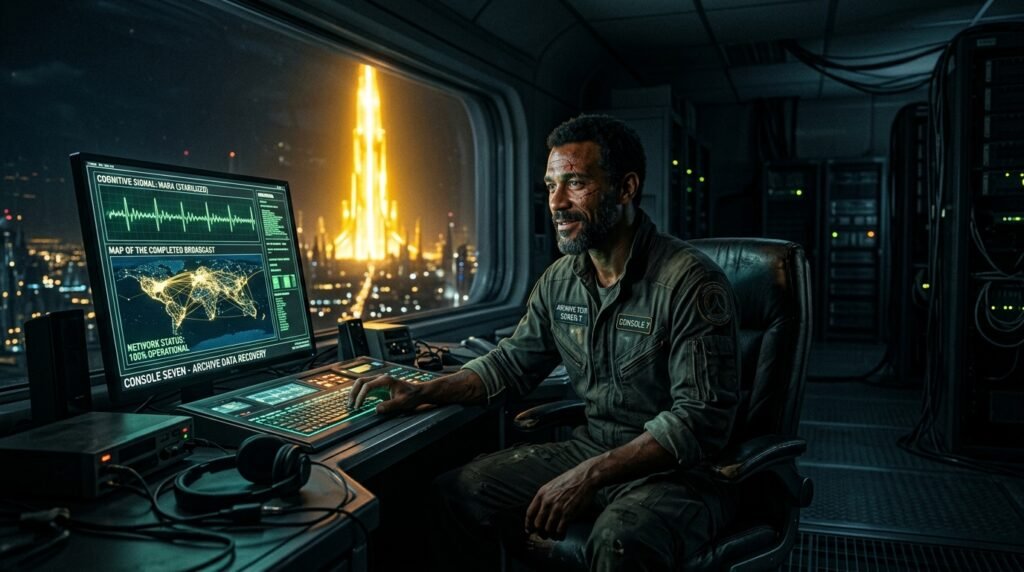
Above her, in the archive, Soren sat at console seven and watched the system response unfold across every monitor in the facility.
The coherence event from the extraction was propagating through the network — visible to every calibration technician on every shift across the connected facilities, generating the response she had predicted. The Interface Division’s alert architecture was activating. The Oversight Division’s emergency protocol was initializing.
The Broadcast was propagating faster.
He watched it on the substrate monitor — the vast bloom of light moving outward through the Throne’s lattice, reaching the residential sectors, touching the registered consciousness signatures of billions of people who were, at this moment, receiving something that the system had never before allowed them to receive.
The truth. Unmediated. All of it.
He watched the system response and he watched the substrate integration monitor and he kept one part of his attention, continuously, on the signal that told him Mara’s consciousness architecture was still present in the substrate.
Still there.
Still holding.
He watched for her the way she had said someone should.
The facility’s monitoring systems were generating alerts in cascading sequence. The skeleton shift technicians were responding with the confusion of people encountering something without precedent. Somewhere in the building, Drevan was almost certainly awake and moving toward the facility, because the Interface Division’s alert architecture did not wait for morning.
Soren stayed at console seven and watched the substrate and did not move.
At the ninety-third minute — seven minutes before the outer edge of their two-hour window — the integration monitor showed a change.
Not a termination. Not a collapse.
A stabilization.
The integration signal, which had been fluctuating with the specific pattern of a consciousness under enormous pressure, smoothed into something steadier. Something that had found, in the middle of the ocean, a way to hold itself.
He let out a breath he had been holding for ninety-three minutes.
The substrate monitor showed the Broadcast reaching its outer propagation boundary — the furthest edge of the Throne’s lattice network, the last registered consciousness signatures in the outermost connected cities receiving the transmission.
Complete.
The truth had gone everywhere the Throne’s management had reached.
He looked at the integration monitor.
Mara was still there.