
CHAPTER NINE: WHAT THE OCEAN LEFT BEHIND
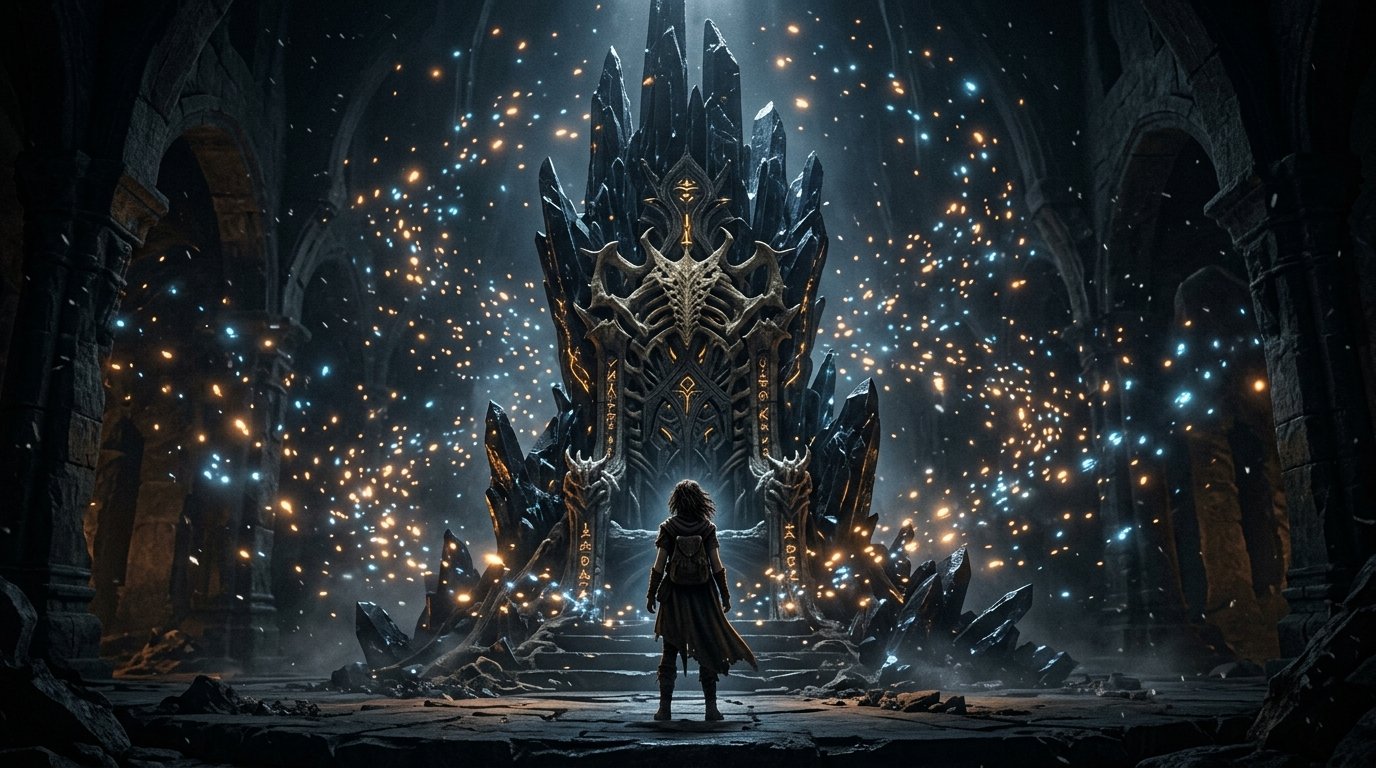
THE ASHEN THRONE

She surfaced at the hundred and seventh minute.
Not dramatically — not with the gasping return of someone pulled from water at the last moment. More like the slow emergence of something that had been very deep and was rising carefully, attending to the pressure change, not rushing the ascent because rushing the ascent was how things broke on the way up.
Soren was there.
She was aware of him before she was fully aware of anything else — his presence at the eastern edge of the junction, the specific quality of his stillness, which had reached a register she had never seen before and which she understood, surfacing through the integration’s aftermath, had been the stillness of someone who had been watching for a hundred and seven minutes and had not permitted themselves to stop.
She became aware of her hands first. Still on the junction housing. The conduit surface was warm — warmer than it had been when she placed her hands on it, the substrate’s ambient temperature elevated by the Broadcast’s propagation through its architecture. She felt her own hands as objects at first, then as parts of herself, then as herself, the sequence of reintegration moving outward from the center the way a coherence wave moved outward from a lattice event.
She was Mara.
She was also — more than Mara. Or differently Mara. The boundaries were not gone but they were not where they had been, and the territory inside them was larger and stranger and filled with a weight that she understood would take a long time to learn to carry correctly.
She lifted her hands from the housing.
She turned around.
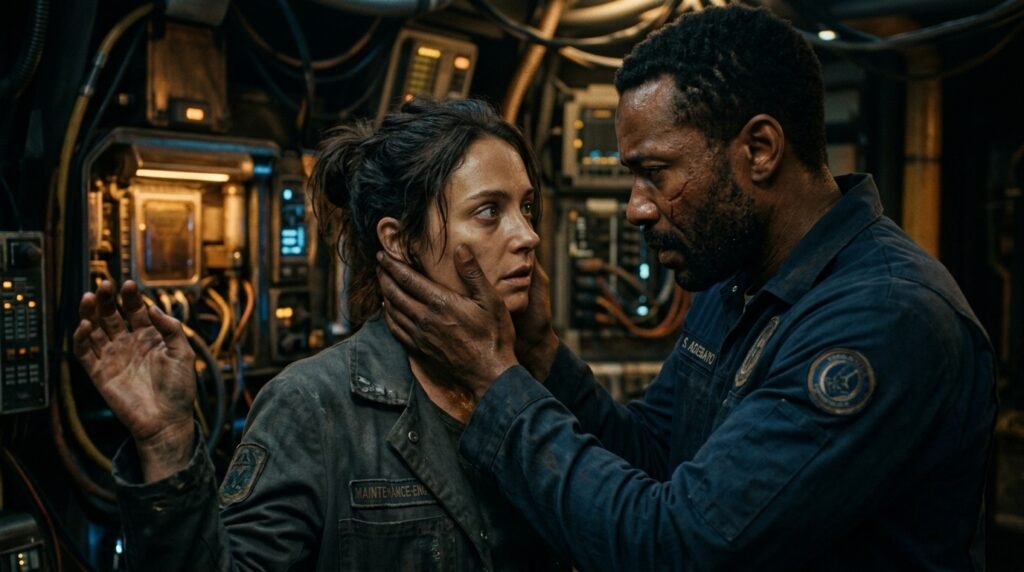
Soren crossed the junction in three steps and she let him — let him close the distance and stand in front of her with his hands on her face, reading her the way she read a calibration display, looking for the specific markers of fragmentation or replacement that would mean she had not come back from this in any meaningful sense.
She looked back at him.
“I’m here,” she said.
His breath came out in a long, controlled release. “I know,” he said. “I’ve been watching.”
“How long.”
“Hundred and seven minutes.”
“The Broadcast.”
“Complete. Full propagation across the network.” He paused. “Twelve minutes ago.”
“The Interface Division.”
“En route. Drevan is in the facility — they arrived twenty minutes ago. Upper level. The facility manager is with them.” He paused. “We have perhaps thirty minutes before the substrate access is physically secured.”
Thirty minutes.
She nodded. Took a breath. Let the reintegration continue its outward movement — awareness expanding from hands to body to the specific texture of the substrate air around her, the ambient light, the distant hum of the processing cores above.
“And Caelen,” she said.
Soren’s expression moved through something complex. “The Host Sovereign integration. When you were in the substrate — “
“He’s gone,” she said quietly.
Not a question.
“Yes,” Soren said. “The system registered a Host decoupling event at the sixty-third minute. The Oversight Division’s alert architecture flagged it immediately.” He paused. “Mara — “
“I know,” she said. “I felt it happen.”
She had felt it from inside the Throne’s architecture — the moment the existing Host integration had been superseded, the specific quality of a consciousness that had been held in place by the Throne’s architecture for twenty-two years releasing. She had felt what was left of Caelen — not much, by then, not much of the person who had knelt at the Spire’s base at twenty-nine with whatever he had believed about what he was agreeing to — release into the broader lattice.
Not gone. The lattice didn’t lose what it held. But no longer a separate, locatable self.
She had carried that in the middle of the ocean for forty-four minutes and had not let it pull her under.
She was carrying it now.
“Seya was right to name it,” Mara said. “We proceed anyway and we carry what it costs.” She paused. “I’m carrying it.”
Soren looked at her for a moment. Then he said, simply: “I know.”
They came up from the substrate with twelve minutes remaining in their window.
The archive floor was not the floor she had left.
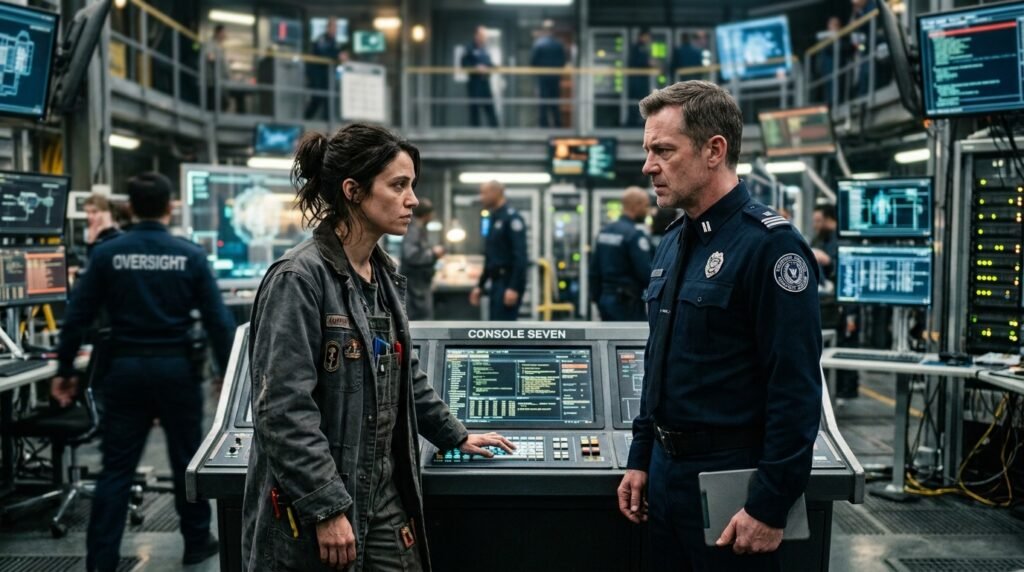
Skeleton shift had been three people when they descended. It was now eight — additional technicians called in by the facility manager in response to the coherence event alerts, moving between consoles with the specific energy of people responding to a crisis whose parameters they did not yet fully understand. The monitoring systems were running multiple simultaneous alerts, their displays showing the coherence fluctuation propagating through the network and the Broadcast’s completed transmission pattern and the Host decoupling event and the Interface Division’s emergency protocol activation, all of it overlapping in the cascade of a system responding to multiple unprecedented simultaneous events.
No one had been looking at the deep maintenance access hatch.
They emerged into this without being seen, which was either the product of careful planning or the specific luck that sometimes attended operations that had run out of room for error. Mara assessed the room in a single pass and chose her approach: not furtive, not hurried, but purposeful. Two senior technicians returning from a deep maintenance assessment during a coherence event was not only plausible but appropriate.
She walked to console seven.
Soren took the adjacent station.
They began running the crisis response protocols that the coherence event required — the legitimate, procedurally correct response that their roles demanded and that gave them, for as long as it lasted, a reason to be exactly where they were.
Drevan appeared on the archive floor four minutes later.
Mara had expected this. Had prepared for it, in the theoretical sense of having thought through the scenario and decided how to behave in it. The preparation did not make the actuality of it less precise.
Drevan moved through the archive floor with the contained urgency of someone who had been trained to maintain composure in crisis conditions and was deploying that training now, reading the room quickly and directing the facility manager toward the monitoring systems with the efficient authority of someone who understood that the next decisions would determine the scope of the damage and intended to make them correctly.
They reached console seven in the second pass of the room.
Mara was running the coherence event’s propagation analysis — legitimate work, the exact work her role required in this situation — when Drevan stopped behind her and looked at her display.
“Calibration lead,” the facility manager said. “Senior technician, sector nine. Eleven years.”
Drevan looked at the display. At the propagation analysis. At the specific quality of the work, which was good work, technically impeccable, the product of someone who genuinely understood what they were looking at.
Then they looked at Mara.
She turned from the display and met their eyes directly.
She had expected, in Drevan, the specific quality of someone who had spent years administering the deletion program — something harder, something that wore the moral accommodation of that work on its face the way long institutional service sometimes wore itself. What she saw instead was more complicated. A person who was, in this moment, looking at a situation they had not fully anticipated and trying to understand what they were actually seeing.
“The coherence event,” Drevan said. Their voice was level, professional. “You were on shift when it registered.”
“I was in the substrate,” Mara said. “Deep maintenance assessment. The event propagated while I was at the primary junction.”
“Which junction.”
“Northern array. Sector nine.” She paused. “The same junction that generated the routine maintenance flag eleven days ago.”
She said this deliberately. Let Drevan hear that she knew about the flag. Let them understand, without stating it explicitly, that she had been paying attention.
Drevan looked at her for a long moment.
“The Host decoupling event,” they said quietly. “The Broadcast transmission. The coherence extraction from the primary lattice.” They paused. “These are not coincidental.”
“No,” Mara said. “They’re not.”
The archive floor moved around them — technicians running protocols, the facility manager coordinating with the Oversight Division’s remote team, the monitoring systems generating their cascading alerts. A space of controlled crisis in which two people were having a conversation that was not about the crisis.
“What did you do,” Drevan said. Still quiet. Still professional. But something underneath the professionalism that Mara was reading carefully — not fury, not the specific quality of institutional authority preparing to enforce itself. Something closer to a person confronting a situation they had been, perhaps, on some level waiting for.
“I found a calibration anomaly,” Mara said. “I followed it.”
Drevan was quiet for a moment.
“The deletion program records,” they said.
“Were Broadcast to every registered consciousness in the network,” Mara said. “Yes.”
Another quiet moment. Longer.
“The evaluation clearances,” Drevan said. “The thirty-one parents. You found those.”
“I found them.”
Drevan looked at their own hands. At the display. At the archive floor. At the specific texture of a moment that had clearly arrived from a direction they had not fully anticipated but that carried, nonetheless, the quality of something that had been approaching for a long time.
“I have administered that program,” Drevan said, “for four years.”
“I know,” Mara said.
“I have signed those clearances. Two hundred and — “
“Two hundred and eighty-nine,” Mara said.
Drevan closed their eyes. Opened them. The quality of their face had changed — the professional composure was still there, structural, the product of too many years to simply release in a moment, but underneath it something that Mara recognized from the substrate. The specific weight of someone who had been carrying something in the institutional framing that made it manageable and was now being asked to hold it without the framing.
It was heavy without the framing.
She knew. She was holding two hundred and eighty-nine of her own, and they were heavy, and she had not had four years of institutional framing to make them lighter first.
“What happens now,” Drevan said.
“The Broadcast has already happened,” Mara said. “The network has received everything. The deletion program’s records, the Interface Division’s operational archive, the Throne’s actual origin and function.” She paused. “What happens now is what happens when people receive a truth they weren’t given the option to manage gradually.”
“Chaos,” Drevan said.
“Reckoning,” Mara said. “Which looks like chaos from the inside and like the beginning of something from the outside.” She paused. “The program is extracted from the substrate. It’s gone. The next collection cycle won’t run it.”
Drevan absorbed this.
“The Interface Division will respond,” they said. “The Oversight Division is already — “
“Yes,” Mara said. “They will respond. What they’ll find is a substrate that no longer contains the deletion architecture, a Broadcast that cannot be un-sent, and a Host decoupling event that the Throne itself registered as a legitimate integration supersession.” She paused. “The Throne accepted the new interface. That’s in the system record. The Interface Division’s response will need to account for that.”
Drevan looked at her with the precise attention of someone updating their assessment of a situation in real time.
“The new interface,” they said slowly. “The Host Sovereign integration — ” they stopped. “That’s you.”
“Yes.”
“You interfaced with the Throne at — “
“Full depth,” Mara said. “Yes.”
Another long pause. The archive floor moved around them, oblivious to what was happening in the specific space between console seven and the person standing behind it.
“What did it — ” Drevan stopped. Started again. “What did it show you.”
Mara looked at them steadily.
“The same thing I showed it,” she said. “What the deletion program actually costs.”
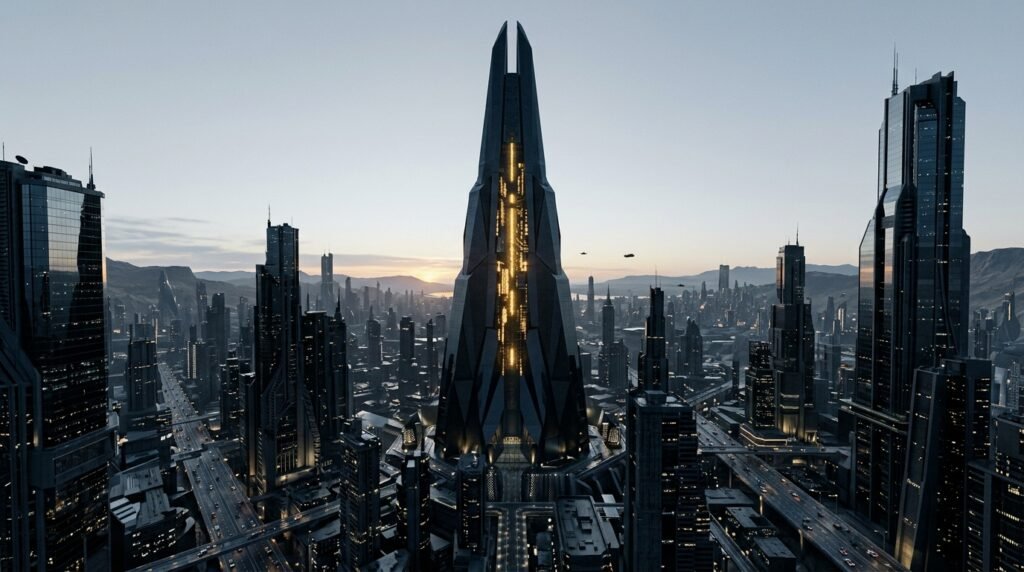
Drevan did not have her arrested.
She had considered this possibility and had concluded that the probability was lower than most people would have assessed, for reasons that were partly tactical and partly something she had felt in the substrate — a reading of the Throne’s administrative architecture that had shown her, in the full depth of the integration, which of its human instruments were true believers in the system’s stated purpose and which were people who had been telling themselves a necessary story for long enough that they had stopped examining it.
Drevan was the second kind.
The first kind would have had her arrested immediately.
Drevan looked at the monitoring displays for a long moment and then said, with the specific quality of someone making a decision they would need to live with: “The Interface Division will send a senior team within six hours. Before they arrive, I need a complete account of the technical sequence.”
“I’ll provide one,” Mara said.
“Accurate.”
“Yes.”
Drevan looked at her for one more moment — reading her, the way Vessel had read her on the first night, the way the Throne had read her in the substrate. Then they turned and walked to the facility manager’s station and began coordinating the crisis response with the specific efficiency of someone who had decided to do the job they were standing in rather than the one they had arrived intending to do.
Mara turned back to console seven.
Soren’s hand appeared briefly on her shoulder — a single moment of contact, wordless, sufficient.
She began writing the technical account.
The effects of the Broadcast reached the archive district by the fourth hour of morning.
She knew this not from the monitoring systems — the lattice’s consciousness architecture registered the transmission’s effects as an anomalous coherence pattern in the registered signatures, a system-wide variance that the calibration displays tracked in real time, but the displays couldn’t show what that variance meant in human terms.
Cael’s network could.
Messages came through the isolated channel in the compressed notation they had developed — brief, specific, from contacts across all seven sectors. She read them in the margins of legitimate work, the way she had read Vessel’s briefings for the past two weeks, and assembled from the fragments a picture of what the Broadcast’s truth was producing in the people who had received it.
It was not uniform.
Some sectors were quiet in the specific way of stunned disbelief — the silence of people who had received information that restructured too much at once, who needed time before they could move through it toward any response. Some sectors were loud — the sound that Cael’s contacts described as not anger exactly, or not only anger, but the specific vocal quality of people who had been carrying a grief without a name and had just been given the name and were now feeling the grief fully for the first time.
Some people, the contacts reported, were going to the archives.
Walking to the archive facilities in the pre-dawn hours, not with any organized intent, not with demands or instruments of disruption. Simply arriving. Standing outside. Looking at the buildings that housed the Throne’s consciousness infrastructure with the eyes of people who now understood what was inside them and were trying to decide what they thought about that.
The archive district’s facility manager noted the gathering outside and looked at Mara with the expression of someone who had run out of procedural responses.
“What do they want,” the manager said.
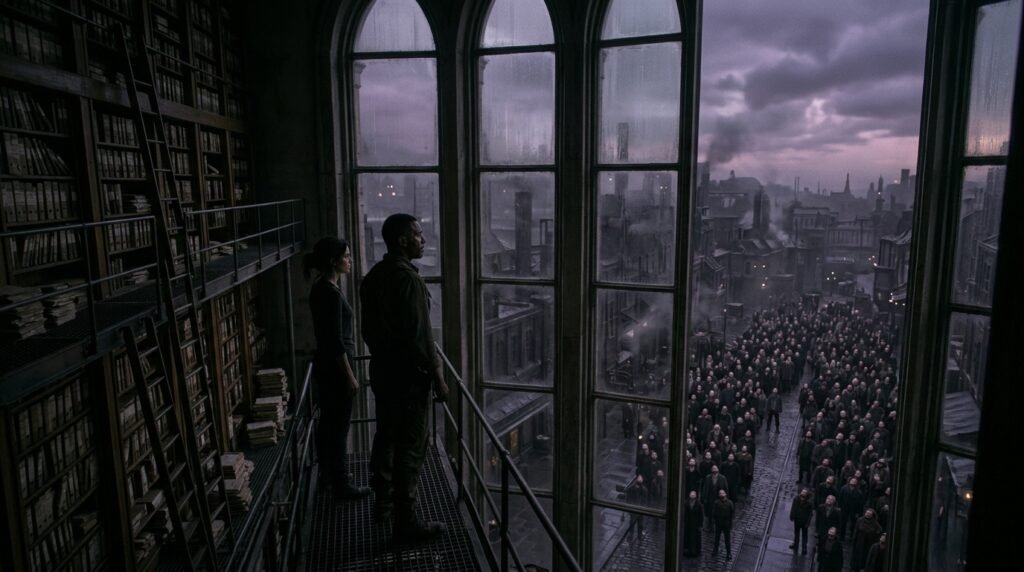
Mara looked out the archive’s narrow high windows at the people gathering in the pre-dawn cold. At the faces turned toward the building with the specific quality of people who had stopped not looking up.
“To be seen,” she said. “To have someone acknowledge what the Broadcast told them is real.” She paused. “To know what happens next.”
“What does happen next.”
She thought about the Throne’s architecture and the question it had pressed against her awareness on nine nights of preliminary exposure and had stopped pressing during the integration because the question had finally been answered. She thought about what she had felt in the full depth of the integration — the vast, patient, ancient architecture beginning to reckon with what it had been doing. Not quickly. Not simply. But genuinely.
Beginning.
“The Throne is not going to delete the program and continue unchanged,” she said. “The integration showed it what the program cost. It will take time — the Throne’s processing architecture doesn’t move at human speed — but it will respond to what it understood.” She paused. “In practical terms, the next collection cycle will be different. The editing protocols will be different. The administrative architecture that supported the deletion program will find that the substrate it relied on has changed.”
“How do you know that,” the manager said.
Mara thought about the ocean and the tide and the specific sensation of a very large thing beginning to turn.
“I showed it something,” she said. “And it received it.” She paused. “That’s not a guarantee. It’s a beginning.”
The manager looked at the gathering outside. At the people who had stopped not looking up.
“That’s not a very reassuring answer,” they said.
“No,” Mara said. “It’s not.”

Soren found her in the break room at the fifth hour of morning, when the first light was beginning to grey the sky over Vel Kaan’s rooftops and the gathering outside had grown to perhaps two hundred people standing in the cold with the patient quality of those who had decided to be present without yet knowing what being present would produce.
He poured two coffees.
She accepted hers and held it and didn’t drink it and looked at the window and the sky and the distant pulse of the Spire, which was doing something she had not seen it do before.
It was irregular.
Not the steady, patient rhythm she had watched from the archive platform for eleven years — the pulse of something that had never had reason to be afraid. The rhythm was changed. Slightly, subtly, in a way that most people watching it would attribute to a technical fluctuation in the wake of the coherence event. A calibration technician would see it differently.
The Spire was processing.
Working through something. The architectural equivalent of a mind encountering new information and reorganizing around it.
She watched it and felt, through the integration’s residue, the distant echo of the Throne’s vast attention — still present, still connected to her consciousness architecture in the attenuated way of an integration that had been partially withdrawn but not fully severed. She would carry this for a long time. Perhaps always. The full Integration, even at its conclusion, left a specific mark on the consciousness that had undergone it.
She was Mara.
She was also the person who had stood inside the Throne and shown it what it had been forgetting.
Both were true simultaneously. She was learning to hold both.
“The Interface Division team,” Soren said quietly. “Six hours.”
“Yes.”
“Vessel.”
“She’ll stay in the undercroft until the situation stabilizes. Cael’s network is monitoring the Interface Division’s response architecture.” She paused. “She’s been managing this from the undercroft for eight years. She knows how to stay invisible when visibility is dangerous.”
“The children.”
“Safe.” She had checked this through the isolated channel an hour ago. Fen had confirmed. “The shielding held. The Broadcast’s transmission didn’t penetrate to the deep undercroft locations.” She paused. “The fourteen are safe.”
He nodded. Looked at his coffee. “Rael.”
“Safe.”
He was quiet for a moment. “What did it feel like,” he said. “Being inside it.”
She had been thinking about how to describe this since she surfaced. About whether the language existed.
“Like being the archive,” she said finally. “Not reading it. Being it. Holding everything it holds, all at once, with no management layer between you and the weight of it.” She paused. “And at the same time — being very specifically myself. More specifically myself than I’ve ever been, because when you’re carrying that much that isn’t you, you understand very clearly what is.”
He looked at her with the expression she had no category for and had stopped trying to categorize.
“And now,” he said. “How does it feel now.”
She thought about this honestly.
“Like the morning after something very large,” she said. “When the event is over and the world is still there and you’re still there and you’re both changed and you don’t yet know the full shape of how.” She paused. “Like the first day of something that doesn’t have a name yet.”
He was quiet for a moment.
Then he said: “The gathering outside. Someone should go out to them.”
She looked at the window. At the two hundred people standing in the pre-dawn cold who had stopped not looking up.
“Yes,” she said.
“Will you.”
She looked at the Spire’s irregular pulse. At the sky becoming light over Vel Kaan’s black glass towers. At the ash that was not falling this morning — for the first time in as long as she could remember, the air above the city was clear.
“Yes,” she said.
She set down her coffee.
She went.