
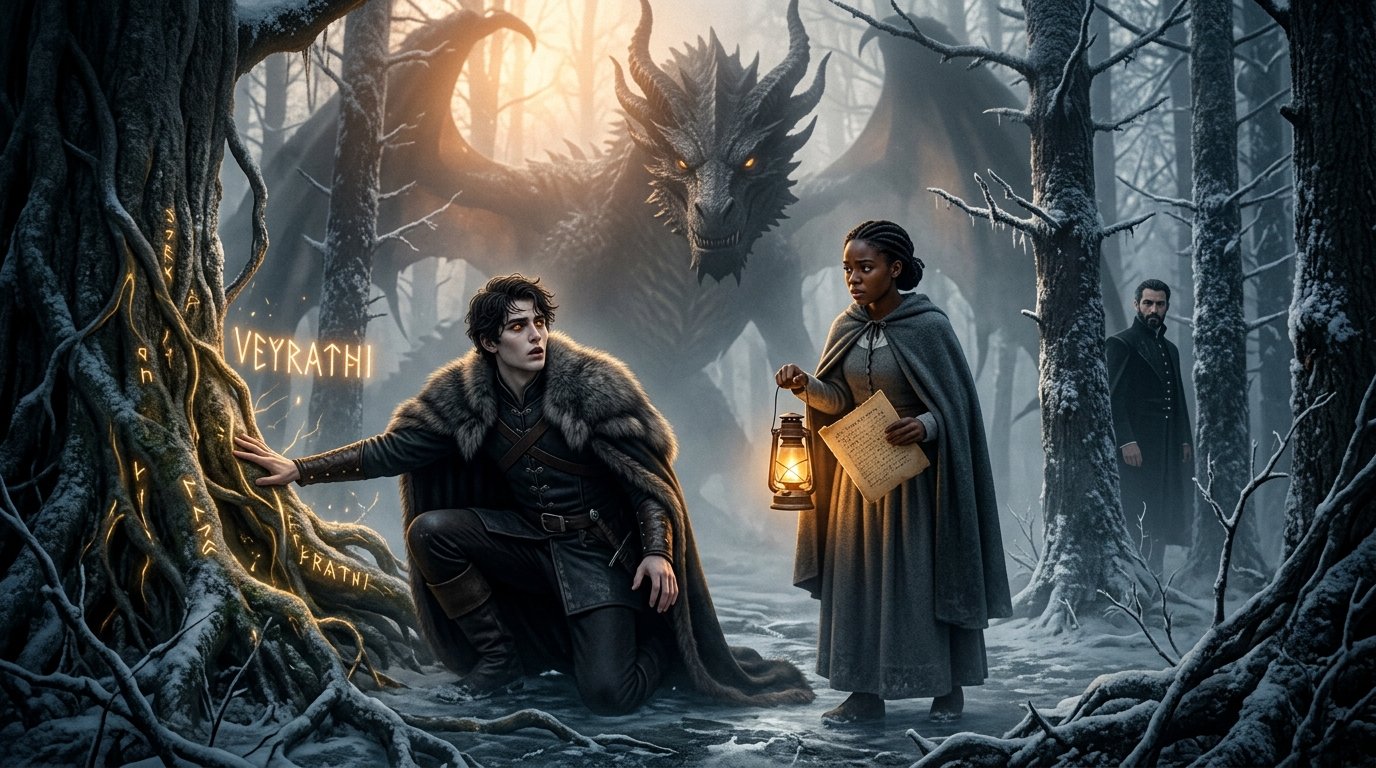
The Prince the Dragons Would Kneel To
LAST KINGDOM OF TYBRELL

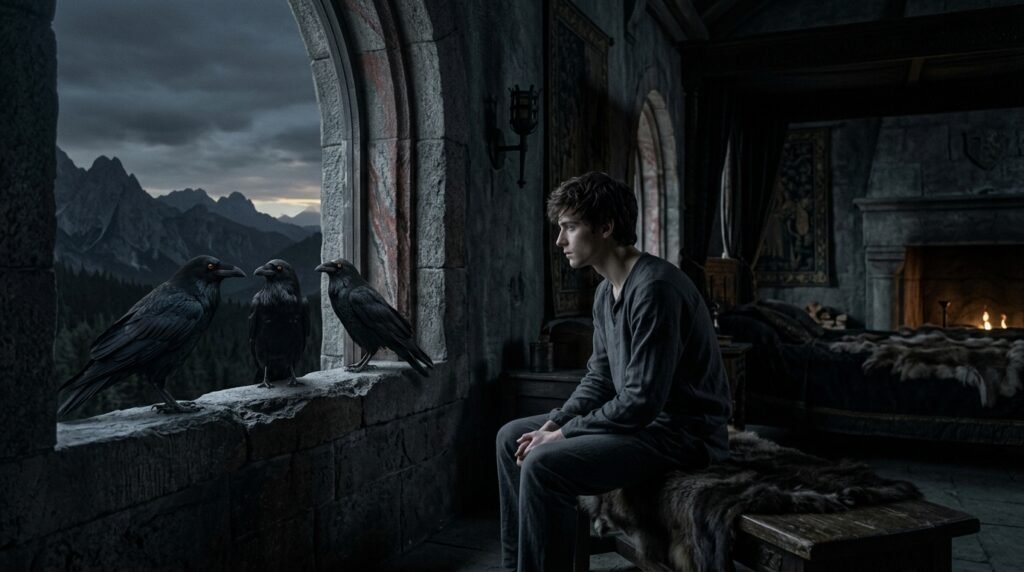
The ravens came before dawn.
They always did in Tybrell — those black-winged messengers that served the kingdom not out of training but out of something older, something the scholars at Vael’s Keep called draconic resonance, the invisible current of dragon will that saturated the very air of the kingdom the way salt saturated coastal wind. The ravens of Tybrell were not ordinary birds. They were larger, their feathers carrying a faint iridescence that caught light like oil on water, and they did not frighten easily. Nothing that lived long in the shadow of dragons did.
Prince James Tybrell watched three of them settle on the window ledge of his chamber as the first grey light crept over the Ashspine Mountains to the east.
He had not slept.
This was not unusual. Sleep had been an inconsistent companion since his fourteenth year, when the nightmares had begun — not the childish terrors of monsters under beds, but something stranger and more visceral. Heat. The sensation of heat from somewhere beneath his ribs, like a coal that refused to die. And sounds he could not explain: deep, rhythmic exhalations, like enormous bellows working in the darkness, and the distant crack of something massive shifting its weight. He had never told anyone about the dreams. Not the court physician, not his father’s advisor Lord Cassel Orn, and certainly not his father.

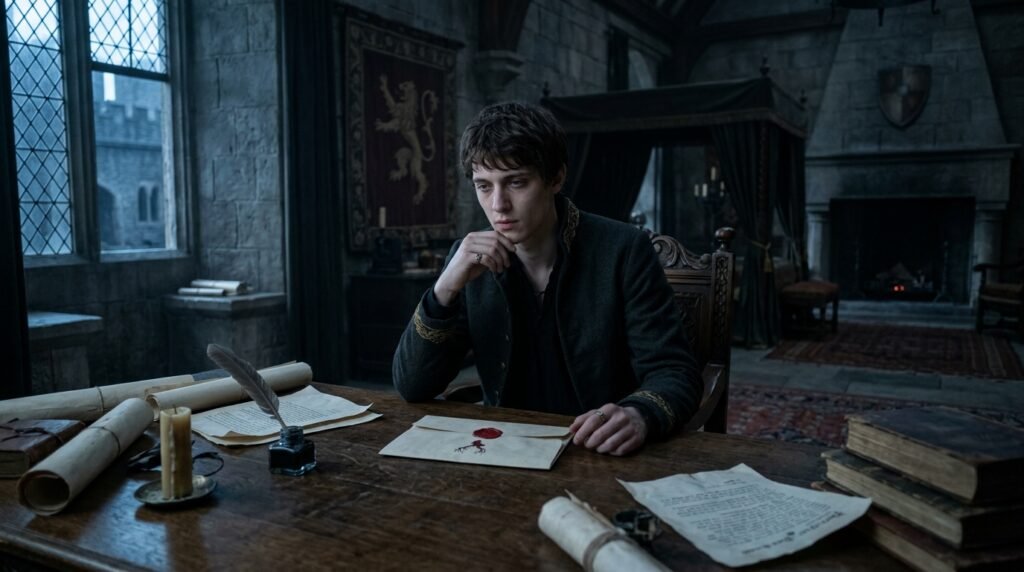
He sat at the window now in his sleeping clothes — plain linen, no embroidery, nothing that announced his rank — and watched the ravens and thought about the letter that had arrived the previous evening.
It sat on his writing desk, already read four times, its contents committed to memory with the precision he applied to everything that unsettled him.
The House of Verath requests formal audience at the Solstice Court. Lord Dayne Verath brings with him his daughter, Lady Mira Verath, seventeen years of age, accomplished in music and courtly arts, and considered by many the finest unmarried noble daughter in the southern reaches. Lord Verath expresses his deepest hope that the crown prince might find occasion to make her acquaintance.
James had set the letter down the first time with the careful neutrality he had learned to perform for the benefit of servants, advisors, and anyone else whose job it was to observe him and report to his father. Then he had walked to the window, pressed his forehead against the cold glass, and stayed there for several minutes while the fire in his ribs did something that felt almost like laughter.
He was being arranged. Again.
The third raven turned its head and looked at him directly. Its eyes caught the grey dawn light and held it — amber, almost orange, the colour of embers. James held its gaze for a moment, something he had learned never to do with people because people interpreted eye contact as challenge or invitation, neither of which he could afford. The raven blinked once, slowly, then turned away.
He pulled on his riding clothes without calling for a valet. This was another habit the court found eccentric in a prince — the preference for dressing himself, for solitude, for the hours before the castle woke when he could walk its corridors without an escort or an agenda. His father permitted it, mostly. His father understood, in the way that large and powerful men sometimes understand the quieter natures of their children, that James required space the way other creatures required air.
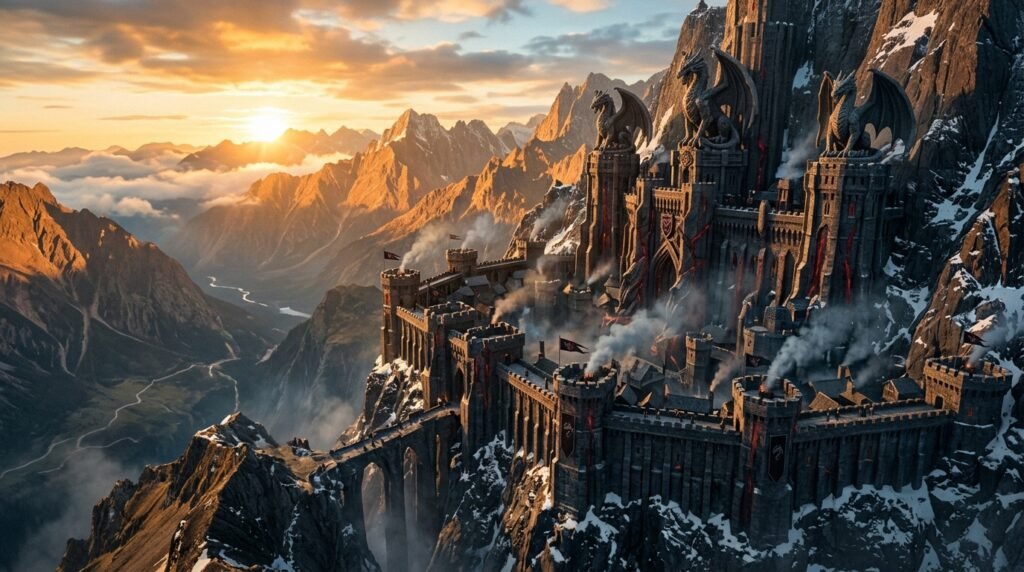
The corridors of Kael Varath — the ancient seat of the Tybrell kings, built into the northern face of the Ashspine — were cold at this hour. The stonework was old Tybrell construction: dark granite veined with a reddish mineral the architects called ashstone, which gave the walls a quality in firelight that made them seem almost alive, pulsing with something interior and warm. The castle had been built five centuries ago by James’s ancestor Varyn the First, who had supposedly designed the entire structure with input from Vaelorath — directing the great dragon to melt and reshape sections of the mountain itself to create chambers large enough to house a creature of Vaelorath’s dimensions. Whether this was history or legend, James had never been entirely certain. The distinction between the two felt thinner in Tybrell than it did anywhere else.
He descended through the servants’ levels — the back stairs, the utility passages — and emerged into the eastern courtyard just as the sun crested the mountains and turned the Ashspine from black to deep amber.
Across the courtyard, half-obscured by the shadow of the dragon hall’s enormous archway, a figure was already moving.
James slowed.
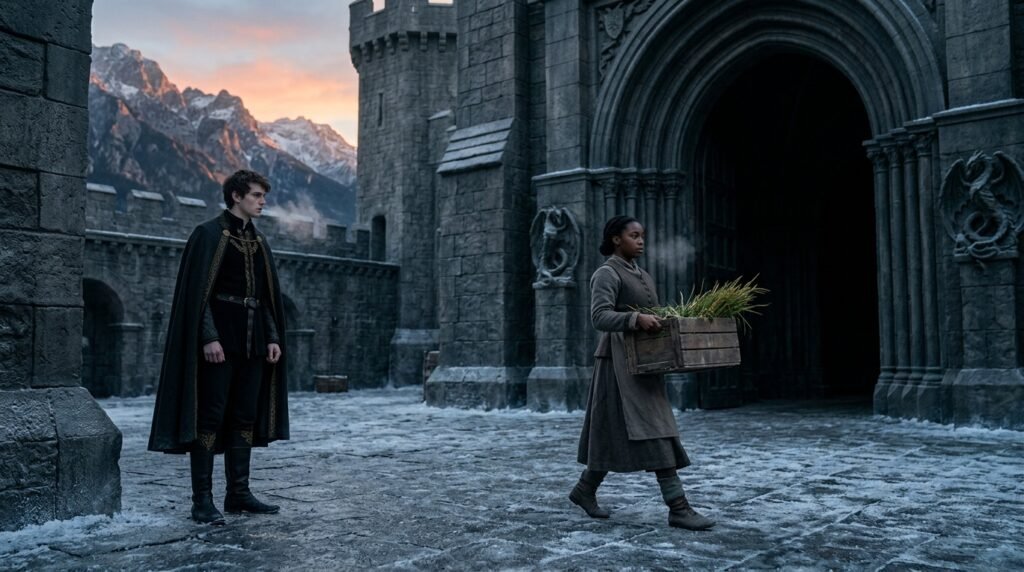
The girl — the young woman, he corrected himself, a correction he’d had to make with increasing frequency over the past year — was carrying a wooden crate filled with rushes toward the hall’s interior, her path taking her across a patch of ice that had formed overnight from a leaking drainage channel. She navigated it with the precise, economical footwork of someone who had learned to move through inconvenient spaces without complaint, adjusting her grip on the crate, her body tilted at exactly the angle required to keep her balance and her burden stable simultaneously.
Sarah Vale noticed him when she was three steps from the ice’s edge. Her eyes came up — dark brown, very direct, the kind of gaze that didn’t perform the automatic downward glance that most servants used in the presence of royalty. She had done this since the first time he had encountered her, eight months ago, when she had been new to the castle staff and had not yet learned that looking a prince in the eye was considered presumptuous. By the time she had learned it, James suspected she had decided the convention was foolish.
She didn’t stop moving. She navigated the last patch of ice, reached solid stone, and set the crate down against the arch.
“Your Highness.” The words were correct, the tone composed. Not warm, not cold. Calibrated.
“You’re up early,” James said. He stayed where he was. There were rules, and he was aware of them even when he found them absurd.
“The rushes in the hall need changing before the morning feeding,” she said. “The dragons don’t appreciate old rushes. Or so I’m told.” A pause. “I’ve learned not to question anything that involves making dragons more comfortable.”
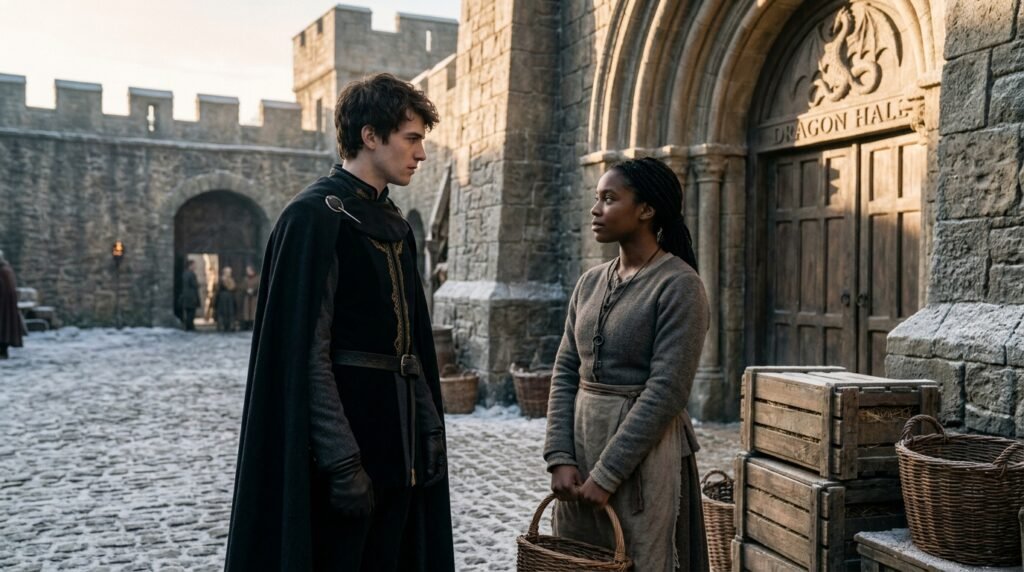
“That’s the wisest policy in the kingdom.”
The corner of her mouth moved. Not quite a smile — Sarah Vale had a precision about her expressions, a governance of them that reminded James uncomfortably of himself. “You’re up early too, Your Highness.”
“I don’t sleep well.”
“Nor do I.”
This was as much personal information as either of them had ever offered the other, and the symmetry of it sat in the morning air between them for a moment before James said, carefully, “You’ve been assigned to the hall rotation?”
“For three weeks now. Since Oldman Drev’s back gave out.” She glanced at the archway behind her, at the darkness that breathed out from the hall’s interior — warm air, heavy with the specific scent of the place, which was old ash and something animal and something else that had no name but that everyone who worked near dragons learned to recognize as simply dragon. “It’s an adjustment.”
“Most people find it terrifying.”
“Most people,” she agreed, in a tone that implied she was willing to be categorized separately.
James almost smiled. He stopped himself — not out of cruelty but out of the disciplined awareness that smiles in public, directed at specific people, became currency in courts, and currency got spent in ways you didn’t intend. “Be careful on that ice when you come back through,” he said instead. “The drainage channel from the kitchen blocks every winter and the stewards ignore it until someone falls.”
“I’ll mention it to the steward.”
“It won’t help. Lord Cassel Orn assigns the maintenance schedules and he hasn’t walked through the eastern courtyard in six years.”
She looked at him for a moment with an expression he couldn’t fully read — something between assessment and surprise. “Then I’ll be careful on the ice,” she said. She picked up the crate again.
“Sarah.” Her name in his mouth felt like something he’d said before, in a different context, though he was certain he hadn’t. She looked back. “What you said about not questioning what makes dragons comfortable — that’s not just practicality. That’s wisdom. Don’t let anyone make you feel otherwise.”
Something shifted in her expression. Not softened, exactly. Adjusted, perhaps. “Thank you, Your Highness.”
She went into the hall. James stood in the courtyard for a moment, watching the archway’s darkness after she’d disappeared into it, then turned and walked toward the training yard, where he was expected to be doing something appropriately prince-like with a sword before the court began to wake.
Kael Varath housed three dragons at its seat. This was not unusual for a castle of its rank — the larger noble houses in Tybrell’s outer territories kept one or two, and the lesser lords kept none, relying instead on the presence of the crown’s dragons as a kind of territorial warranty. But the three at Kael Varath were not equivalent creatures.
There was Thyrannis, the war-dragon, scale-plated in deep grey and built like a siege engine with wings, used primarily by the crown’s military commanders for the aerial surveys and occasional demonstrations of force that kept Tybrell’s border lords compliant. Thyrannis was approximately sixty years old, reliable, intelligent in the way of experienced soldiers — competent, disciplined, and entirely uninterested in the opinions of anyone who did not feed it or fly it.
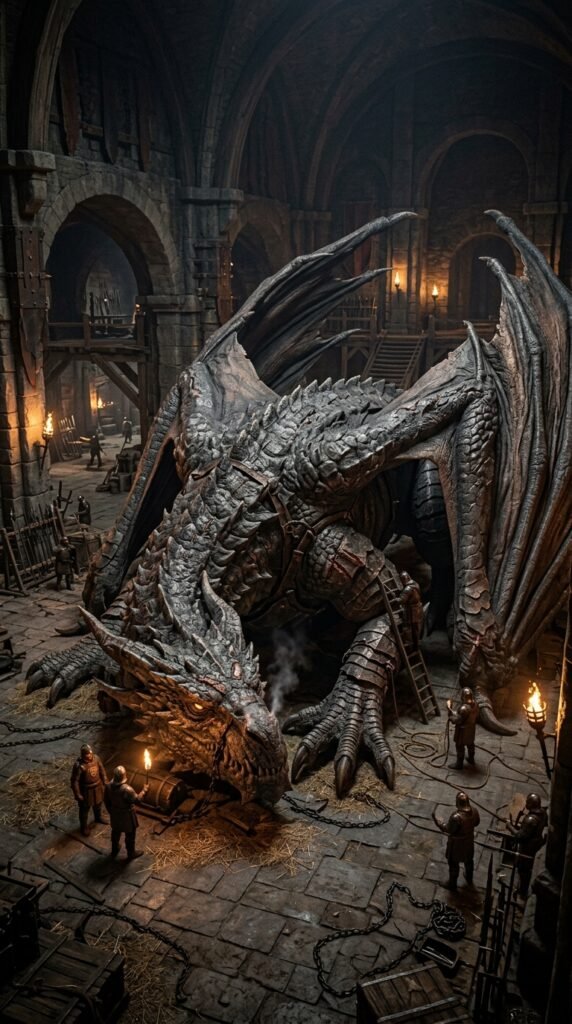
There was Veska, a female of the ash-wing variety, her scales the pale grey of weathered limestone, smaller than Thyrannis and considerably more temperamental. She had been a gift from the House of Calrath in James’s grandfather’s time and served no military function anymore, existing now as a kind of living symbol of the crown’s bond with the dragon line. She was eighty years old and had been known to ignore direct commands from even the king’s senior communion-trained handlers.
And there was Vaelorath.
James had been in Vaelorath’s presence perhaps forty times in his life. He remembered each occasion with the specific clarity of experiences that leave a permanent mark.
The great dragon did not live in the main hall with Thyrannis and Veska. There was a secondary structure at Kael Varath’s base, built against the raw rock of the mountain face, that had been constructed specifically for Vaelorath during the reign of James’s great-grandmother. It was not elegant. Elegance was not a consideration when designing a structure meant to contain something of Vaelorath’s dimensions — the building was simply large, built from the thickest stone the quarries could provide, reinforced with iron at every joint, and oriented so that the enormous doors opened onto a cleared expanse of mountain plateau where the dragon could launch and land without destroying anything vital. The scholars called it the Primary Enclosure. The castle staff called it, almost universally, the Dark Hall.
James was not due to visit the Dark Hall today. He had no reason to be there, and his father would be conducting the morning communion at the seventh bell, which was a private ritual that James had never been invited to attend. The communion between a Tybrell king and his primary dragon was the most intimate act in the kingdom’s culture — more private than prayer, more binding than marriage — and Aldric Tybrell conducted it alone, without witnesses, in the pre-dawn stillness when the castle was quietest.
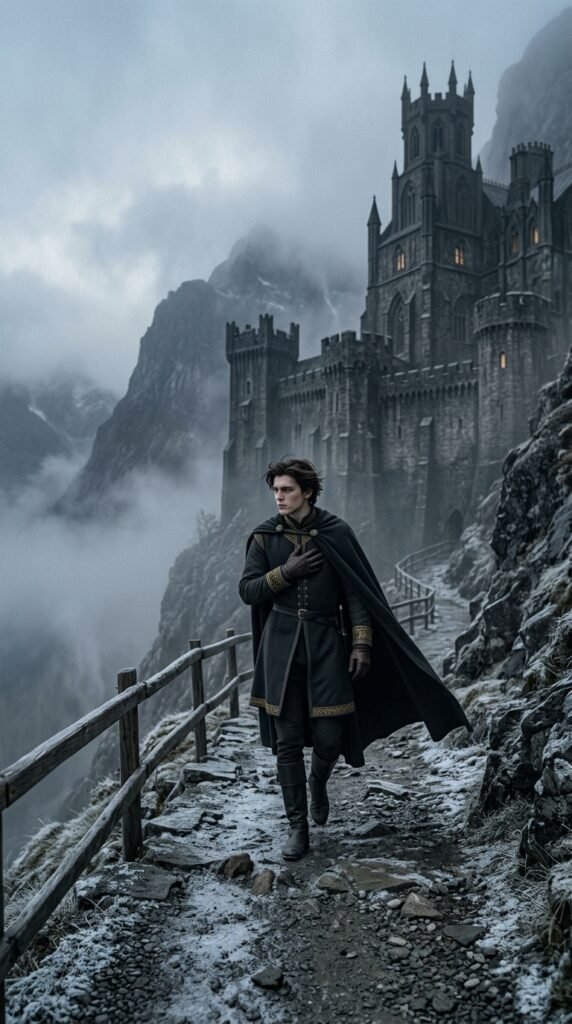
James walked past the Dark Hall on his way to the training yard.
He always tried not to. He always failed.
There was something that happened when he came within a certain distance of the structure — within perhaps fifty yards of its outer walls. A sensation in his chest, not painful, not entirely pleasant, that was closest to the feeling of recognizing a piece of music you know intimately but haven’t heard in years. A kind of resonance. A vibration at the very edge of perception.
He had noticed it first at age eleven. He had been accompanying his father on an inspection of the dragon facilities and had fallen behind the group, distracted by a crack in the ashstone wall that had been filled with some kind of reddish mortar he’d never seen before. And then the sensation had hit him — that feeling, deep and structural, like the ringing of a massive bell at a frequency just below what the ear could properly register — and he had stood completely still for almost a minute before one of the guards had touched his shoulder.
Are you well, Your Highness?
He had been perfectly well. He had been, in that moment, more alert and present than he had ever been in his life. But he had said yes, I’m fine, and moved on, and had spent the following years constructing careful detours and alternative routes through the castle that minimized his proximity to the Dark Hall without making it obvious that he was avoiding it.
He failed at the detours often. The Dark Hall was at the castle’s base. So many of his preferred routes led past it.
This morning, the vibration was stronger than usual. Stronger than it had been in months — almost strong enough to make him stop, almost strong enough to make him press his hand flat against the outer wall the way some superstitious part of him had always wanted to, just to feel whether the stone was warm. He kept walking. He kept his hands at his sides.
From somewhere behind the wall, in the enormous darkness of the enclosure, something shifted.
James walked faster.
The Solstice Court was three weeks away, and Kael Varath was entering that particular state of elevated industry that preceded any major gathering of the nobility — a state that James privately categorized as controlled panic dressed in formal clothes. Lord Cassel Orn, the king’s chief advisor and the man most responsible for managing the logistical nightmare of housing, feeding, and politically navigating forty-odd noble families for a period of ten days, had aged approximately a decade in the past month. James had watched it happen with sympathy and the helpless inability to offer any assistance that was actually useful.
“The Veraths will require the eastern guest wing,” Lord Cassel said, following James through the upper corridor at the pace of a man who had no choice but to follow because stopping meant the prince would simply continue without him. Cassel Orn was fifty-three years old, grey-haired, perpetually ink-stained, and moved with the jerky efficiency of a man who had been interrupted too many times in his life to fully commit to any single activity. “Which creates the problem of the Mirhaels, who traditionally occupy the eastern wing and have, I might add, occupied it for eleven consecutive Solstice Courts and will regard any change as a deliberate insult.”
“Give the Mirhaels the northern suite,” James said. “Lord Mirhael has gout. The northern suite has the heated floors. He’ll prefer it and convince himself it was his idea.”
Cassel made a note. “The seating arrangement for the formal dinner—”
“Seat Duke Frederick away from Lord Dayne Verath.”
A pause. “They’re old allies, Your Highness.”
“I know.”
“Separating them might be read as—”
“Lord Cassel.” James stopped walking. Cassel nearly walked into him and adjusted at the last moment with the reflexes of long practice. “Frederick and Verath spent two hours together in my father’s antechamber last month, and neither of them was there to see my father. I know because my father was hunting. I want them apart at the dinner table. Find a reason.”
Cassel looked at him for a moment with an expression that contained, in careful layers, surprise, reassessment, and something that might have been approval if approval had not been so entirely absent from Lord Cassel Orn’s usual emotional register. He made another note. “I’ll arrange it.”
“Thank you.”
They resumed walking. After a moment, Cassel said, “Your Highness, the matter of Lady Mira Verath—”
“I’m aware of the letter.”
“Lord Dayne will expect—”
“I know what he expects. I’ll be courteous. I’ll be interested. I’ll be everything the court requires me to be.” James’s voice didn’t change in tone but something beneath it went flat, like a plank closing over a well. “Arrange the seating however serves the kingdom best.”
“Of course,” Cassel said, with the diplomacy of a man who had learned that of course was the safest response to statements that meant the opposite of what they said.
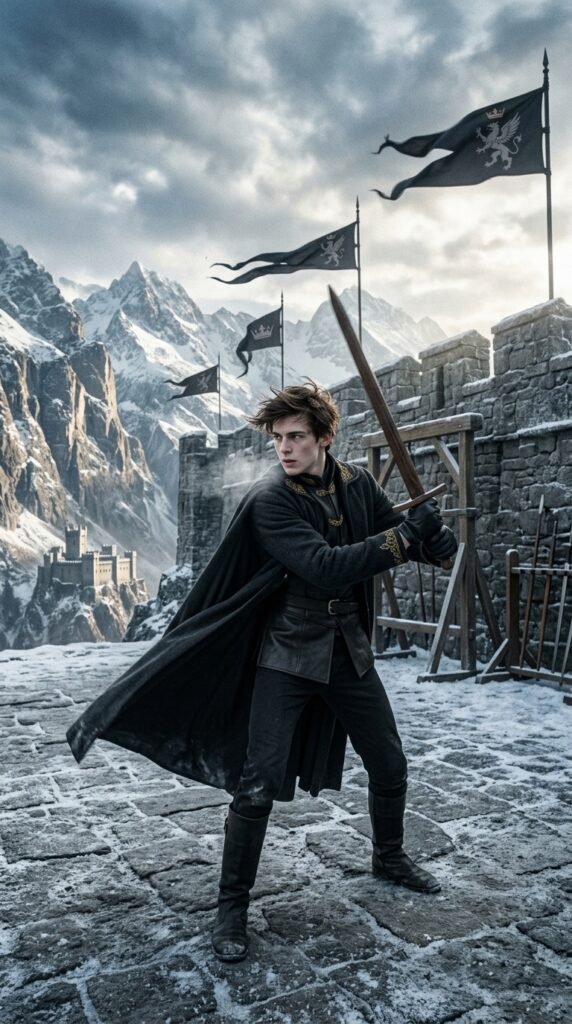
The training yard occupied the castle’s southern face, a wide stone enclosure exposed to the full wind off the mountains and therefore, for most of the year, bitterly cold. James sparred there every morning with a man named Torvan, who was not technically a knight — he held the title of arms captain, which was distinct in Tybrell’s martial structure because it implied a focus on the practical rather than the ceremonial. Torvan was thirty-eight years old, built like a man who had spent three decades doing nothing except lifting heavy things and fighting people, and had the face of a former battlefield soldier, which he was. He had four fingers on his left hand. He’d lost the fifth to a Calrath skirmisher during the border conflict of James’s infancy and appeared to regard its absence with the same equanimity with which he regarded everything else.
“Your footwork,” Torvan said.
James reset his stance. The practice sword in his hand was wood, practice swords always being wood because James was a decent enough swordsman that the alternative occasionally endangered the people around him, and wood kept the bruises superficial. “What about it?”
“You’re thinking.”
“I’m sparring.”
“You’re thinking while sparring. I can see it. You go somewhere when you’re troubled.” Torvan circled him slowly. “Wherever you go, it makes your left shoulder drop.”
“My left shoulder doesn’t drop.”
Torvan feinted left, then drove forward right, and the wooden blade caught James across the ribs hard enough to draw a sharp exhale. “Your left shoulder drops.”
James stepped back, breathing through the impact, and did what he was told — stopped thinking. Or rather, stopped directing his thinking, let the analytical current that ran constantly beneath his attention simply flow without interference, because Torvan was right and had always been right and it was one of the more irritating things about him. His stance adjusted. His grip shifted a quarter inch. He waited.
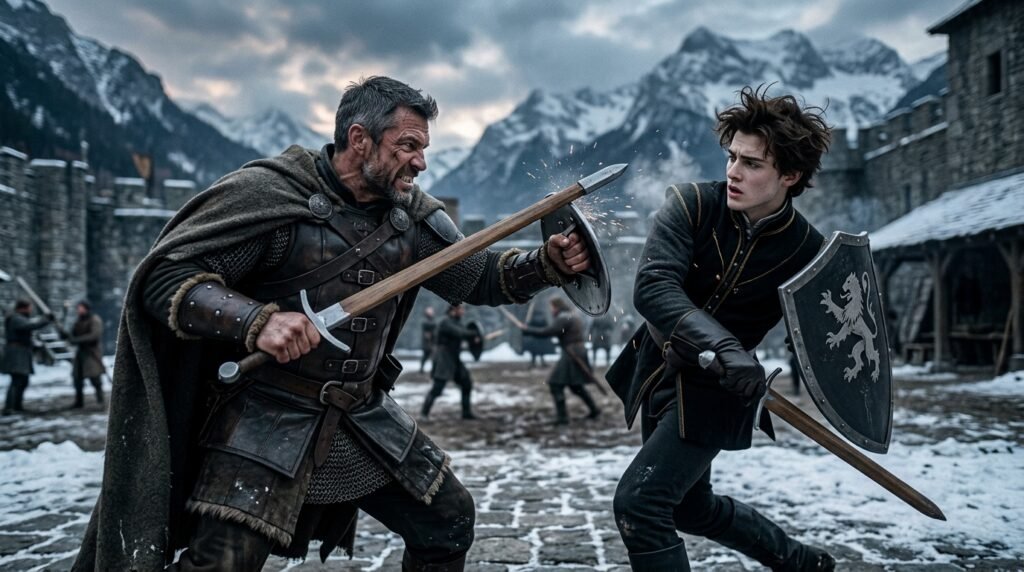
Torvan came again and James moved inside the swing, turned, and got the practice blade against the back of Torvan’s knee before the captain could complete his rotation.
Torvan looked down at the blade. Then at James. “Better.”
“The letter from Lord Verath arrived yesterday,” James said, stepping back to distance.
“I heard.”
“The whole castle heard.”
“The whole castle was going to hear.” Torvan rolled his neck, reset. “What are you going to do about it?”
“What I’m required to do.”
“That’s not an answer.”
“It’s the only answer available to me.”
Torvan considered this. He had the unusual quality, for a man of his profession, of actually considering things before responding. “Your father had the same problem when he was your age. Different girl, same problem.”
James looked at him. “My father’s problem?”
“Before your mother. There was a girl from the Orn valley. Merchant family. Your grandfather forbade it.” Torvan shrugged with the single shoulder that wasn’t currently guarding. “Your father did what was required of him.”
James thought about his father — King Aldric, who was large and certain and moved through the world as though the world had been specifically arranged for his passage. Who laughed loudly and hunted in all weather and sat his throne with the ease of a man who had been told he belonged there so many times that the information had become structural, had become bone. Who had loved James’s mother, Lady Erryn of the House Carath, with the visible and uncomplicated devotion that was the one aspect of his father’s personality that James had never been able to approach from any analytical angle, because it simply was, solid and unexamined, like bedrock.
“He seemed happy,” James said. “With my mother.”
“He was.” Torvan’s expression shifted — just slightly. “He did what was required. Then he found a way to be happy inside it. That’s what kings do.”
“And if I can’t?”
Torvan raised his practice blade. “Then you spar harder. Ready?”
James raised his blade.
He was not ready. He suspected he wouldn’t be for some time. But he moved anyway, because readiness, like sleep, was not something he could afford to wait for.
That evening, the king summoned him.
Aldric Tybrell’s private study was on the castle’s uppermost habitable level, above the formal chambers, accessed by a staircase that most of the castle staff were never required to climb. It was a large room but not a grand one — the grandeur in Aldric’s world existed in the formal spaces below, the throne room and the Communion Hall and the Great Gallery where the portraits of twelve generations of Tybrell rulers watched visitors with the particular intensity of people who have been rendered permanent. The study was where the king actually lived: books stacked against walls that had been built for tapestries, maps spread across a table that had been built for formal dining, a fireplace large enough to stand in and currently burning with the specific aggression of a fire that had been given too much wood by someone trying to compensate for the mountain cold.
King Aldric stood at the window when James entered. He was fifty-one years old and still appeared to be in his early forties — the Tybrell line aged slowly, which the scholars attributed to the draconic resonance that ran through their blood, though this was the kind of explanation that explained nothing and satisfied everyone. He was large, James’s father — not brutishly so, but with the natural authority of a man who had been the largest person in most rooms for his entire life. His hair had gone silver at the temples and his beard was kept shorter than fashion suggested, a personal preference he had maintained since his coronation. He turned when James entered, which was a small thing but not a nothing — many men in Aldric’s position received visitors without turning, letting the supplicant wait while the powerful man finished his contemplation of whatever view had been engaging him. Aldric never did this. James had noticed it at age nine and filed it away as information about what kind of man his father actually was beneath the king.
“Sit,” his father said, and dropped into the chair nearest the fire with the ease of a man whose body still obeyed him entirely. James took the chair opposite. Between them, a low table held a decanter and two cups, one already poured. “Take the cup. You look like you need it.”
James took the cup. The wine was dark, from the south — the Vale region, where Sarah came from, though he didn’t note this aloud. It tasted of warm stone and something that might have been smoke.
“You spoke with Cassel,” his father said.
“He followed me.”
“He follows everyone. It’s how he stays useful.” Aldric poured his own cup. “He tells me you want Frederick and Dayne Verath separated at the formal dinner.”
“I do.”
“Reasons?”
James told him — the antechamber, the meeting, the forty-five minutes, the king’s absence. He told it the way he told his father everything of this nature: plainly, without dramatic emphasis, allowing the facts to arrange themselves in the order that made their implications visible. His father listened the way he always listened, without interruption, his grey eyes steady and entirely attentive. When James finished, Aldric was quiet for a moment.
“You noticed that two months ago,” Aldric said.
“Yes.”
“And you’re telling me now.”
“I wanted to be certain it wasn’t coincidence.”
“And you’re certain.”
“I’m more certain than I was two months ago.”
Aldric turned his cup in his hands slowly. “Frederick is my brother,” he said, which was not quite a defense and not quite a dismissal. It was something more honest than either — an acknowledgment of complexity. “He has always wanted more than he has been given. I have always known this.”
“And?” James said, carefully.
His father looked at him with an expression that was not simple — it never was, when Aldric Tybrell chose to be fully present in his own face rather than behind the composure of kingship. There was love there, and assessment, and something that might have been unease, which James had never seen in his father before and therefore noted with the specific alertness he reserved for unfamiliar things.
“And I am watching,” Aldric said. “As are you. Perhaps that’s enough for now.” He paused. “The Veraths.”
“I know.”
“Dayne Verath is a powerful lord. His southern territories provide a quarter of the kingdom’s grain output. A marriage alliance—”
“I understand.”
“James.” His father’s voice shifted — not commanding, something softer and more difficult. “I’m not asking you to love the girl. I’m asking you to consider what you owe the kingdom against what you want for yourself. These are not the same negotiation.”
James held his cup and said nothing.
“Whatever else you’re feeling,” Aldric said, and his voice was quieter still, “whatever else is occupying your attention — be careful. Courts have long memories and longer tongues. And you are not a prince who can afford to be misread.”
He meant Sarah. He couldn’t possibly know about Sarah — there was nothing to know, not really, not yet — but he meant her anyway, or something like her, or the entire category of things that James wanted and could not have. James wondered sometimes whether his father was reading his thoughts or simply reading him, which were different processes with the same result.
“I’ll be careful,” James said.
“Good.” Aldric settled back. The fire cracked. Outside, the mountain wind moved against the stones. “Stay a while. Tell me what you’ve been reading.”
James told him. And for an hour, in the high room with the fire and the dark wine, they talked about books — his father asking questions with the genuine curiosity of a man who read more than his reputation as a warrior-king might suggest, James answering with the cautious pleasure of someone who had found, in this specific space, that his particular kind of intelligence was not inconvenient but valued. It was the closest thing to ease that James knew.
When he left, he carried the feeling with him down the stairs and through the corridors and back to his chamber, where the three ravens had gone but the letter from Lord Verath remained on his desk.
He didn’t read it again. He went to the window instead and looked out at the mountain and the darkness below, where the Dark Hall sat against the rock like a secret the mountain was keeping, and felt the vibration in his chest — faint, tonight, like something very far away breathing slowly — and thought about his father’s face when he’d said I am watching, and the thing he had seen there that was not quite unease.
He thought about Frederick.
He thought about Sarah navigating ice in the grey dawn with a crate of rushes and the footwork of someone who had learned to move through difficult terrain.
He didn’t sleep for a long time.
When he did, the dreams were worse than usual — the heat, the bellows-sound of vast lungs, and something new: a colour, deep and saturated, the absolute black of scales that absorbed light entirely, and amber eyes that he could not tell, in the dream, whether they were looking at him or looking through him to something that existed in the same space but was not quite the same him.
He woke at dawn with the taste of ash in his mouth.
The ravens were back.

Very interesting
Well written story 😘🔥🔥🔥