
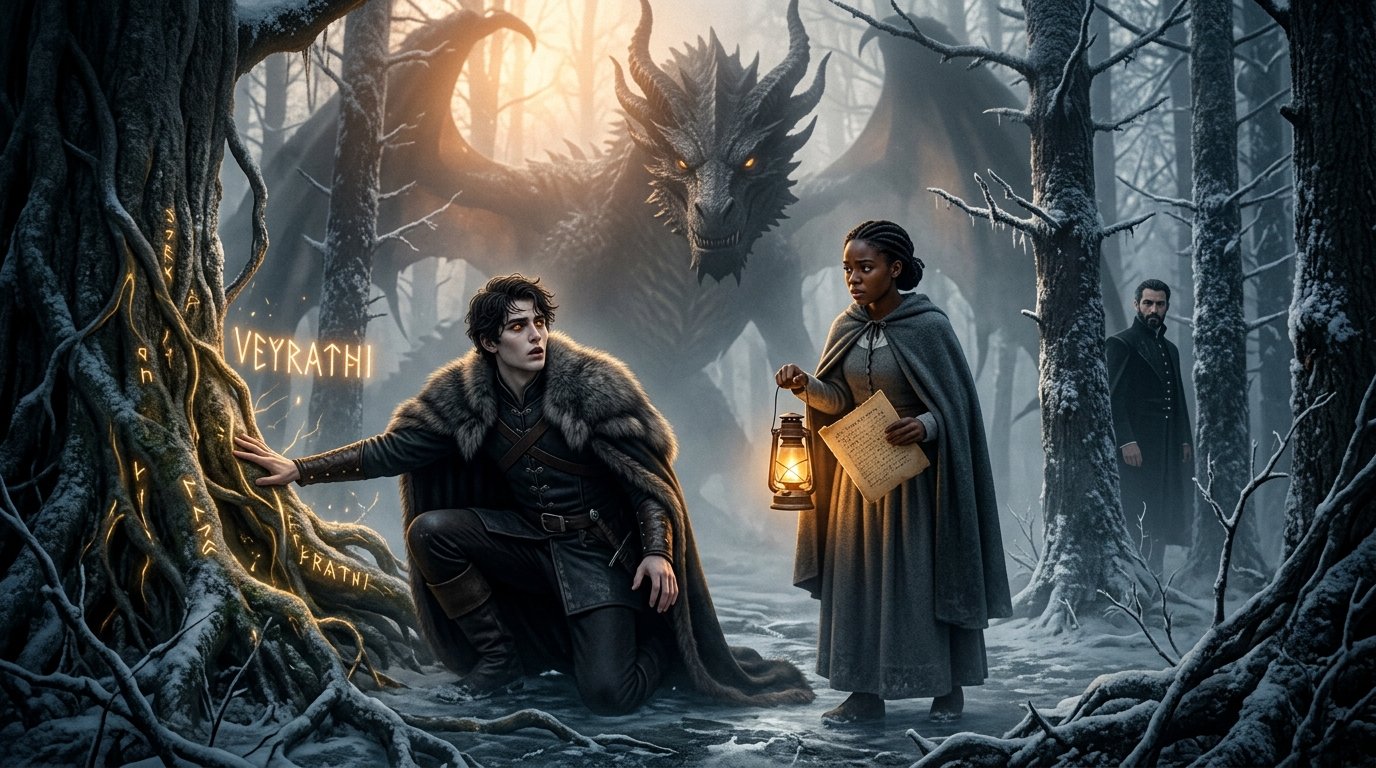
CHAPTER FOUR: FIRE IN THE BLOOD
LAST KINGDOM OF TYBRELL

The Royal Hunt was not optional.
This was the thing James had understood since childhood with the specific clarity of a child who has tested every available alternative and found each one sealed. The Solstice Hunt was tradition in the way that only things older than living memory could be tradition — not a custom that existed because someone had decided it was a good idea, but a practice so embedded in the kingdom’s identity that questioning it was less like questioning a policy and more like questioning weather. It happened. It had always happened. It would continue to happen regardless of the preferences of any individual compelled to participate.
The premise was this: on the fourth morning of the Solstice Court, the king’s hunting party rode into the Ashwood — the dense, ancient forest that spread from the mountain’s eastern base across forty miles of ridgeline and valley — while one of the crown’s dragons flew scouting patterns above the canopy, driving game toward the riders below. It was less a hunt than a demonstration. The dragon’s involvement made it so — the terrified flight of elk and boar and the larger predators of the Ashwood toward the waiting riders was not sport in any meaningful sense. It was theatre: a visible reminder that in Tybrell, the partnership between the Tybrell line and dragonkind had practical applications, and that practical application was, at its root, a form of dominance.
James hated it.
He had participated in it four times. Each time he had ridden competently, had taken his quota without excess, and had said nothing about what he privately thought of the exercise, which was that it was an elaborate performance of power for the benefit of people who needed reminding that power existed, and that the dragon’s involvement reduced the entire thing to a kind of organized cruelty dressed in the language of tradition.
He had told exactly one person this opinion. Sarah had listened and then said, without particular emphasis: So is most of what courts do. Organized cruelty dressed in the language of tradition. At least the hunt is honest about the dragon.
He thought about this as he dressed in the grey pre-dawn, pulling on riding leathers that were properly broken in and properly maintained because Torvan had opinions about equipment and James had long since learned to apply them. His chamber was cold despite the fire — the mountain cold at this hour seeped through ashstone with the patience of something that had been doing it for millennia and saw no reason to stop.
Outside his window, the Ashwood was invisible in the darkness, its presence indicated only by the absence of stars at the eastern horizon where the treeline rose. In an hour, light would find it. In two hours, he would be inside it.
He stood at the window and breathed evenly and told himself that the tightness in his chest was the cold.
The hunting party assembled in the main yard at first light: twelve riders, the king included, plus a retinue of handlers and beaters who would work the forest edges on foot. The noble guests who wished to observe had been provided with a viewing platform on the lower eastern slope — a structure of timber and good carpeting that Cassel’s staff had erected in two days and that made the whole enterprise look, to James’s eye, uncomfortably like a public spectacle, which was perhaps the point.
Thyrannis circled overhead.
The war-dragon’s passage over the yard cast a shadow that made the horses shy and the assembled lords’ sons grip their reins tighter than necessary. Thyrannis was airborne with the specific competence of a large thing that had been doing its job long enough to do it without apparent effort — wing-beats deep and rhythmic, the grey scales catching the early light and throwing it back as a dull metallic gleam, the enormous head oriented downward in the scanning posture of a creature that was simultaneously aware of everything in its visual field and apparently concerned with none of it.
The horses that James’s family rode were Ashspine-bred, trained from foalhood in the proximity of dragons, and they tolerated Thyrannis the way you tolerate something you have been told not to be afraid of often enough that you’ve mostly believed it. His own horse — a dark bay gelding he’d named Cael, for no reason he’d ever made public — shifted once beneath him and then held still, which James appreciated as much as he appreciated most things the horse did, which was considerably.
His father rode at the column’s head, which was where his father always rode — not for the symbolism of it, or not primarily, but because Aldric Tybrell was a man who processed the world best from the front of whatever was happening. James rode third, behind his father and Lord Cassel, who rode in his hunting clothes with the expression of a man being slowly murdered by an inconvenience and was too professional to say so.
Frederick rode seventh. He was a good rider — elegant, controlled, the kind of horsemanship that came from training rather than instinct. He had positioned himself beside Lord Dayne Verath, despite James’s seating arrangements at the formal dinner having separated them. In the hunting column, James had no authority over positioning. He noted this. He noted that Frederick was aware he had no such authority, and had chosen the hunt to exercise a proximity he’d been denied at the table.
“Your Highness.” At his left, Petyr Verath had managed to manoeuvre his horse into the adjacent position with the determination of a young man who had decided that last night’s humiliation was going to be converted into connection rather than avoidance. James gave him credit for it. “I — I wanted to thank you. For last night.”
“Don’t mention it,” James said. He meant this literally.
Petyr took the hint with more grace than James had expected. “The forest,” he said instead, looking ahead at the treeline. “Is it as difficult as people say?”
“It’s dense. The Ashwood was old before the castle was built — the interior goes dark quickly even at midday. Stay with the group, follow the dog-handlers, and don’t mistake the sounds the dragon makes overhead for proximity. Thyrannis is loud when he drives game. The sound carries further than the animal does.”
“Have you been in there alone?”
“Yes.”
“Is it—” Petyr stopped, seemed to think better of what he’d been about to ask. “I’ve heard there are things in the interior. Old things. Not animals.”
James looked at him. “What have you heard?”
“Stories. My father says the forest is full of old stories. Pre-Varyn territory. Before the Tybrell seat was established.” He shrugged, managing to make it look casual in the way of someone who wanted information but didn’t want to appear to want it. “He says the Ashwood was where the old lords went when they needed to — disappear, he called it. When they needed to become something else for a while.”
Become something else.
James looked at the treeline and said nothing.
They entered the Ashwood at the forest road’s beginning, where the trees were still manageable — old oaks and ash of the variety that gave the forest its name, their winter-bare branches creating a canopy that was dense even without leaves, a grey lattice through which the morning sky was visible in fragments. The beaters moved wide to either side, spreading through the forest’s edge with their long poles and dogs. Above, Thyrannis had shifted to his hunting pattern — a long, low spiral designed to push the forest’s interior life toward the riders.
James heard the dragon long before he saw him on any given pass: the deep bass percussion of the wingbeats, the change in air pressure that preceded each pass like a weather event in miniature, and then the shadow sweeping across the canopy in a darkness too large and too fast for any cloud. Below the shadow, the forest went silent and then exploded into movement — birds lifting in clouds from the upper branches, smaller animals scattering at ground level, the larger game beginning their panicked run toward the drives’ open channels.
The first elk broke cover twenty minutes into the ride. James saw it from the corner of his eye — a large male, antlers still full for the season, its run the specific desperate quality of flight rather than evasion. He unslung his bow, notched, and put the arrow exactly where it needed to go in the time it took to exhale, which was less time than most people took to think about it.
The elk went down. The dogs would find it.
He notched again and rode.
The column spread as the hunt progressed, which was always the pattern — the formal group structure of the beginning giving way to smaller clusters as riders followed different drives, the dogs’ calls pulling people in different directions. His father had moved ahead with Lord Mirhael, who was a genuinely competitive hunter and the kind of man for whom the score mattered regardless of the field. Cassel had, predictably, fallen back to the column’s rear, where he could be technically present at the hunt without doing anything as physically demanding as pursuing game. Frederick and Verath had angled north together, toward the higher ground where the drives typically pushed the boar.
James found himself, by the second hour, riding alone.
This was not entirely an accident. He had a preference for the forest’s deeper sections — the interior, where the old trees were oldest and the light filtered through more layers of canopy and the sounds of the outer hunt became a distant reference rather than an immediate reality. He had been told, repeatedly, to stay with the group. He had told himself this as well. But the horse moved well in the silence and the light was extraordinary this deep — pale gold through grey bark, moving in the slow, breathing way of light in spaces that have been old for a very long time.
He wasn’t tracking game. He was simply riding.
He was thinking about his father’s colour in the yard that morning — not pale, not exactly, but something adjacent to it. A diminishment. The quality of a man whose substance has been reduced by some internal process, the way a fire reduces fuel. He had caught it only in glances because Aldric had been performing vitality for the court with the expertise of long practice, but James knew his father’s real face well enough to read what the performance was covering.
The thought sat in the centre of his attention and wouldn’t move and he was trying to think around it, or through it, when Cael stopped.
The horse didn’t shatter. Didn’t rear. He simply stopped, completely, with the abruptness of an animal that has encountered a perceptual boundary it will not cross. His ears went flat and then forward and then flat again and his breathing changed — quick and shallow, the pattern of a prey animal trying to be still and small and unnoticed.
James looked up from his thoughts.
The forest was wrong.
He couldn’t have said, precisely, what had changed — the trees were still the same trees, the pale winter light still moved through the same canopy, the ground was still frozen leaf-litter and exposed root. But something in the quality of the space had shifted, the way a room shifts when another person enters it, and whatever had entered this section of the Ashwood was not the kind of presence that reduced things to simple categories.
The heat came first.
Not external heat — not warmth from a fire or a change in the mountain air. Internal. The coal beneath his ribs that he had lived with for three years igniting, abruptly, beyond anything he had felt before. Not painful yet. Not yet. But the heat of something that is about to be painful, the moment before the burn registers, and James gripped Cael’s reins and breathed through it and told himself it was — nothing, it was nothing, it was—
Cael made a sound that James had never heard a horse make. Low, not quite a whinny, the sound of an animal that has decided that every instinct it possesses is directing it to leave and that it is willing to abandon its rider to accomplish this.
“Easy,” James said, but his voice came out wrong — rougher, lower, a register he didn’t recognise as his own, and the sound of it frightened him more than the horse’s distress because it came from inside him, from the same place the heat was coming from.
He dismounted. He wasn’t certain why — some instinct that put solid ground beneath his feet before anything else could happen, some basic need for the stability of stone and earth. His boots hit the frozen ground and the impact sent a vibration up through his legs that was not the vibration of landing from a horse but something that answered the heat, resonated with it, like two notes finding each other across a distance.
Cael left. He went quickly, back the way they’d come, without looking back, and the sound of his hooves faded in less than a minute and the forest was silent in the way that forests are only silent when everything in them is holding very still.
The heat built.
James pressed his back against the nearest large tree — an ash of enormous girth, its bark deeply furrowed, old enough that it had been old when Varyn the First set the first stone of Kael Varath — and tried to apply the analytical discipline that had served him in every other circumstance of his life to what was happening inside his body, which was beyond the reach of analytical discipline and getting further by the moment.
His hands were shaking.
Not trembling — shaking, with the violent involuntary force of something that had no interest in being controlled, and when he held them up to look at them in the pale light, the skin of his palms was — different. Not visibly, not to any eye that wasn’t looking for it with the specific horror of someone who knows what they’re looking for. But beneath the surface. A pressure. A thickening. As though something was moving under his skin with the patient, deliberate force of a thing that has been waiting long enough that it has stopped being in a hurry.
No, he thought, with a clarity that was almost calm and almost certainly a symptom of the fear being too large to fully register.
The pain arrived.
It was not the pain of injury. It was not the clean, locatable pain of a blade or a blow, the kind of pain that has a source and a direction and the mercy of indicating what has been damaged and where. This was structural pain — the pain of things that were supposed to be fixed and settled and immovable being asked to become something else. It started in his spine and spread outward like a crack running through ice, and he heard himself make a sound that he did not intend and would not have recognised as his own voice, and he slid down the tree trunk to the frozen ground because his legs had made a decision independent of him.
Not here, he thought. Not here, not now, not—
The forest heaved.
At least, it felt that way — the trees didn’t move, but his perception of them did, expanding and contracting simultaneously, as though his eyes were suddenly showing him a different set of distances than the ones he had used his entire life. The sky between the branches, which had been a grey fragment above, was suddenly enormous — not because the canopy had changed but because he was seeing it from a lower position, and the lower position felt both wrong and entirely correct in a way that made no sense and that his body understood completely.
He pressed his forehead to the frozen ground and gripped the root of the ash tree with both hands and held on.
Hold on, he thought, or said, or both. Hold on. You are James Tybrell. You are seventeen years old. You are in the Ashwood on the fourth morning of the Solstice Court. Your name is James. Your name is—
The heat crested.
There was a moment — and he would return to this moment in the months that followed and examine it from every angle, searching for language adequate to it and never quite finding it — a moment of absolute and terrible clarity in which he understood precisely what was happening. Not what it meant. Not why. Only what: the thing in his blood that had been living beneath the surface of him for years, patient and ancient and utterly disinterested in his consent, was answering something. A call. A frequency. The veth-karath, the thing the old texts described as a shepherd’s note — not a command, not a demand, something more fundamental — and whatever was making that call was somewhere in this forest, deep in the Ashwood where the oldest trees grew and the light barely reached, and his blood was trying to answer it.
With his body.
With all of him.
He stopped fighting.
This was the thing he could never fully explain afterward, even to himself. Not surrender — not the passive acceptance of defeat. Something more active than that. A decision, made in the space of a second that felt much longer, to stop directing his energy toward resistance and redirect it toward — control. Not preventing whatever was happening but inhabiting it. Being inside it rather than outside it, pushing back.
He breathed.
The pain didn’t stop. It was enormous and structural and seemed to involve every system of his body simultaneously, the kind of pain that you can’t analyse because it’s happening to the instrument you use to analyse with. But inside it, he breathed. He counted his breaths. He pressed his hands flat against the frozen root and felt its solidity and held his attention on that solidity — the specific, particular reality of frozen bark against human skin — as an anchor.
The heat peaked.
And then — slowly, incompletely, with the terrifying quality of a natural process interrupted mid-course — it began to recede.
Not gone. Not resolved. Interrupted. Retreating back to the coal beneath his ribs, smaller than it had been moments ago but not small, and the pressure beneath his skin easing like a tide going out, and the pain diminishing from unbearable to merely significant over the course of perhaps five minutes during which James did not move from the frozen ground.
When he finally sat up, his back against the ash tree’s root, he found he was looking at his hands again.
They were his hands. Entirely, entirely his hands — the ink stain on the right forefinger from three days ago, the callus on the left palm from the practice sword, the small scar at the base of the right thumb from a childhood fall on ashstone. His hands.
He pressed them flat to his thighs and breathed.
The forest was still silent. Whatever had sent everything into hiding had not left — James could feel it, not with his hearing but with that other register, the one below hearing, the vibration in his chest that had gone quiet during the episode in the specific way that a tuning fork goes quiet when it has found the note it was struck to find. The thing in the forest had not moved. It was simply — present. Waiting.
He stood. His legs held. He was grateful for this in the specifically wordless way that you are grateful for things after the moment when you thought they might not be available to you.
He looked into the deep forest.
Between the trunks, perhaps forty feet deeper into the old ash growth, something moved. Something large enough to part the undergrowth at knee-height as it went, but with the slow and specific deliberateness of something that was not fleeing and was not hunting. Something that was simply going.
He watched until the movement stopped being visible.
Then he stood at the ash tree’s root for a very long time, alone in the silence, and thought about nothing that could be put into words.
He found Cael grazing at the forest road’s edge, apparently having decided that the distance from whatever had happened was now sufficient and that grass was a reasonable priority. James caught the reins and mounted and rode back to the group without speaking to anyone he passed. His riding clothes were dirty from the ground, his hands were still unsteady, and he was quite certain that his face was doing something he couldn’t control, because when he came alongside Lord Cassel at the column’s rear, the advisor looked at him with an expression that moved through several phases before settling on a careful blankness.
“You’re back,” Cassel said.
“Yes.”
“We had some concern when your horse returned without you.”
“I dismounted. To track a shot.” The lie came out steady. He was grateful for this too. “Lost the trail in the interior.”
Cassel looked at him for another moment. “Are you well, Your Highness?”
James looked forward at the column. His father was up ahead, laughing at something Lord Mirhael had said, the sound carrying back through the bare trees. The laugh sounded real, which was either a comfort or a demonstration of his father’s extraordinary discipline, and James could not currently determine which.
“I’m well,” he said. “Thank you, Lord Cassel.”
He rode the rest of the hunt in silence. He took no more shots. He moved through the rest of the morning with the careful, deliberate attention of someone who has discovered that the ground beneath them is less solid than it appeared and who has decided that the only useful response to this information is to move more carefully, not less.
He did not tell anyone.
That evening, in the castle, he went to the restricted archive.
He pulled every text that mentioned the Veyrathi. He pulled the cosmological fragment. He pulled the compilation with the marginal notation. He pulled two more volumes he had not yet read fully, selecting them by age and script type in the dark certainty that he was looking for something specific that he didn’t yet have the language to name.
He read for six hours.
At the end of six hours, he had found three additional references to the Veyrathi that he hadn’t known existed in the archive, and one passage in a text of uncertain authorship that was not about the Veyrathi specifically but about the experience of draconic transformation as recorded in second-hand accounts from the early period — before the Burning of Carath, before the records became sparse and strategic.
The passage read:
“Those who spoke with the Veyrathi in the days before the Withdrawal described the transformation not as a becoming but as a remembering — as if the human form were a discipline maintained against some larger and more natural shape, and the dragon-form the relief of ceasing to maintain it. They said the first transformations came without warning or will. They said the pain was total. They said the self did not disappear within the dragon but was, rather, made larger by it, expanded into a consciousness that could hold more than a human mind was built to hold. They said it was the most terrifying experience imaginable. They said they would not undo it for anything the world could offer. These two things, they said, were not contradictions.”
James read this four times.
Then he closed all the books carefully and arranged them exactly as he had found them and put out the lamp and sat in the dark for a while.
When he left the archive and climbed back through the alcove and walked to his chamber, the castle was deep in its nighttime quiet. He passed no one. The corridors were dark between the wall sconces, the ashstone walls absorbing the light.
He stopped outside his chamber door.
On the floor in front of it, placed with the careful deliberateness of someone who had considered the act rather than performing it impulsively, was a single folded piece of paper. He picked it up. Opened it.
The handwriting was small and precise and used a slightly unusual letterform in the capital letters — the influence of pre-Reformation orthography on a hand trained in a retired scholar’s house in the Vale territories.
I found another text. Sub-level three of the archive, eastern shelf, the volumes without markings. The language is older than anything I’ve read before. I think I need your help with it. I also think you should know: the dragons were strange today during the hunt. Both of them. Thyrannis and Veska. I was in the hall for the afternoon feeding rotation. From the second bell until the third, both of them were still. Completely still, facing east. Toward the forest. I’ve never seen anything like it.
— S
James stood in the corridor with the note in his hands and looked at the wall and thought about two dragons standing motionless in the dark of their hall, facing east, for a full hour.
Facing the Ashwood.
Facing him.
He folded the note and put it in his breast pocket, against his chest, and went inside.
He sat at his desk. He did not sleep. He watched the window lighten from black to grey to the pale amber of mountain dawn, and listened to the ravens settle on the ledge, and felt the coal in his chest burning at a new and unfamiliar depth.
And thought — with the slow, careful honesty of a person who has run out of useful alternatives to it — that whatever he was, it was not only a prince.
And that whatever a prince was going to be insufficient for was already in motion.