
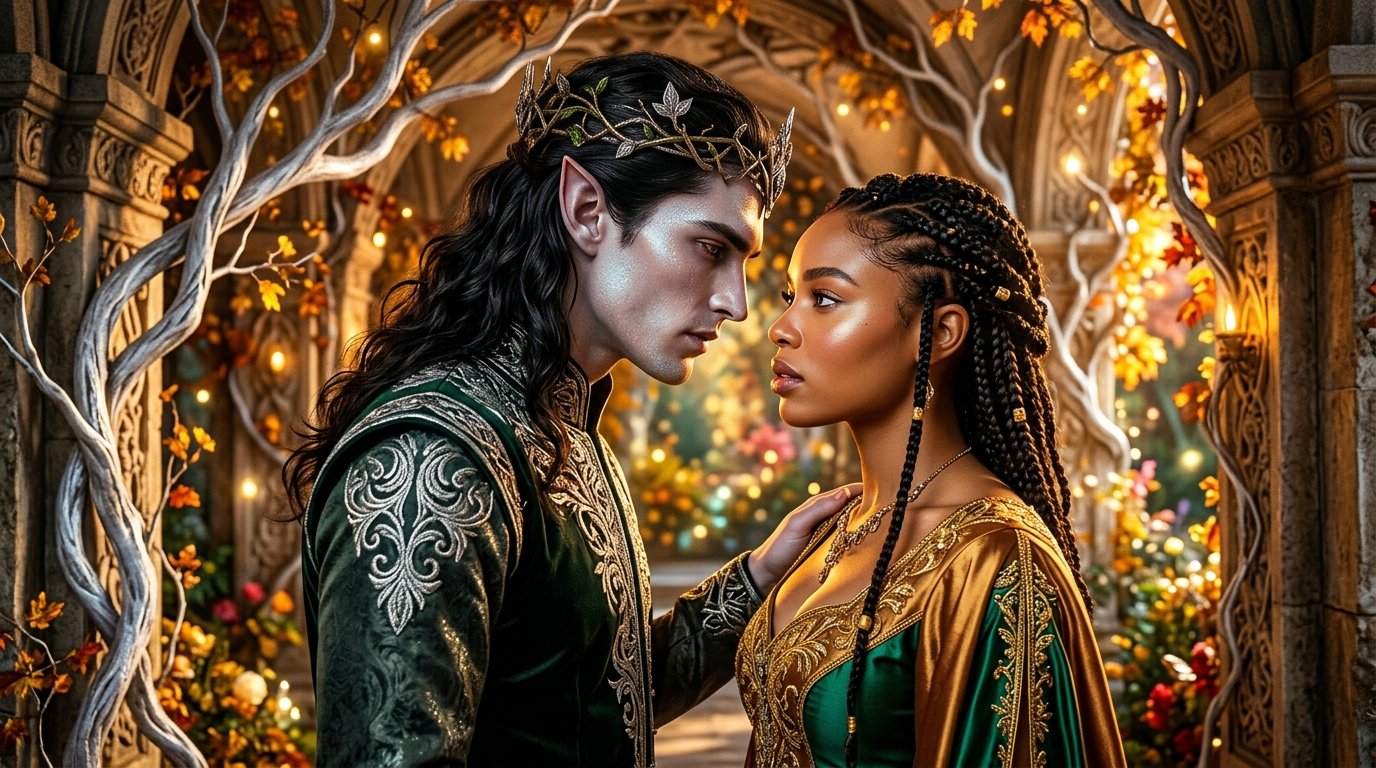
Chapter One: The Girl Who Should Not Be Here (A Fae King Romance)
THE KING'S CHOSEN A Novel of the Fae Courts

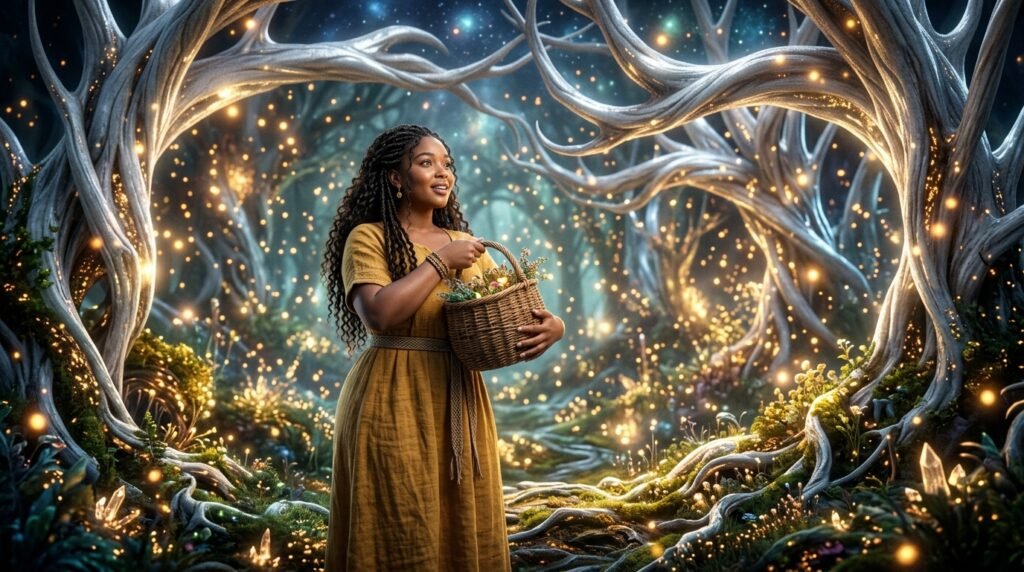
The forest did not want her there. A Fae King Romance
Mara Voss knew this the way she knew most things — quietly, in the space behind her sternum where instinct lived and logic rarely visited. The trees here were older than names. Their bark had gone silver-white in the moonlight, smooth as polished bone, and their roots rose from the earth in great arching knuckles, as though the ground itself had tried to swallow them whole and failed. The air smelled of something she had no word for. Sweet, yes. But also electric. Also ancient. Also wrong in the way that beautiful things sometimes were — the way a flame was wrong when you held your hand too close and felt the heat turn from pleasure to warning in a single heartbeat.
She should not have followed the lights.
Everyone in the village of Ashenmere knew this. It was the first thing mothers whispered to their children before sleep, the first rule stitched into the fabric of growing up on the border of the Fae Wood. Do not follow the lights. Do not eat what the forest offers. Do not step off the path after dark, no matter how lovely the music sounds, no matter how warm the glow looks against the cold.
Mara was twenty-three years old. She had heard the warning four hundred times if she had heard it once.
She had followed the lights anyway.
In her defense — and she was already constructing this defense, already rehearsing it for the moment she made it back to the village alive and her mother demanded an explanation — in her defense, she had not meant to. She had been walking the eastern path back from the mill, the one that ran along the outer edge of the wood where the trees were still ordinary, still oak and elm and ash with bark the colour of ordinary earth, still trees that did not watch you. She had been tired. Her back ached from the long hours bent over cloth, her fingers were raw from the needle, and the basket on her arm was heavy with the bolts of fabric her mother needed by morning.
She had not been looking for magic.
But then the light had appeared between the trees. A warm, honeyed gold, pulsing gently like a second heartbeat, and before her mind had formulated the thought do not follow, her feet had already turned.
Three steps off the path. That was all it had taken.
Three steps, and the world she knew dissolved behind her like salt in rain.
Now she stood at the edge of something vast and incomprehensible, and she could not have said how long she had been walking or how far she had come from the path. The basket was still on her arm — she was holding it with both hands now, pressed against her middle like a shield, as though bolts of cotton and linen might somehow protect her from whatever this was.
Whatever this was.
She had no adequate framework for it. The word festival kept trying to surface in her mind, because there was feasting and music and light, but festival was far too small a word, too human a word, for what sprawled before her in the hollow between the silver trees. The clearing was enormous — she could not see its far edge — and it moved with life the way a river moved with current, constantly, fluidly, everything in motion and nothing still. Lanterns hung in the branches above, but they burned without flame, without wicks, their light a deep amber that cast the whole scene in the colours of late summer even though it was the cool heart of spring. Long tables had been laid with food that gleamed in ways that food should not, fruits that were the wrong colour, wines that shimmered, breads braided with flowers that were still blooming, still growing, threading through the loaves as though bread and blossom had decided to become a single thing.
And the people.
Mara’s breath left her in a slow, involuntary exhale.
She had grown up on the border of the Fae Wood. She had heard stories all her life. She thought she knew, in the abstract theoretical way one knew things one had never seen, what the fae looked like.
She had known nothing.
They were tall — most of them, though not all — and they moved with a liquid quality that reminded her of the way candlelight moved across water, all shimmer and shift, never quite solid. Their ears came to elegant points beneath hair that fell in every colour the natural world offered and several it did not: the deep green of pine needles, the burnished copper of autumn leaves, white as new snow, black as the space between stars. Their faces were — she wanted to say beautiful but the word felt inadequate, felt like calling the ocean wet. They were beautiful the way cliffs were beautiful, the way storms were beautiful, the way things that could destroy you were beautiful when observed from a safe distance. Cheekbones like architectural features. Eyes that caught the amber light and gave back colours it didn’t contain. Skin in every shade from deep brown to pale silver, some with patterns on their skin that moved faintly, like the shadows of leaves in a breeze.
Their clothing was extraordinary. Some wore gowns that seemed woven from actual moonlight, fabric that shifted and rippled without wind. Others wore armour that looked grown rather than forged, plates of bark and bone and something crystalline that she could not name. Still others wore almost nothing, their bodies adorned only with flowers and vines that twined around their limbs as living jewellery, responsive, moving gently.
They were laughing. Talking. Drinking. One pair was dancing in a space between the tables, their bodies moving to music Mara only now realised she could hear — low, complex, threaded through with a melody that seemed to bypass her ears entirely and go straight to somewhere deeper, somewhere behind her thoughts. She felt it in her molars. She felt it in the soles of her feet.
She should leave.
She could not move.
This was, she understood distantly, part of the problem. This was why the warning existed. Because when you saw them, when you truly saw them in their own space with their own light falling across their extraordinary faces, your body forgot that leaving was an option. Your body decided, on a level beneath reason, that whatever happened next, you would rather it happen here, in their proximity, than anywhere else in the ordinary grey world.
Move, she told herself. Turn around. Walk back the way you came. You do not belong here and they will notice you and when they do—
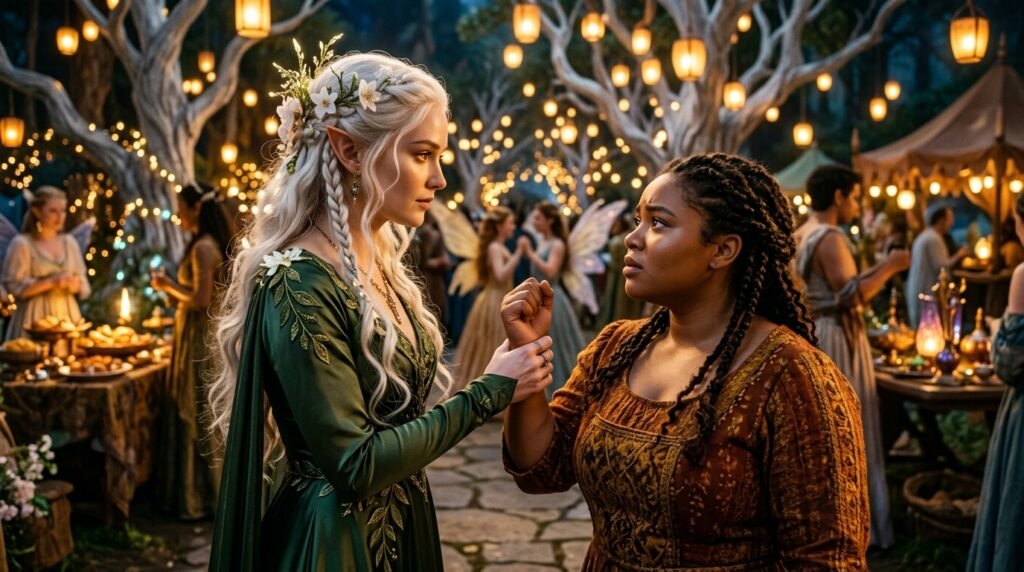
A hand closed around her wrist.
Mara did not scream, which surprised her. She made a sound — a short, strangled thing — and spun, and found herself looking up at a fae woman who was regarding her with an expression of almost clinical curiosity. The woman was tall, willowy, her skin a deep warm umber, her hair a mass of tiny white flowers woven through black braids that fell to her waist. Her eyes were amber, the same colour as the lantern light, and they moved over Mara with the focused assessment of someone cataloguing a problem.
“Human,” the woman said. Not an accusation. Just an observation. Like noting the weather.
“I—” Mara began.
“You followed the Midsummer lights.” Still not an accusation. Something almost like amusement moved through those amber eyes. “How far did you walk?”
“I don’t know.” This was true. Time had done something strange between the path and here. “I only meant to come a little way.”
“They all mean to come only a little way.” The woman had not released her wrist. Her grip was not painful but it was absolute — the kind of grip that communicated, politely but clearly, that Mara was not going anywhere until this woman decided otherwise. “You are on the Midsummer Grounds. Do you know what night this is?”
Mara looked around again at the feast, the lanterns, the extraordinary beautiful creatures filling the hollow. Something cold moved through her despite the warmth of the air.
“Midsummer,” she said.
“Midsummer Eve,” the woman corrected. “The one night of the year when the border thins and the lights are permitted to call out. They are not meant for humans. But humans do love to follow things they have been told not to follow.”
“I’m sorry,” Mara said. “I’ll go. I didn’t mean to intrude. If you’ll just—”
“Point you toward the path?” The woman tilted her head. “And if I do, and you walk out of here, what do you remember of what you’ve seen?”
Mara said nothing, because she understood that this was not a question with a good answer. She understood that she had walked into something with rules she didn’t know, and that the rules would apply to her regardless of her ignorance of them.
“I won’t tell anyone,” she said. “I have no desire to—”
“No.” The woman’s grip shifted, not tighter, but somehow more certain. “That is not the concern. The concern is what you carry out. Midsummer magic clings to those who walk through it. If you leave now, uncleansed, you will bring it with you. And what it does to a human life when it takes root…” She made a small sound. “It is not always cruel. But it is always permanent.”
Mara stared at her.
“So what does that mean?” she asked, because she was, at her core, a practical person, and practicality demanded that she understand her situation before she panicked about it. “What happens to me now?”
The woman seemed to consider her for a long moment, those amber eyes moving over her face with something that was not quite sympathy but was adjacent to it.
“It means,” the woman said, “that you must be presented. To the Court. To the King.” A pause. “It is the law. Any human who walks the Midsummer Grounds must be brought before the King of the Autumn Court before they can be released. He will decide what is to be done with you.”
The words what is to be done with you did extraordinary things to Mara’s heart rate.
“What are the options?” she asked, still practical, still fighting the panic down.
“Many,” the woman said, and the almost-amusement was back in her eyes. “Most of them not terrible. Come.” She turned, drawing Mara with her by that unbreakable grip. “I am Thessaly. I am the King’s First Steward. And you—”
“Mara,” Mara said. “Mara Voss.”
“Mara Voss.” Thessaly repeated her name with a slight, unreadable emphasis. “Come, then, Mara Voss. Try not to eat anything, touch anything, or agree to anything until you have spoken with the King.”
“Should I be frightened?” Mara asked, because she needed to know.
Thessaly glanced back at her over one elegant shoulder.
“You should be careful,” she said. “They are not the same thing.”
The crowd parted for Thessaly.
It parted the way water parted for stone — not because it was pushed, but because Thessaly moved with the absolute certainty of someone who had never once in her long life expected to be in anyone’s way, and the world accommodated this expectation. Mara, drawn along in her wake, was less certain of her reception. She felt the eyes landing on her the moment they moved into the heart of the clearing — felt them the way you felt sudden cold, that specific prickling awareness of being observed by many things at once. She kept her chin up. She did not know why she did this — it was not bravery, exactly, more a reflexive pride, the same thing that made her meet the eyes of the village women who looked at her body like a verdict. The same thing that had kept her spine straight through a lifetime of being looked at and found wanting.
She was a broad woman. This was a fact she had made her peace with through years of private negotiation and occasional hostilities. She had her mother’s build — wide shoulders, a generous waist, hips that the village dressmaker described diplomatically as full, a softness to her that no amount of physical labour had ever touched. She was not small. She had never been small. And in a world that frequently communicated its preferences about the size of women’s bodies, she had learned to carry herself as though her body were not a subject open for discussion.
Here, now, under the amber lanterns of the Midsummer Court, she felt those eyes moving over her with an intensity she had never encountered before. Not the familiar human assessment — not the narrowing judgment of village women, not the dismissive glance of men who had already decided — but something different. Something more like the way you looked at a thing you had never seen before and were not yet sure how to categorise.
She kept her chin up.
She followed Thessaly through the feast, past tables laden with that shimmering impossible food, past groups of fae who stopped their conversations to watch her pass, past a trio of musicians playing instruments she could not name that produced the bone-deep melody still resonating somewhere behind her thoughts. The music changed slightly as she moved through it, she noticed — or perhaps she was imagining it — seemed to shift toward something more minor, more questioning, like a song that had encountered an unexpected note and was deciding what to do with it.
They were heading toward the far end of the clearing, where the trees grew densest and the lantern light was richest, where the amber deepened toward gold and the air held that electric quality most intensely. There was a raised area there — not a platform, not built, but rather a natural elevation of the ground, a place where the earth had decided to lift itself slightly, and on this elevation there was a single chair.
Not a throne. Or — not what Mara thought of as a throne. There was no gold, no velvet, no rigid ceremonial grandeur. It was made of wood, living wood, she realised as they drew closer, a chair that had been grown rather than carved, its arms and legs the living branches of a tree that rose from the earth beneath it and arched overhead, lacing together into a canopy of dark leaves. Flowers grew in the joins of the branches — deep purple, almost black in this light, clustered thickly enough to look intentional. The whole thing breathed, she realised. Slowly, barely perceptibly, but the leaves moved and the branches shifted and the flowers turned their faces with the infinitesimal tracking of things that were alive and aware.
The chair was empty.
Mara noticed this with a complicated emotion she could not immediately name. Relief, yes. But also — she did not examine this closely — something that might have been disappointment. She had been bracing herself for something. For the culmination of whatever this was. The empty chair felt like a sentence left unfinished.
“He is here,” Thessaly said, as though reading her thought. “He does not often sit.”
Mara turned, following the direction of Thessaly’s gaze, and found him.
He was standing at the edge of the elevated ground, slightly apart from the small cluster of advisors and courtiers who hovered in his periphery, his back half-turned to the clearing, looking out toward the dark line of the trees beyond. He was speaking with someone — a tall male fae with silver hair who leaned close with the posture of someone conveying urgent information — but even in profile, even in the middle of a conversation, even standing still with his attention apparently elsewhere, he was the most present thing in the clearing.
Mara would struggle later to explain this. She had just walked through a crowd of extraordinary creatures, every one of them beautiful, every one of them magnetic in the way that the fae simply were, and she had kept her chin up and her eyes forward and felt their observation like weather, uncomfortable but manageable. But when she saw him, something in her chest did something she had no category for.
He was tall — taller than most even in this assembly of tall creatures — with a build that suggested not just height but density, a solidity to his frame that the other fae, for all their grace, didn’t quite have. He wore dark clothing, deep green-black, close-fitted, without ornamentation, which distinguished him immediately from the elaborate dress of his court. His hair was dark, the colour of bark in deep shadow, and it fell to his jaw in waves that were not quite tamed and not quite wild. His skin was a warm deep brown, and even in profile she could see the architectural severity of his features — the strong line of his jaw, the sharp angle of his cheekbone, the way his brow sat low over his eyes in a way that suggested either thought or intensity or both.
His ears came to fine points through his hair.
On one hand — the one not currently gesturing in response to something his advisor had said — he wore a ring of dark metal, set with a stone that was the same deep amber as the lantern light, and it pulsed once, slowly, as though breathing.
He was not, she thought, what she had expected.
She had expected something colder. More distant. The King of the Fae, in the stories, was always either terrifying or transcendently beautiful in a way that was its own kind of terror, remote as a winter sky, untouchable and uninterested. She had expected to feel small in his presence, smaller even than she normally did, crushed by the weight of what he was.
She did not feel small.
She felt — and this was strange, this was a strange and unaccountable thing — she felt seen, even though he had not looked at her yet.
Thessaly had stopped walking. They were perhaps twenty feet from where he stood, and the First Steward seemed to be waiting for him to conclude his conversation, and the Silver-haired advisor was still speaking in low, rapid tones, and Mara stood with her basket pressed against her chest and tried to remember how to exist normally in her body.
Then the advisor finished speaking.
And the King turned.
He turned with a movement that was almost casual, unhurried, the turn of someone who had decided to look at something and saw no reason to rush the decision. He turned, and his eyes found her immediately, without searching, as though he had known exactly where she was standing the whole time. As though he had perhaps been aware of her presence since before she reached the elevated ground.
His eyes were amber.
No — that was not right. She reached for the description and found it insufficient. They were amber in the way that fire was amber — with light behind them, with depth, with something that moved and shifted. The lantern light caught them and they gave back more than they received, gleaming with a warmth that was not simple or uncomplicated, that contained within it something she had no name for in a person she had known for three seconds.
He looked at her.
She looked back.
The music, she realised distantly, had changed again. Or perhaps it had stopped. She could not be certain.
For a long moment — a moment that stretched in the strange elastic way of moments that matter — neither of them moved. His expression was not what she expected either. She had braced for the cool assessment of a ruler examining a trespasser, for the slight contempt of a powerful creature confronted with an ordinary human woman who had stumbled into his domain and disrupted his evening. She had braced for dismissal.
His expression was not dismissal.
She could not name it. It was too complex for the name she wanted to give it, and she did not know him well enough to read it accurately, and she was also, she admitted to herself, having some difficulty thinking clearly. It was the music. It was the magic in the air. It was the amber eyes that had not yet left her face.
He took a step toward her.
Not many — just one, a single unhurried step that brought him fractionally closer, that shifted the geometry of the space between them in a way she felt rather than measured.
Then, to her right, a voice said: “Caelum. The Vanthorpe delegation is waiting.”
The King — Caelum, she filed the name somewhere deep — did not look toward the voice. He continued looking at her for one more breath. Two.
Then he said, without looking away: “They can wait longer.”
A ripple of surprise moved through the courtiers nearby. Mara registered this distantly — the exchanged glances, the barely-suppressed reactions — but she could not look away from him to observe it properly.
“My lord—” Thessaly began.
“Who is she?” he said.
Not to Thessaly. To Mara. His eyes still on hers, direct and absolute as a hand extended in greeting.
Mara’s chin was still up. She did not know when she had decided that it would stay up, but the decision had apparently been made somewhere below the level of conscious thought, in the same place where she had decided, years ago, that she would not apologise for taking up space. She looked back at the King of the Autumn Court and she said, clearly, steadily:
“Mara Voss. I followed the Midsummer lights. I know I shouldn’t have. I’m prepared to accept whatever the appropriate consequence is, provided it doesn’t involve anything permanent or fatal.”
Something happened to his expression.
She would spend a great deal of time afterward trying to name it. It was too fast — a flicker, a shift — there and gone before she could catch it properly. But whatever it was, it lived at the intersection of surprise and something warmer than surprise, and it transformed his face for one unguarded moment into something that was not the face of a king at all.
He almost smiled.
She was nearly certain he almost smiled.
“Mara Voss,” he said. Repeating her name the way Thessaly had, but differently — with a weight that Thessaly’s repetition hadn’t carried, a careful quality, like someone testing the balance of a thing before trusting it with pressure. “Who told you about the consequences?”
“Your steward,” she said. “On the way here.”
“And you are not frightened.”
“I didn’t say that.” She held his gaze. “I said I was prepared.”
This time the smile was not almost. It was brief, controlled, contained within the span of a single breath, but it was real, and it did something to the severity of his face that she was not prepared for. It made him look younger. It made him look, for that instant, like someone who was genuinely, unexpectedly pleased.
He looked at her for one more long moment. Then he turned to Thessaly.
“See that she has everything she needs,” he said. “Food, drink — real food, Thessaly, nothing that binds — a place to sit. I will speak with her before the night ends.”
“The Vanthorpe delegation—” Thessaly began again.
“Can wait,” he said again, with the absolute, effortless finality of someone who had never once in his life needed to raise his voice to be heard.
He looked at Mara one more time.
“Do not leave,” he said.
It was not a question. It was not quite an order. It lived in the space between the two, and it looked at her with those amber eyes that gave back more light than they received, and Mara, who had spent her entire life resisting the things people told her to do, stood with her chin up and her basket against her chest and said nothing.
Because she found, to her deep unease, that she did not want to.
They gave her food that was real — bread and butter and something that tasted like apple and honey, all of it familiar and ordinary, a small island of the human world in the middle of this extraordinary one. They gave her wine that Thessaly confirmed, somewhat formally, contained no magic whatsoever, which Mara found both reassuring and faintly hilarious given the source. They gave her a seat at the far edge of the feast, slightly removed from the densest part of the crowd, and the crowd respected this distance for approximately four minutes before the curiosity overrode politeness and they began to drift closer.
She watched them the way she watched the customers who came to her mother’s shop — the ones who looked at the fabrics and thought they were hiding their desire but weren’t, who touched the cloth with reverent fingers and tried to act as though the touching were casual. The fae who drifted into her orbit did it in the same way, sidling, pretending to be interested in other things, letting their extraordinary eyes slide over her in quick assessments that they seemed to believe she wasn’t noticing.
She was noticing.
She was also, she admitted to herself, watching him.
This was not entirely intentional. He was simply very difficult not to watch. He had returned to the business of his court after that one brief, extraordinary exchange — was deep in conversation with the Vanthorpe delegation, whoever they were, three fae in silver-grey who spoke with the contained gestures of diplomats — and he was not looking at her. She was certain he was not looking at her. He had not looked at her since he walked away.
And yet she kept catching the angle of his jaw, the set of his shoulders, the way he stood in conversation differently from how she imagined a king was supposed to stand — not elevated and apart but present, leaning slightly forward, engaged. She kept noting the way the amber light moved over his dark hair. She kept noticing his hands, which were expressive when he spoke, which described things in the air with an unselfconscious fluency that contradicted the contained control of the rest of him.
She told herself this was reasonable. He was the King of the Fae. She was about to be brought before him for judgment. It was sensible to observe him.
She was not sure she entirely believed herself.
“You’re staring,” said a voice beside her.
She turned sharply to find a young fae male who had settled on the ground beside her seat without her noticing — young by what measure she could not say, since she had no framework for fae ages, but something about him read as young, or perhaps simply unguarded in the way of the young. He had green hair, the colour of new leaves, and eyes like polished bronze, and he was looking up at her with an expression that was cheerful and entirely too knowing.
“I’m observing,” she said.
“In his direction,” said the young fae. “Repeatedly.”
“He is going to pass judgment on me before the night ends. I am entitled to study him.”
The young fae grinned. He had pointed teeth, she noticed, very white and very sharp, which should have been unsettling and somehow wasn’t because the grin was so genuinely gleeful. “What’s your name?”
“Mara.”
“Human Mara who followed the Midsummer lights.” He settled more comfortably, crossing his legs. “I’m Fenn. I am, technically, a courtier, though I prefer to think of myself as a professional observer of interesting situations.”
“Is this an interesting situation?”
“Extraordinarily.” His bronze eyes moved between her and the direction of Caelum and the diplomats with obvious relish. “He didn’t finish his sentence, you know. When he saw you. Lorcan — that’s the silver-haired one — Lorcan was in the middle of telling him something about the border negotiations and Caelum just… stopped. Mid-sentence. Turned around. That does not happen.”
Mara took a careful sip of her magicless wine.
“I’m sure it was just the novelty,” she said. “A human blundering into the Midsummer Grounds. He was probably deciding how to handle the problem.”
Fenn looked at her with those bronze eyes that were far too perceptive for the cheerful expression they sat beneath.
“Yes,” he said, pleasantly. “I’m sure that’s all it was.”
She did not dignify this with a response. She returned to her bread and her observation — her sensible, practical observation — and did not look in the direction of the King of the Autumn Court for a full seven minutes, which was, she felt, a reasonable personal achievement under the circumstances.
On the eighth minute, she looked up.
He was looking at her.
Not the quick slide of the other fae, not the curious drift of courtiers checking their peripheral interest. He was looking at her directly, openly, with those amber eyes that she now knew could contain a smile before it reached his mouth. He was still in conversation — his body was still angled toward the delegation — but his face had turned, just slightly, just enough.
He was looking at her the way you looked at something you were trying to memorise.
Mara held his gaze for three seconds. Then, with enormous effort, she looked away.
Beside her, Fenn made a sound that was not quite a word but was eloquent regardless.
“Not a word,” she said.
“I said nothing,” he said, deeply pleased with himself.
The night deepened around the feast.
The music shifted and changed, sometimes fast and wild, driving the dancers between the tables into spiralling flights, sometimes slow and low and resonant, the kind that made you feel the hour in your bones. The food renewed itself on the tables — she watched this happen once, turning to look when she heard a sound that was not quite sound, a harmonic hum, and saw a platter of fruit simply bloom, the empty dish suddenly full again, as though time had reversed in that small concentrated space. The lanterns overhead remained steady, unflickering, and she had long since given up wondering what kept them burning.
She had stopped tracking time. This was, she suspected, partly the nature of the place — time in the Midsummer Grounds moved differently, she had heard this in stories, though she had imagined it as something dramatic, some obvious distortion, not this quiet dissolution of urgency. She was not worried about the hour. She knew, in the abstract, that she should be — her mother would be awake, the fabric would still be undelivered, the ordinary world had its own timeline and she was falling behind it — but the knowledge sat without weight, like a fact about someone else’s life.
She was not enchanted. She was almost certain she was not enchanted. Thessaly had given her unenchanged food and wine and had been scrupulously clear about this.
She was just — here. In the particular way that a place can hold you without magic, simply by being too full of light and sound and life to leave.
Fenn had drifted away sometime during the third change of music, called by someone across the feast with the kind of imperative that required no elaboration, and she had been alone since then — in the relative sense of alone that meant she was not currently in conversation with anyone, not that she was unwatched. She was very much watched. She had become, she understood, a subject of general interest. She could see groups of fae nobles — and they were nobles, she could identify this even without the vocabulary for fae hierarchy, could read the quality of their clothing and their bearing and the way they inclined toward each other with the specific body language of people sharing pointed opinions — she could see them watching her with expressions that ranged from curious to amused to something considerably less charitable.
She kept her back straight. She finished her bread.
“Mara Voss.”
She turned.
He was there.
She did not know how he had crossed the clearing without her noticing — or perhaps she had been too focused on the noble observers to track his approach — but he was there, standing perhaps five feet from her, without the delegation, without Lorcan, without the cluster of advisors and courtiers. Essentially alone, which struck her, even now, as significant. Kings did not move through their own courts alone.
He looked different at five feet than he had at twenty. At twenty he had been architectural, a feature of the landscape, the elevated ground and the living throne creating a frame that was designed to communicate power, distance, significance. At five feet he was simply — present. Real in the way that the bread had been real, that the wine had been real, in the way that things without enchantment were real, with an ordinariness beneath the extraordinary that surprised her.
He was still the most beautiful thing she had ever seen. But at five feet, the beauty was personal rather than general. It belonged to him rather than to the idea of him.
“My lord,” she said, because she had gathered, over the course of the evening, enough to understand she should probably say something acknowledging.
“Caelum,” he said. His voice was low, unhurried, with a quality she had not fully registered across twenty feet. A resonance. A depth. “You do not need to call me anything else tonight.”
She looked at him steadily. “Is tonight the only night that applies?”
Something moved in his eyes. Not the almost-smile — something more considered than that.
“That,” he said, “depends on choices that have not been made yet.” He looked at her with those amber eyes that she had been watching all evening from a distance and that were now close enough that she could see they were not simply amber — they were amber and gold and something deeper, something that lived beneath the colour like light at the bottom of a clear pool. “May I sit?”
She stared at him.
A king, asking permission to sit at her side.
“This is your court,” she said. “These are your grounds.”
“Yes,” he said. “Which is why I am asking rather than simply doing it.”
She moved her basket. He sat.
The conversation that followed was the strangest one she had ever had, and she had once spent four hours in debate with old Master Vance, the miller, about the philosophical implications of grain taxonomy, so her frame of reference was not entirely narrow.
He asked her about the village. He asked with genuine attention, leaning slightly forward in the particular way she had noticed during his conversation with the diplomats — the same quality of engagement, directed now entirely at her, at her descriptions of Ashenmere and the mill and the life she had lived on the border of the wood. He asked what she did and she told him about her mother’s shop, about the fabrics and the needles and the particular satisfaction of a seam that lay flat and straight, and he listened in a way that made her feel she was describing something significant rather than ordinary.
She asked him questions in return. This seemed to surprise him — or perhaps not surprise, but interest him, she was learning to read the nuances now, the difference between the still expression and the alive one. She asked about the Midsummer Gathering, about the tradition of it, about the lights and what they were. He told her they were a natural phenomenon, or as close to natural as anything in the fae world was — the Midsummer magic expressing itself, reaching out, drawn to openness and curiosity.
“So they find people who are likely to follow them?” she asked.
“They find people who are capable of wonder,” he said. “Which is not quite the same thing.”
She thought about this.
Around them, the feast continued its own life, and she was aware — peripherally, with the part of her mind she’d devoted to self-preservation since arriving — that they were being watched with extraordinary intensity. Every noble eye in the clearing had found reasons to face in this direction. She could feel the attention like pressure, like heat.
“They’re watching us,” she said.
“They are watching you,” he said. “And wondering what I intend.”
“What do you intend?”
He looked at her.
The amber eyes were very close now. The conversation had done what long conversations did — reduced the distance that courtesy maintained, brought them gradually into proximity, until she was aware of him at a specific, physical, molecular level that was distinct from simple sight. She could see the exact line where the lantern light touched his jaw. She could see the small, deliberate stillness he held himself in, the contained quality of him, and she understood suddenly that this was not coldness or distance — it was restraint. It was something held carefully.
“Tonight,” he said slowly, “I intend to ensure that you leave these grounds safely, that whatever Midsummer magic you’ve absorbed is properly settled, and that you are returned to your village without harm.” A pause. “Beyond tonight is, as I said, a question of choices.”
“Whose choices?” she asked.
The amber eyes did not look away.
“Both of ours,” he said.
Mara looked at him. At the King of the Autumn Court, sitting beside her in the lantern-light, at the edge of his own feast, without his advisors, asking her questions about seams and grain mills and the particular quality of life on the border of his wood. At the amber eyes that gave back more light than they received.
She thought about the warning she had heard four hundred times. Do not follow the lights.
She thought about the three steps off the path.
She thought about how, if she had not taken those steps, she would not be here. And that thought arrived with a feeling that was not simple or clean — not relief exactly, not joy, not anything she had good words for.
Just the sense of something beginning.
“You should probably deal with the Vanthorpe delegation,” she said.
He almost smiled.
“Probably,” he agreed.
He stood. He looked down at her — and the geometry of the thing shifted again, height and angle, the lantern light behind him, the leaves of his living throne visible above and behind, and he was the King again in the way he had been when she first saw him, that weight and presence, and she tipped her chin up to hold his gaze.
“Do not leave,” he said. Again. The same words, the same not-question, not-order. “Until I have spoken with my steward and made arrangements.”
She looked up at him.
“I’ll be here,” she said.
And she meant it, which was the part she found most alarming of all.
Thessaly found her twenty minutes later with the information that the Midsummer magic Mara had absorbed was, in the steward’s professional assessment, minimal and unlikely to cause permanent disruption, and that the King had arranged for a fae escort to walk her back to the path before dawn.
“Before dawn?” Mara said.
“The Midsummer Grounds begin to thin with the light,” Thessaly said. “If you are still here when the sun rises, the thinning is… unpleasant for humans. It is better to leave before.”
Mara looked around the clearing — at the feast, the lanterns, the extraordinary creatures who filled the hollow with their voices and their music. At Fenn, who had reappeared somewhere across the clearing and was watching her with undisguised interest. At the elevated ground and the living throne with its breathing branches.
At the King, who was back with his delegation, who was not looking at her.
Who had, once, tonight, looked at her like he was memorising her.
“Before dawn,” she agreed.
Thessaly looked at her with those amber eyes that saw too much.
“He will want to know your name,” the steward said. “Again. In a different context.”
“He already knows my name.”
“He knows the word,” Thessaly said. “He will want to know the name.”
Mara looked at her. “Is that a warning?”
The First Steward of the Autumn Court was quiet for a moment.
“No,” she said finally. “It is, I think, the opposite of a warning.”
They walked her out just before the sky began to grey.
The escort was Fenn, which surprised her — she had expected something more formal, more official — but Fenn seemed pleased with the assignment in his guileless, unguarded way, chattering as they walked back through the silver trees about the history of the Midsummer Gathering, about the thinning of the borders and the nature of the lights and approximately fourteen other things she would need weeks to fully process.
She was almost at the path when he stopped.
“Mara,” he said, and his voice had shifted, lost some of its cheerfulness — not seriously, but meaningfully, the way voices shifted when something true was being said.
She turned.
“He has not looked at anyone the way he looked at you,” Fenn said, “in a very long time.”
She held the young fae’s bronze eyes.
“He is a king,” she said. “And I am a seamstress’s daughter from Ashenmere who walked off a path she should have stayed on.”
“Yes,” Fenn said. “And he is also the person who stopped a sentence mid-word when you walked into his clearing, and who sat beside you for an hour when he had a delegation of three frustrated diplomats waiting for him, and who said ‘both of ours’ when you asked about choices.” He tilted his head. “I do not think ‘king’ and ‘seamstress’s daughter’ are the categories that matter here.”
Mara looked at him for a long moment.
Then she looked back at the silver trees, at the fading amber glow of the Midsummer lights still visible between the branches, at the world she was about to step back into — ordinary, greyish, without lanterns that burned without flame or music that lived in your bones.
“Good night, Fenn,” she said.
“Good morning,” he corrected, cheerful again. “And Mara—”
She was already stepping onto the path.
“—he is going to send for you.”
She walked.
The path was exactly where she had left it. Ordinary earth, ordinary dark, the trees around her oak and ash and elm again, bark the brown of common earth. The basket was still on her arm. The fabric inside was slightly damp with the night air but otherwise undamaged.
Ahead, the lights of Ashenmere.
Behind, the Midsummer Wood, and the feast, and the amber lanterns, and the King who had asked permission to sit beside her, and the sound of his voice saying her name for the first time with that careful, weighted quality, as though her name were a thing of value being handled with appropriate care.
He is going to send for you.
Mara walked toward her village in the grey pre-dawn, and her chin was up, and her hands were steady on the basket, and somewhere in the space behind her sternum where instinct lived, something was turning over slowly, examining itself, uncertain and unsteady and more alive than it had been this time yesterday.
The forest did not want her there, she had thought, at the beginning of the night.
She was no longer sure that was true.

This is so good Ebony Stories, I enjoyed reading 💯😘🔥🔥🔥