
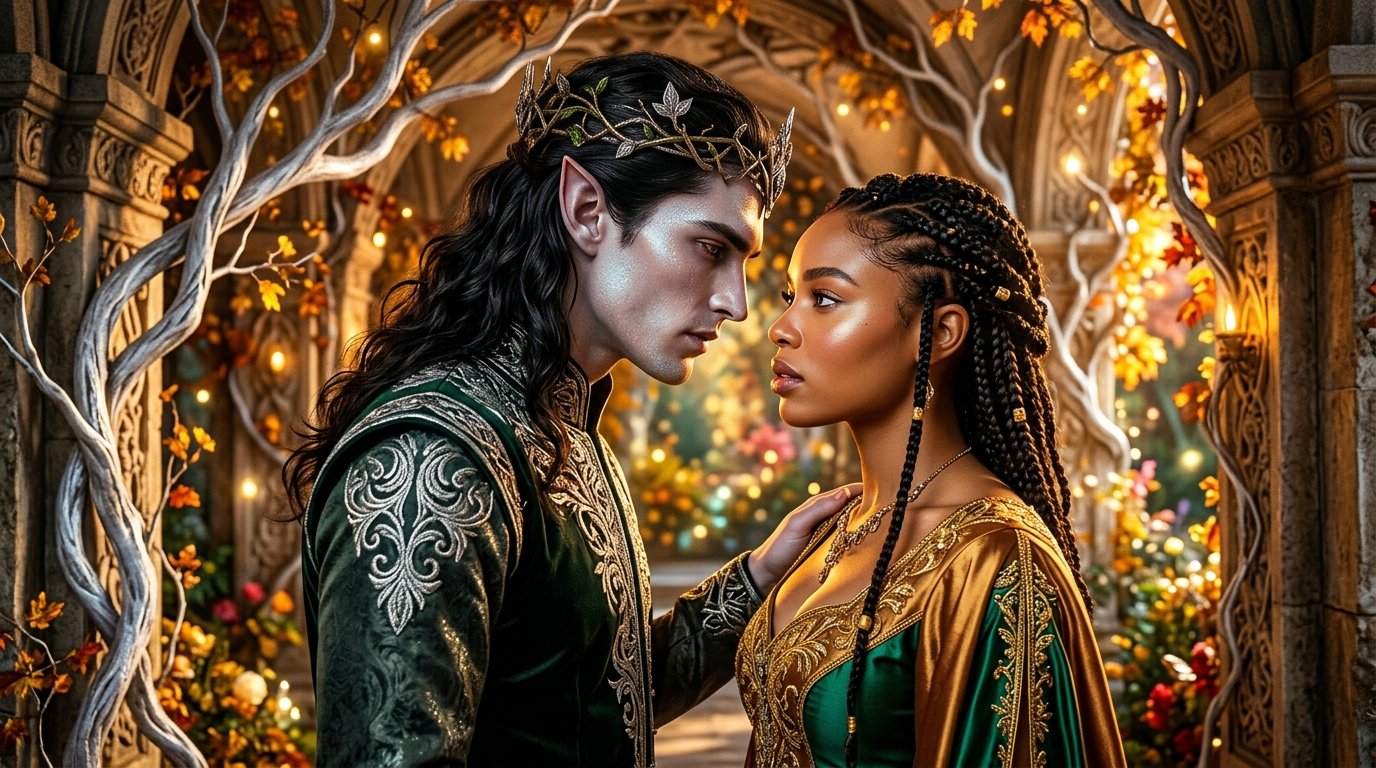
Chapter Two: Fae Court Whispers
THE KING'S CHOSEN A Novel of the Fae Courts

The village of Ashenmere woke the way it always did — gradually, practically, without ceremony.
The mill started first. Old Master Vance never slept past the fourth hour regardless of season, and the sound of the wheel was so constant, so foundational to the rhythm of the village, that most of its three hundred residents had long since stopped hearing it the way you stopped hearing your own heartbeat. Then the baker’s chimney began to smoke. Then the livestock. Then the slow accumulation of voices and footsteps and wooden shutters thrown open against the morning light that constituted, collectively, Ashenmere deciding to be awake again.
Mara had not slept.
She sat in the back room of her mother’s shop — the room where the good fabrics were kept, rolls of linen and wool and the occasional bolt of silk that came in from the southern traders, propped against the walls in careful order by colour and weight — and she sat among them on the low stool her mother used for the close work, and she watched the grey light through the small window graduate from dark to pale to something approaching gold, and she tried to think clearly.
This was more difficult than usual.
Her mind kept returning to the Midsummer Grounds with the irritating persistence of a splinter — every time she pushed it away, it surfaced again, bringing with it specific sensory details she did not need and could not stop accessing. The amber lanterns. The music that lived in her molars. The way the fae nobles had watched her with their various expressions of curiosity and assessment. Fenn’s bronze eyes and guileless grin. Thessaly’s unreadable amber ones.
And Caelum.
Caelum, who came to sit beside her without ceremony, without announcement, without the apparatus of kingship, and asked her about seams.
Caelum, who had not finished his sentence.
She pressed the heels of her hands against her eyes and breathed slowly and performed the mental exercise she had developed over years of managing the gap between what she felt and what was sensible to feel. She inventoried the facts. Fact: she had accidentally trespassed on the Fae King’s Midsummer Grounds. Fact: she had been assessed and found harmless and escorted back to the path without incident. Fact: a very beautiful, very powerful, very ancient and extraordinary creature had spoken with her for an hour because it was his lawful obligation as king to deal with trespassers personally. Fact: she was a seamstress’s daughter from Ashenmere with a delivery to make and a mother to face and a life that had not changed simply because she had stepped off a path for one strange and impossible night.
These were the facts.
She sat with them.
Then she put down her hands and looked at the window and said, very quietly, to no one:
“He said both of ours.”
This was not a fact. This was the problem.
Her mother found her there at full light, which was when Reva Voss typically descended to the shop to begin the day’s work, and which was when she found her daughter sitting on the work stool looking as though she had been awake all night, the bolts of fabric still undisturbed on the shelves, the delivery basket sitting on the cutting table with the cloth inside not yet pressed or folded or in any way prepared.
Her mother was a small woman. This was one of the great injustices of Mara’s youth — she had inherited her father’s family’s breadth, her father who had left when she was seven and about whom they did not speak, and not her mother’s fine-boned slightness. Reva Voss was narrow and quick and brown-eyed and contained, with calluses on her fingers from forty years of needlework and a gaze that missed nothing. She stood in the doorway of the back room and looked at Mara and said:
“Where were you.”
Not a question. The inflection was all wrong for a question.
“The eastern path,” Mara said. “It took longer than expected.”
“The fabric is not pressed.”
“I know.”
“Healer Sondra needs it by midmorning.”
“I know, Mama. I’ll press it now.”
Her mother looked at her for a long moment with those nothing-missing brown eyes. Then she came into the room and picked up the basket and began to examine the contents with the methodical care of someone who had been checking fabric for flaws since before Mara was born.
“You look like you haven’t slept,” she said.
“I haven’t.”
“Why.”
Mara considered how to answer this question. She was not, in general, a person who lied to her mother — they had arrived, through years of friction and negotiation, at a form of communication that involved a great deal of silence and implication and very little outright deception. Her mother was not easy to deceive. And her mother had grown up on the border of the Fae Wood the same as everyone else in Ashenmere and had heard the warnings and given the warnings and had once, when Mara was twelve, held her by both arms and said listen to me, Mara, the wood is beautiful and the wood is real and the wood will take you if you let it, do you understand me, with an intensity that had left Mara slightly shaken.
“I took a wrong turn,” she said carefully. “On the path.”
Her mother’s hands went still on the fabric.
“A wrong turn,” Reva Voss said, with a tone that could have stripped paint.
“I didn’t eat anything,” Mara said. “Or drink anything that— nothing happened to me, Mama. I was escorted back to the path before dawn. I’m fine.”
Her mother set down the basket. She turned. She looked at Mara with an expression that was doing a great deal of work — a whole conversation’s worth of emotion being conducted entirely through the medium of brown eyes and the particular set of her mother’s mouth.
“How far did you go,” she said finally.
“Far enough.”
“Mara.”
“I’m fine,” she said again, and meant it. “I was brought before — there is a procedure, apparently, for humans who wander in. A law. It was all very formal and I was treated courteously and I was brought back to the path before the sun rose.” She met her mother’s eyes. “I am not enchanted. I am not bound. I am sitting here in your back room in the ordinary morning and nothing has permanently changed.”
Her mother looked at her for a very long time.
“Nothing,” she repeated.
Mara thought about amber eyes that gave back more light than they received.
“Nothing that affects you,” she said. “Or the shop. Or anything in the village.”
This was, she noted privately, not the same statement as the first one. But her mother did not appear to notice the substitution, or chose not to. She turned back to the basket. She began, with the careful efficiency of long habit, to press and fold the cloth for Healer Sondra.
“Help me with this,” she said. “And then sleep. You’re no use to me half-dead.”
Mara got up from the stool.
“Yes, Mama,” she said.
She did sleep, eventually, through the middle hours of the day, on the narrow bed in her room above the shop while the village went about its business below her window. She slept deeply and without dreams that she could remember, and woke in the late afternoon to find the room gilded with slant light and her body reminding her, firmly, that she was a person with a back that ached and fingers still raw from yesterday’s needlework, a person with a physical existence that required maintenance.
She lay in the golden light and stared at the ceiling and felt, with great clarity, the full strangeness of what had happened.
She had been inside the Midsummer Grounds. She had sat at the feast of the Autumn Court. She had spoken for an hour with the King of the Fae, who had asked to sit beside her, and who had looked at her with amber eyes that she was certain, now, in the honest privacy of her own room, she would never fully stop seeing.
He is going to send for you, Fenn had said.
She turned this over.
The sensible response to this information — the response of a practical woman who understood her place in the order of things — was to consider it a pleasantry. A courtier’s offhand comment made to a human trespasser to soften the strangeness of the night. An unlikely kindness. Not a prediction.
She was a practical woman. She told herself this regularly and believed it most of the time.
She stared at the ceiling and she did not entirely believe it now.
Three days passed.
Three days in which Mara pressed fabric and ran deliveries and listened to her mother’s instruction on the fine points of a lapped seam and ate supper at the ordinary table and went to bed at ordinary hours and did not, deliberately did not, take the eastern path.
On the fourth day, the Court began to talk.
She did not know this immediately. She was not, at first, aware of the gossip moving through the Autumn Court like current through water, jumping from noble to noble with the speed and enthusiasm that only truly extraordinary information achieves. She did not know that by the second morning after Midsummer, every person of consequence in Caelum’s court knew that the King had spent an hour of his own Midsummer feast sitting beside a human woman — a common one, apparently, no family of note, a border-village girl who worked in a seamstress’s shop — while the Vanthorpe delegation cooled its collective heels and three other matters of court business went unaddressed.
She did not know that the Court’s First Lady, the Duchess Imerial Vayne, had reacted to this information with such a precise, controlled expression of displeasure that three of her attendants had instinctively stepped backward.
She did not know that Lord Lorcan — the silver-haired advisor she had noticed speaking with Caelum on the night — had gone to the King the morning after Midsummer and had a conversation that lasted, by various accounts, either forty minutes or three hours depending on who was doing the accounting, and had emerged from it looking like a man who had been handed a problem he had not the tools to solve.
She did not know any of this for four days.
On the fifth day, she went to the market, and she knew.
The Ashenmere market was a modest affair by the standards of larger towns — a cluster of stalls around the well at the village centre, mostly farmers and the occasional traveling trader, nothing that would have impressed anyone from outside the border country. But it was the heart of the village’s social life, the place where information moved, and Mara had been attending it since she was old enough to carry a basket on her own.
She knew, within sixty seconds of arriving, that something had changed.
It was in the way Mrs. Aldren looked at her — Mrs. Aldren who ran the egg stall and who had known Mara since birth and who looked at her now with an expression that was partly surprise, partly something more complicated, before rearranging her face into a careful pleasantness. It was in the way the conversation at the grain merchant’s stall stopped when she passed and resumed at a lower register. It was in the way young Sela from the tanner’s stopped and stared with her mouth slightly open before being nudged sharply by her older sister.
Mara bought her eggs. She bought the thread her mother needed. She kept her face still and her pace unhurried, because she had spent a long time learning not to give observers the satisfaction of a reaction, and she was very practiced at it.
It was at the bread stall that Danna Whitmore found her.
Danna Whitmore was forty-five, loud, kind in the way of people who had decided long ago that life was too short for subtlety, and the closest thing Mara had to a friend in Ashenmere outside her mother’s orbit. She appeared at Mara’s shoulder with the specific energy of someone who has been waiting to deliver information and has reached the limit of their patience.
“Tell me it’s true,” she said.
“Tell me what’s true,” Mara said, examining a loaf.
“That you were in the Wood on Midsummer night and the Fae King himself sat with you for an hour.”
Mara set down the loaf. She turned. She looked at Danna.
“How,” she said, “do you know that.”
“Because Pedder Crane’s boy was coming back from the northern farm after dark and he heard the music and he crept close enough to see and he saw the King — he saw him, Mara, said he was unmistakable, there’s not another one like him — sitting with a human woman at the edge of the feast, just the two of them, talking, and then the next morning his sister’s friend who lives closer to the Wood border says she heard from one of the fae who comes to trade at the southern crossing that the entire court is—” Danna paused for breath. “That the entire court is talking about it.”
Mara looked at her steadily. “The entire court.”
“That’s what she said.”
“The fae court.”
“Yes, Mara, that’s the one there is.”
She turned back to the bread. She selected a loaf. She was very calm. She was a practical woman and she was very calm.
“What,” she asked carefully, “is the fae court saying.”
Danna’s expression shifted into something that was half excitement and half the particular apprehension of someone about to deliver information they know will not be received simply.
“That the King has not — that he has never — Mara, from what this woman understood, the King has not paid that kind of attention to anyone, man or woman or anything else, in living memory. And fae memory is—”
“Long,” Mara said.
“Very long.”
Mara paid for her bread. She adjusted the basket on her arm. She looked at Danna Whitmore, who was watching her with an expression of breathless anticipation that Mara found equal parts touching and alarming.
“It was one conversation,” she said. “At a feast where I was technically a legal matter he was obligated to deal with. That is all it was.”
Danna looked at her. “Is that what you believe?”
Mara thought about amber eyes. About both of ours.
“It’s what I know,” she said, which was, technically, the truth.
Danna opened her mouth.
“Not another word,” Mara said, and walked.
By the end of that week, the gossip in Ashenmere had achieved a life of its own, as gossip does — had expanded and elaborated and taken on the specific narrative shape that communities impose on any story that has the word king in it. She heard versions of the night that bore a diminishing resemblance to her actual experience: versions in which the King had danced with her, had given her gifts, had declared intentions of a highly specific and romantic nature. She heard, from three separate sources, that the fae court was in an uproar. She heard, from Pedder Crane himself, who was either blessed with excellent sources or a very confident fabricator, that the King’s council had called an emergency session.
She pressed fabric. She ran deliveries. She kept her chin up and her expression neutral and she did not go near the eastern path.
On the ninth day after Midsummer, she had just come in from a delivery to Healer Sondra’s when her mother called to her from the front of the shop, and there was a quality in her mother’s voice that made Mara stop with one foot still on the doorstep.
She came through.
There was a fae at the door.
Not Fenn. Not Thessaly. A stranger — tall, formal, dressed in the deep green and dark gold of Autumn Court livery, with the contained, impassive expression of someone performing an official function. He stood in the doorway of her mother’s shop with the careful stillness of a creature who was aware of the effect his presence was having on the human woman standing six feet away from him with both hands gripping her sewing basket until her knuckles went white.
He looked at Mara.
He produced, from within his coat, a letter.
The seal on it was wax the colour of amber, pressed with a mark she had not seen before — a tree, she thought, bare-branched, intertwined with something flowing, a river or wind or magic made visible.
“For Mara Voss,” he said. His voice was even, formal, without inflection. “From the Court of the Autumn King.”
The silence in the shop was profound.
Mara looked at the letter.
She thought about Fenn’s bronze eyes. About the particular, knowing quality of his voice when he had said: he is going to send for you.
She crossed the room and took the letter from the fae’s hands. He inclined his head slightly — not a bow, but acknowledgment — and then he was simply gone, the way the fae were sometimes simply gone, with a completeness that left no transitional moment.
Mara stood with the letter in her hands.
Behind her, she heard her mother set down her scissors with the slow deliberation of someone choosing not to drop them.
“Mara,” Reva Voss said.
“Mama.”
“What is that.”
“A letter.”
“From.”
A pause. “The Autumn Court.”
Another pause, longer, with more weight.
“Open it,” her mother said. The voice was very controlled. “Please.”
Mara broke the seal.
The letter was written in a hand she somehow knew was his — not because she had any reference for his handwriting, but because it looked the way his voice had sounded, unhurried, deliberate, each word sitting in its space as though it had been placed rather than written.
It did not read the way she expected a summons from a king to read. She had expected formality — had expected the official language of courts and legal obligations, the procedural vocabulary of fae law. The letter was none of those things. It was direct and personal and it said:
Mara Voss —
There are matters related to the Midsummer encounter that require formal resolution, as my First Steward will confirm if you ask her, and she can be reached through the southern wood-crossing at any hour. This is true.
It is also true that I have thought about our conversation with a frequency and attention that I have no official justification for, and that I have been advised, by three separate people whose counsel I generally respect, that sending this letter is inadvisable.
I am sending it anyway.
You told me you were prepared rather than frightened. I find myself hoping you are still so.
I am asking you to come to the Court — not as a matter of law, though the legal framing is available if it is more comfortable — but because I would like to continue a conversation that ended before I was ready for it to.
The choice is yours. It will always be yours.
— Caelum
Mara read it twice.
Then she folded it carefully along its original crease and held it in both hands and stood very still for a moment while the ordinary shop settled around her — the bolts of fabric on their shelves, the cutting table, the smell of beeswax and linen and her mother’s particular rosewater.
Her mother was very quiet behind her.
“Well?” Reva said, at last.
Mara turned around.
She looked at her mother — small, sharp, brown-eyed, the woman who had held her by both arms at twelve years old and said the wood will take you if you let it. The woman who had raised her alone and had made the shop work through two bad winters and a drought and had never, in Mara’s memory, let anything take her by surprise without preparing for it first.
Her mother was looking at her with an expression she could not immediately categorise. Not the alarm she had expected. Not the carefully controlled panic she had braced for.
Something more complex than that.
“It’s from the King,” Mara said. Unnecessarily.
“I gathered.”
“He’s asking me to come to the Court.”
Her mother was quiet for a moment. “Is it a summons?”
“No.” She looked at the folded letter. “He says the choice is mine.”
Another silence.
“Do you want to go?” her mother asked.
And this was the question. This was the question underneath all the other questions, the one she had been not-asking herself for nine days while she pressed fabric and ran deliveries and kept away from the eastern path. Not should you go, not is it wise, not what does this mean and what will the village say and what will become of the shop while you’re gone. Just: do you want to.
Mara looked at the letter in her hands.
She looked at the seal — the bare tree, the flowing line, the amber wax.
She thought about a conversation that had ended before she was ready for it to, which was how he had described it, which was also, she realized, entirely accurate.
“Yes,” she said.
Her mother made a sound that was not quite a sigh and not quite the sound of a woman resigning herself to a thing she had feared since her daughter was twelve years old. Something between the two.
“Then you should go,” Reva Voss said. “But Mara—” She stopped. She began again. “Be careful.”
“I know.”
“Careful,” her mother said again, with a weight that encompassed a great deal more than the word usually held. “Not frightened. Careful.”
Mara looked at her.
“I know, Mama,” she said. “I know the difference.”
The response she sent was brief. She wrote it three times before she was satisfied, and the final version said:
Caelum —
The formal framing is unnecessary. I am coming because I want to, which I think we have both already understood.
I will need directions, as the Midsummer lights are seasonal and I prefer not to wander again.
— Mara Voss
She brought it to the southern wood-crossing at first light, which was a place she had known all her life as a theoretical location — the place where the fae came to trade, where the occasional border-dweller left offerings on Solstice nights, where the boundary of the ordinary wood was marked by a pair of trees so much older and taller than their neighbors that they had become a kind of doorway, framing a dark slot of air between them.
She left the letter folded at the base of the right-hand tree and walked home and did not look back, which required approximately the same amount of effort as everything else she had been doing for the past nine days.
The directions arrived before noon.
Not a letter this time — a small piece of bark, smooth on one side, with a path drawn in silver ink that was still faintly warm when she picked it up from the doorstep. The path was detailed and precise, marked with landmarks she recognized from the eastern walk — the triple-forked oak, the stream crossing, the old stone that sat in the middle of nowhere doing nothing obvious — and it ended at a door she had never seen marked on any map of the wood.
On the back of the bark, in that same unhurried hand:
The path is open for you from this day. Three days hence, if you are willing.
I will have Thessaly meet you at the door.
— C
Three days.
She had three days to think about what she was doing.
She spent one day thinking about it and two days trying to stop thinking about it and doing useful, practical things like helping her mother reorganize the back room and completing a mending commission and walking the village with Danna Whitmore, who extracted absolutely zero additional information from her because Mara had spent years developing excellent defenses against Danna’s particular brand of affectionate interrogation.
She packed a small bag on the evening of the second day. She sat on her bed and looked at it and felt the strangeness of the thing — a seamstress’s daughter from Ashenmere packing a bag to visit the Fae King’s court because he had sent a letter saying he wanted to continue a conversation.
The choice is yours, he had written. It will always be yours.
She thought about the things that meant. She was not naive — she understood that a fae king expressing interest in a human woman was not a straightforward or casual thing. She had heard enough stories to know that the involvement of the fae in a human life rarely ended in the middle — it ended in transformation or tragedy or something so outside the ordinary that ordinary ceased to apply. She knew this.
She also knew that she was twenty-three years old and she had spent twenty-three years on the border of a wood that was full of something extraordinary and she had spent twenty-three years being told not to follow the lights and she had followed them anyway and what had happened was not tragedy and not transformation but an hour of conversation with a man — a being — who had asked about seams and listened like it mattered.
She picked up the bag.
She set it by the door.
She did not sleep well. She lay in the dark and listened to the ordinary sounds of Ashenmere and thought about the fae court and what it would be like to walk into it in daylight — not at the magical threshold of Midsummer, with its amber lanterns and its particular enchantment, but in the ordinary light of a regular day, as herself, as Mara Voss.
She thought about what the court must be saying.
She had heard the gossip from Ashenmere — the human border-village gossip, which was already embroidered beyond recognition. She had some sense of what it meant that Caelum had sat beside her, that he had sent a delegation to silence and an hour to conversation. She understood, in the peripheral way of things heard but not fully processed, that this was not usual. That the fae court observed its king with the close attention of courts everywhere and that the attention he had given her had been noticed and was being discussed with the focused energy of a community that had found a subject that mattered.
She wondered what they thought of her.
She thought she probably already knew.
She had seen it in the faces of the nobles at the feast — the quick assessments, the exchanged glances, the cool and measuring looks. She was human, which was already a complication. She was common-born, which was another. And she was — herself. Her body, her face, her presence, all of the things she had been quietly managing other people’s reactions to for most of her life.
She lay in the dark and she was honest with herself, because private honesty cost nothing and she had always believed in it.
She thought: they will look at me and find reasons. They will look at me and construct arguments. They will look at me and be unable to understand, and from that inability they will build something sharp.
She thought: this is not new. I have managed sharp things before.
She thought about Caelum’s voice saying the choice is yours.
She thought about the amber eyes.
She closed her eyes.
On the morning of the third day, she rose early, dressed practically, ate the bread her mother had left on the table — her mother, who had hugged her the night before with a tightness that said everything the words hadn’t — and picked up her bag.
She took the eastern path.
At the triple-forked oak she bore left, as the bark-map indicated. At the stream crossing she stepped on the flat stones her map had marked rather than the mossy bank. At the old stone she paused, because the bark-map indicated a pause, and looked at the trees ahead, which were the silver-barked ancient ones, the bone-pale trees of the deeper wood, and breathed in the air that smelled of sweet and electric and ancient.
The door was where the map said it would be — and it was genuinely a door, which she had half-expected to be metaphorical and was not. It stood between two silver trees as though it had grown there, dark wood, taller than a man, with no handle visible and no hinges and no frame except the trees themselves.
Thessaly was waiting.
The First Steward of the Autumn Court stood to the left of the door with the same composed, amber-eyed quality Mara remembered from Midsummer — the particular stillness of someone who had been waiting for a specific thing and had been entirely prepared to wait longer. She looked at Mara, and Mara looked at her, and something that was not quite a smile moved through Thessaly’s expression.
“Mara Voss,” she said.
“Thessaly,” Mara said.
“You came.”
“I said I would.”
Thessaly regarded her for a moment. Then: “I want to prepare you for some things. Before we go in.”
“All right.”
“The Court knows you are coming. There was no way to prevent this — the King’s correspondence is observed, and the summons became known almost immediately.” A pause. “There are factions who are already opposed to your presence. They will not express this to you directly today, because the King has made his expectations clear. But you will feel it.”
Mara held her gaze. “I expected as much.”
“There is a woman,” Thessaly said carefully, “named Imerial Vayne. She is the Court’s First Duchess and she is, by any reasonable accounting, the most politically powerful noble in the Autumn Court outside the King himself. She has — expectations. Regarding the King’s future. She has held these expectations for a long time and has invested considerably in them.” Another pause. “She will be gracious to your face today.”
“And less gracious otherwise.”
“Yes.”
“I’ll manage,” Mara said.
Thessaly looked at her with those amber eyes that saw too much, and the not-quite-smile returned.
“I believe you will,” she said. “One more thing.”
“Yes.”
“He is — ” Thessaly stopped. Reconsidered. “He has been difficult to be around for the past nine days. His council has noticed. I am telling you this not to create expectation but simply as context.”
Mara looked at her.
“Difficult how?” she asked.
“Distracted,” Thessaly said. “Present in body. Less reliably present in mind.” The amber eyes were steady, direct. “He is not a man who is frequently distracted.”
The morning air moved between the silver trees with a sound like breath.
“Thessaly,” Mara said carefully. “What exactly is it that you’re telling me?”
The First Steward of the Autumn Court was quiet for a moment.
“I am telling you,” she said, “that you matter here. Whatever they say to you and whatever they do to make you feel otherwise, you should know that before you walk through that door.” A pause. “You matter to him. Already. In whatever way that is possible after one Midsummer night and a letter and nine days of — distraction.”
Mara breathed.
She looked at the door between the silver trees. She looked at the morning light falling through the ancient canopy above it, green-gold, living, old.
She thought about warnings that weren’t warnings.
She thought about her mother’s face.
She thought about being twenty-three years old on the border of something extraordinary.
She looked at Thessaly.
“Open the door,” she said.
Thessaly inclined her head.
The door opened.
And Mara Voss, seamstress’s daughter from Ashenmere, stepped through.
On the other side of the door, the Autumn Court was already waiting.
She understood this the moment the door swung wide and the full view of the Court’s receiving hall expanded before her — and it was extraordinary, it was day-lit and magnificent in a way that Midsummer had not prepared her for, all warm stone and living wood and light falling through windows of something that was not glass but achieved its effect, amber and green and gold. It was full of people who had arranged themselves with the practiced casualness of people who are definitely not waiting for someone but happen to all be in the same room at the same time.
Every pair of eyes in the room found her immediately.
Mara kept her chin up.
She noted the expressions — the curiosity, the assessment, the studied neutrality that was its own kind of expression. She noted a woman near the far wall who was watching her with a smile so perfect it could only have been constructed: tall, extraordinary, silver-haired with skin like pale gold, wearing a gown that probably cost more than Ashenmere’s entire annual output, and whose eyes were the grey of a winter sky — beautiful and cold and very, very focused.
Imerial Vayne, she understood without being told.
She held the duchess’s gaze for three seconds — equal, steady, unhurried — and then she looked away, not quickly, not dismissively, just finished looking, the way you looked away from something that did not require further examination.
And then she saw Caelum.
He was across the hall — standing with Lorcan again, which seemed to be their default configuration, papers in hand, the posture of a man mid-discussion. But his head was already turned. He had seen her the moment the door opened, she understood, had perhaps been watching for it, and the expression on his face was not the royal composure she had half-expected, not the managed neutrality of a king in his public court.
He looked, for one unguarded moment, like a man who had been waiting nine days for something and had just had the wait end.
The something in her chest did what it had done in the Midsummer clearing.
She did not examine it closely.
She walked forward into the hall, past the assembled eyes, past the perfect cold smile of Imerial Vayne, with her chin up and her hands steady and her bag on her arm, and when she reached Caelum she stopped and looked up at him and said:
“I’m here.”
And he looked at her with amber eyes that gave back more light than they received, and he said:
“I know.”
And then, to the elaborate visible horror of at least four nobles in the immediate vicinity, he smiled at her — not the controlled almost-smile of Midsummer, but fully, genuinely, without restraint — and said:
“Come. I’ll show you the Court.”