
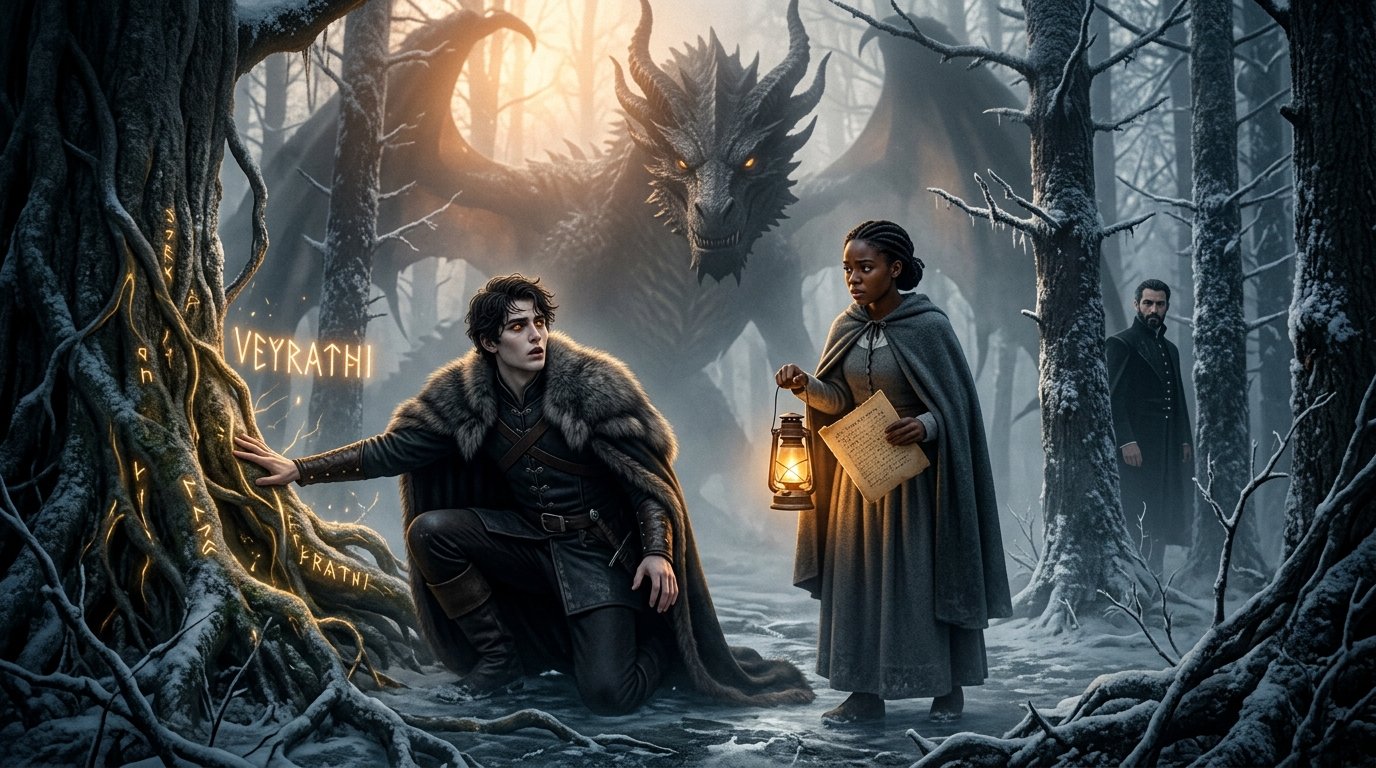
CHAPTER TWO: THE GIRL WHO READS
LAST KINGDOM OF TYBRELL

The restricted archive of Kael Varath occupied a section of the castle’s lower east wing that most of the permanent staff didn’t know existed.
This was not an accident. The archive had been constructed three centuries ago by King Varyn the Third, who had been, depending on which historical account you trusted, either a brilliant scholar-king or a deeply paranoid one — the two were, in James’s estimation, not mutually exclusive. The room existed below the regular library level, accessed through a door in the back of a linen storage alcove that appeared, to any uninstructed eye, to be part of the wall. The door was not locked. Lord Cassel had once explained this apparent security failure to James by pointing out that a locked door announces there is something worth locking, while a hidden door simply disappears. The principle had made immediate sense to James and he had applied it, as a philosophy of concealment, to several aspects of his own interior life.
He had discovered the archive at age twelve, during one of his solitary explorations of the castle’s lesser-used passages. He had told no one and had spent the following five years treating it as his private library, returning regularly to read texts that the official scholars would have found either irrelevant or dangerous, depending on the text.
He arrived there on the sixth morning after his conversation with his father, at an hour when the linen alcove above was empty, and found the door not entirely closed.
James stopped.
The door was always closed. He closed it himself, every time, with the careful deliberateness of someone who understood that an open door was information about a person’s location and activities. He stood in the alcove, in the grey light filtering through a narrow window slit, and thought about this for exactly the length of time required to conclude that turning around and pretending he hadn’t seen it was the wrong choice and also, at some deeper and less rational level, not something he was capable of doing.
He pushed the door open.
The archive was small — twelve feet by perhaps twenty, lined floor to ceiling with shelving that held documents in various states of preservation, from bound volumes of obvious age to loose sheafs of vellum rolled into wooden cases and sealed with wax that had long since dried to brittleness. The room smelled of old paper, old leather, and the specific mustiness of enclosed spaces that had kept their contents intact through sheer indifference to the passing of time. A single oil lamp burned on the reading table at the room’s centre.
Sarah Vale sat at the table with a book open before her and did not look up when he entered.
He recognized the posture: the slight forward lean, the stillness of a person wholly present in a text, the hand resting loosely near the page without touching it, ready to turn but not turning yet. He knew the posture because it was his own.
She looked up after a moment. Her expression went through several distinct phases in rapid succession — surprise, calculation, something that might have been the beginning of alarm — and then resolved into a controlled composure that impressed him, under the circumstances, considerably more than most things had recently.
“Your Highness,” she said.
“You’re reading,” James said. He said it the way he might have said the sky is grey — as observation, not accusation, though he was aware it could be received as either.
“I was.” She didn’t close the book, which told him something. People who were afraid of being caught doing something they shouldn’t be doing closed the evidence. Sarah Vale, in this moment of significant vulnerability, kept the book open. “You’ll want to know how I can read.”
“I already know you can read. I’ve watched you annotate the hall feeding schedules for three weeks.”
Something flickered in her expression. Not quite surprise. “You noticed that.”
“I notice most things. It’s a habit.” He crossed the room and looked at the open book. The text was in old Tybrellian script — pre-reformation orthography, the cramped and angular lettering that had been simplified into modern Tybrellian standard approximately two hundred years ago. Reading it required either a scholar’s training or someone who had spent a very significant amount of time with very old texts. He looked at her. “Who taught you?”
A pause. Then: “My mother’s employer. In the Vale territories. A retired scholar — Master Aldyn Voss, if you know the name.”
He didn’t, but he filed it. “What is he to you?”
“He was kind. When my mother worked in his house, he had no children and too many books and I was curious. Those three things together produced a teacher.” Her voice was level, the cadence of someone who had rehearsed the explanation but not recently. “I know it’s not—”
“What are you reading?” James said.
She looked at him for a moment as though recalibrating something. “A compilation. Pre-Reformation historical records. Dragon lore, mostly — the volume covers the period roughly a thousand years before Varyn the First.” She glanced down at the page. “I was looking for information on Dragon Spirit Communion. The historical practice, before it became formalized in the crown’s protocols. I wanted to understand why the dragons in the hall respond differently to the handlers than they do to each other.”
James pulled the second chair from the wall and sat down across the table from her, which was either a significant breach of decorum or simply an intelligent decision depending on who was doing the evaluation. “What do you mean, differently to each other?”
Her eyes sharpened. This was the expression, he was realizing, that indicated he had asked a genuinely interesting question rather than a functionally necessary one. “Thyrannis ignores Veska,” she said. “Completely. She could walk past him at three feet and he looks at the wall. But if I take Veska’s feeding data to the eastern side of the hall — past the partition, near where his section begins — he turns. Not dramatically. Just a quarter rotation. Tracking her location.”
“He’s aware of her.”
“He’s acutely aware of her. But he performs indifference. Consistently.” She turned the book slightly toward him, indicating a passage without requiring him to ask. “According to this, pre-formalization dragon communion was not individual — it was collective. Riders weren’t just bonded to their own dragons. They were part of a broader… the text calls it a Kethara. A communion web. Every dragon in proximity was part of it. Every bonded person was connected to every other dragon through the web.”
James read the passage. His old Tybrellian was adequate — not perfect, but adequate. “This was before the Communion Protocols,” he said.
“Two centuries before. The Protocols formalized individual bonding and discontinued collective communion. The official history says it was for stability — individual bonds were more reliable, more controlled, less prone to…”
“To what?”
She met his eyes. “Cascade failure. If one bonded person died while in full collective communion, the shock propagated through the entire web. Every dragon would be affected. Every bonded rider.” She paused. “The text says several historical incidents involved entire dragon populations going into kethara shock simultaneously. Mass behaviour shifts. Aggression, disorientation. In one case, it says the dragons began flying south together. All of them. Every dragon in the region, coordinated, no command given. Flying south.”
James sat with this for a moment. “South toward what?”
“The text doesn’t say. Or rather — it doesn’t say explicitly. But in the margin, someone has written something in a different hand. Older, probably. The ink is darker.” She turned the book fully to face him.
James leaned forward. The marginal notation was in a script he almost didn’t recognize — archaic, the letterforms slightly different from any Tybrellian variant he’d seen, with ligatures that looked borrowed from a third language. He translated slowly, under his breath, aloud without meaning to:
“They flew toward the Veyrathi. They always do. The dragons know what we have forgotten — the true masters never truly left. They only changed their shape.”
The room was very quiet.
James read it twice more. Then he sat back in his chair and looked at the lamp flame for a moment and felt the vibration in his chest — that resonance, the frequency below hearing — stir briefly, like something turning over in sleep.
“The Veyrathi,” he said.
“You know the term.”
“Every scholar in Tybrell knows the term. Dragon-shifters. The mythological race of beings from before Varyn the First who could transform physically into dragons and commanded all dragons by their nature rather than through trained communion.” He looked at her. “They’re considered legends. Historical metaphors, most likely — the way early cultures personified the draconic bond in the bodies of exceptional riders.”
“That’s the official position,” Sarah said.
“You have a different one?”
She was quiet for a moment — the silence of someone deciding how far to extend trust, measuring the distance against the weight of what was on the other side. “I have a different reading of the evidence,” she said, finally. “This compilation has fourteen separate references to the Veyrathi across a four-hundred-year period. They’re not the same account repeated — they’re from different regions, different political contexts, different authors. The details are consistent in ways that myths typically aren’t. Myths accumulate variation. These…” She turned back through the pages, indicating. “These stay remarkably similar.”
“What do the details say?”
“That the Veyrathi didn’t ride dragons. That they became dragons — physically, completely — and that while in dragon form they could hear all other dragons simultaneously. Not communicate. Hear. The way you might hear a crowd. And in hearing them, they could…” She stopped.
“Could what?”
“The word the text uses is veth-karath. It means, approximately, call them home. Like a shepherd’s call. Not a command. Something more fundamental than a command.” She closed the book gently. “Something that dragons would respond to regardless of any existing bond or training. Because it came from something they recognized as their own kind.”
James said nothing.
The lamp flame bent sideways briefly in a draft from somewhere, though the archive’s door was closed, and then straightened.
“The historical record says they vanished a thousand years ago,” Sarah continued. “All at once. No recorded extinction event. No war, no plague, no explanation. They simply ceased to appear in any historical documentation after a specific generation. As though they—” She paused. “As though they stopped being what they were. Or stopped being visible as what they were.”
“Or someone ensured they wouldn’t be visible,” James said.
Sarah looked at him. “That thought occurred to me too.”
They sat with it — the lamp flame, the old books, the weight of a thousand years of deliberate forgetting pressing down from the shelves above them. James was aware, in a way that was becoming familiar but was still not comfortable, of the vibration in his chest. It was stronger than it had been in the courtyard. Stronger than it had been in weeks.
He stood. He moved to the shelves and pulled volumes at random — not random, he was categorizing by age and script type, which was what he always did in archival spaces — and worked through a sequence of three volumes before finding what he was looking for: a fragment of early Tybrellian cosmological record, the kind of text that existed in the grey territory between formal history and religious doctrine, that certain scholars treated as mythology and certain other scholars treated as compressed history.
He found the passage in four minutes. He had, he realized, been thinking about where it would be for months without knowing why.
“…and in the last age before Varyn raised his stone seat against the Ashspine, the Veyrathi numbered no more than twelve in the whole of the known world. Of these twelve, the last was named in no record that survived the Burning of Carath. The Burning also consumed whatever treaty they had made with the first Tybrell kings, and so it is not known what was promised in exchange for the Veyrathi’s withdrawal from the world of men. Only the dragons remember, and the dragons do not speak to those who merely ride them.”
James read it twice. Then he set the volume on the table in front of Sarah.
She read it. Her expression did what it always did when she encountered genuinely significant information — it became very still, the way surfaces become still when something is moving beneath them.
“Only the dragons remember,” she said.
“And the dragons don’t speak to those who merely ride them.”
“Merely ride.” She looked up. “That phrasing. Merely.”
“As opposed to those who do something else,” James said.
“Something else,” she repeated. And then, carefully, with the precision of someone handling something fragile: “Your Highness. In the three weeks I’ve been assigned to the hall — Thyrannis and Veska. Do you know how they typically respond to unknown visitors? People they haven’t encountered before?”
“Thyrannis ignores them until they’re within his feeding radius. Veska postures — scales-up, neck-extended. A warning display. Standard territorial behaviour.”
“Yes.” She held his gaze. “You came to the hall entrance two weeks ago. During the morning feeding. I saw you from inside.”
James remembered. A Thursday. He’d been passing and had stopped for a reason he hadn’t examined.
“Thyrannis turned toward you,” Sarah said. “Full rotation. Immediate. Before you were within thirty feet of the entrance. And Veska—” She stopped.
“What did Veska do?”
Sarah’s voice was very even. “She lowered her head. All the way to the floor. And she kept it there until you left.”
James was quiet for a moment that lasted longer than he intended.
“That could be explained by familiarity,” he said.
“You’ve been to the hall perhaps eight times in the past year. The senior handlers go twice daily. Thyrannis doesn’t rotate for them.” She paused. “There’s something else. The week before last, one of the hall boys dropped a feeding bucket near Veska’s section — loud, startling, exactly the kind of provocation that triggers her threat display. She was mid-display — full posture, fully committed — when you walked past the exterior wall.” Another pause. “She stopped. Immediately. Mid-display. And turned toward the wall.”
Toward him. Through the wall.
James looked at the lamp.
“I don’t know what that means,” he said. He said it with enough neutrality that it was almost true.
Sarah said nothing. She was, he was learning, intelligent enough to leave space for the things people needed to say at their own pace.
“These texts,” he said finally. “Have you told anyone you’ve been reading them?”
“No.”
“Good.” He collected himself — the specific internal act of gathering his expression and his bearing back into the arrangement that was Prince James Tybrell, quiet and composed and giving nothing away. “Don’t. Not yet.” He looked at her. “The feeding schedule annotations — you’ve been improving the efficiency of the rotation?”
“The morning handler sequence loses forty minutes across the three sections because of a routing issue. I’ve been adjusting the order.”
“Show me what you’ve written. Tomorrow morning. I’ll bring it to Lord Cassel as a recommendation from my observation of the hall operations.” He paused. “Your name won’t be on it. I’m sorry.”
She looked at him for a moment with that expression he could never fully read — complex and entirely her own, something that no one had trained her to produce. “I know how courts work, Your Highness.”
“I know you do. I’m sorry anyway.”
She nodded. Not gratefully — equably. As if apology and its absence were simply two different weather conditions and she had learned to operate in both. It was, James thought, one of the more quietly devastating things about her: the degree to which she had been forced to become accommodation, and the degree to which she had refused to let it make her small.
“The archive,” he said. “You found the door.”
“I found the door three weeks after I arrived at the castle,” she said. “Doors like that one are — findable, if you move through spaces with attention rather than purpose.”
“That’s an interesting distinction.”
“It’s the difference between going somewhere and noticing where you are.” She glanced at the shelves. “I won’t come back if you prefer. It was clearly not intended for—”
“Come back,” James said. “Please.” And then, because politeness in this context felt like a misrepresentation of something important: “There are texts in here I’ve been trying to read for two years that require fluency in pre-Reformation orthography and someone to think alongside. I’ve been reading them alone and I think I’ve been wrong about them. I think I need someone who reads differently than I do.”
Sarah looked at him for a long moment. Then she said, “I read for what the text is trying to hide.”
“I read for what it’s trying to say.”
“Those aren’t the same thing.”
“No,” James said. “That’s why I need you.”
He left the archive and pulled the door carefully closed behind him and stood in the linen alcove for a moment in the dark, his hand flat against the cold wood, feeling his own heartbeat and that other thing, that resonance, that he had been telling himself for six years was a medical curiosity and nothing more.
They flew toward the Veyrathi. They always do.
He walked back through the castle and said nothing to anyone and that evening, at the formal dinner, sat across the table from Lord Cassel and performed eighteen minutes of entirely convincing conversation about grain tariff adjustments in the southern territories while thinking about amber eyes and old marginalia and the sound of a dragon’s neck lowering slowly, slowly, to the floor.
Duke Frederick Tybrell arrived at Kael Varath four days before the Solstice Court.
He was not expected for three.
James was in the western gallery when the gate bells rang and went to the window in time to see his uncle’s company ride into the main yard — not the ceremonial entrance but the utilitarian western gate, which was a choice that communicated either informality or strategic preference for the entrance that bypassed the guard rotation schedule. Frederick did not do things by accident. James had understood this since age nine.
His uncle was forty-four years old and looked, as he always did, precisely and deliberately like what he was: a Tybrell lord of the secondary line, handsomer than the king by a consensus that had been noted publicly enough to become one of those court facts that everyone knew and no one mentioned. Where Aldric was built for presence — large, inevitable, filling space as a natural consequence of being — Frederick was built for precision. Lean, controlled, with the kind of physical economy that came from training the body to waste nothing. His hair was dark where Aldric’s had gone silver, his beard immaculate, his riding clothes expensive in the way that Frederick’s everything was expensive: without ostentation, which was its own category of expense.
He dismounted and handed his horse to a groom without looking at the animal, which was how Frederick treated everything he no longer needed. He looked up at the gallery window.
James stepped back from the glass before he could determine whether his uncle had actually been looking at him or simply looking upward in the general way of people entering enclosed spaces.
He decided it didn’t matter. Frederick was here a day early, and the western gate, and Lord Dayne Verath was arriving tomorrow, and his father’s expression when James had said I am watching had contained something James was still translating.
He went to find Lord Cassel.
He went quickly.
That night, from the eastern courtyard, he watched the Dark Hall.
He watched it for an hour without knowing exactly why — sitting on the stone steps of the kitchen annex, his breath fogging in the winter air, his hands around a cup of something hot that a confused scullery boy had provided when James had appeared in the kitchen doorway looking like a prince who needed something warm and couldn’t explain why.
The Dark Hall was silent. No light. No movement from the enormous doors.
But the vibration was there, steady and low, like a pulse.
And once — just once, in the forty-seventh minute of his watching — from behind the iron-reinforced stone, something answered it. A sound so deep it was felt rather than heard, resonating in his sternum, in the bones of his face, in the place behind his eyes where thought and something older than thought conducted their quiet negotiations.
James sat very still.
The sound didn’t repeat.
He stayed until the cold became unreasonable, then went inside, and did not sleep until almost dawn, and dreamed of black scales and amber eyes and the sensation of falling from a height so great that the falling itself became indistinguishable from flight.