
CHAPTER TWO: THE ARCHITECTURE OF LIES
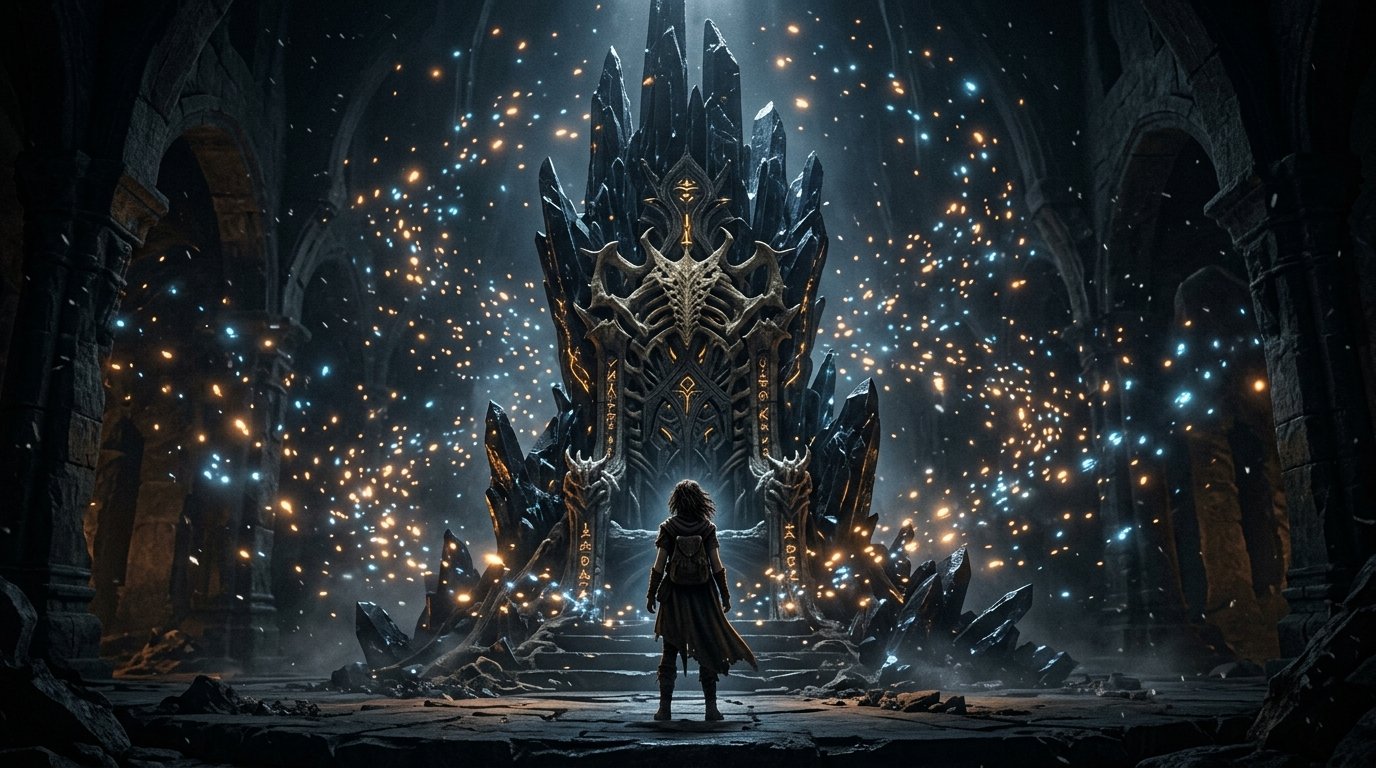
THE ASHEN THRONE

She didn’t sleep.
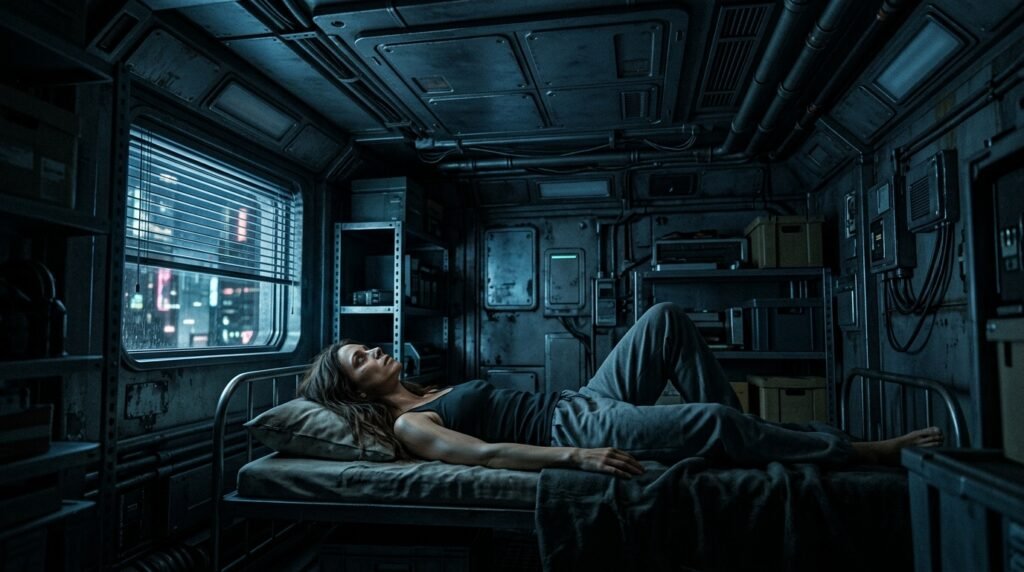
Not because sleep wouldn’t come — exhaustion had a way of overriding even the sharpest grief, and by the third hour of lying on her narrow archive-district cot staring at the pressure-sealed ceiling, her body was making its case loudly and without subtlety. She didn’t sleep because sleeping felt like a betrayal. Like agreeing to pause. Like telling the part of her that had woken up in the archive — the part that was still standing at console seven with its hands frozen over a calibration report — that it was acceptable to set this down for a few hours and return to it refreshed.
It was not acceptable.
She lay still instead, which was not the same as resting, and let her mind work.
The first thing she needed to understand was the scope.
A single deleted signature could be an anomaly — a system error, a corruption event, a low-level administrative decision made by some mid-tier Oversight clerk who had exceeded their authority and would eventually be quietly reprimanded. Mara had been in the archive long enough to know that bureaucracies generated aberrations the way cities generated ash. Constantly, invisibly, for reasons that were usually mundane and occasionally sinister and almost always traceable to someone trying to protect something small and personal — a career, a relationship, a minor transgression.
But this was not that.
The deletion had been too clean. Too architectural. The compression of the surrounding lattice, the complete excision from every accessible database layer, the reaching into the mother’s own memory to remove the knowledge of the child — that was not a clerk protecting a career. That required access to layers of the system that Mara, in eleven years of senior maintenance work, had never been authorized to touch. That required either a Host Sovereign directive or something close enough to one that the distinction didn’t matter.
Which meant this had come from the top.
Which meant Amara had not been an accident or an anomaly or a casualty of bureaucratic carelessness.
Amara had been a decision.
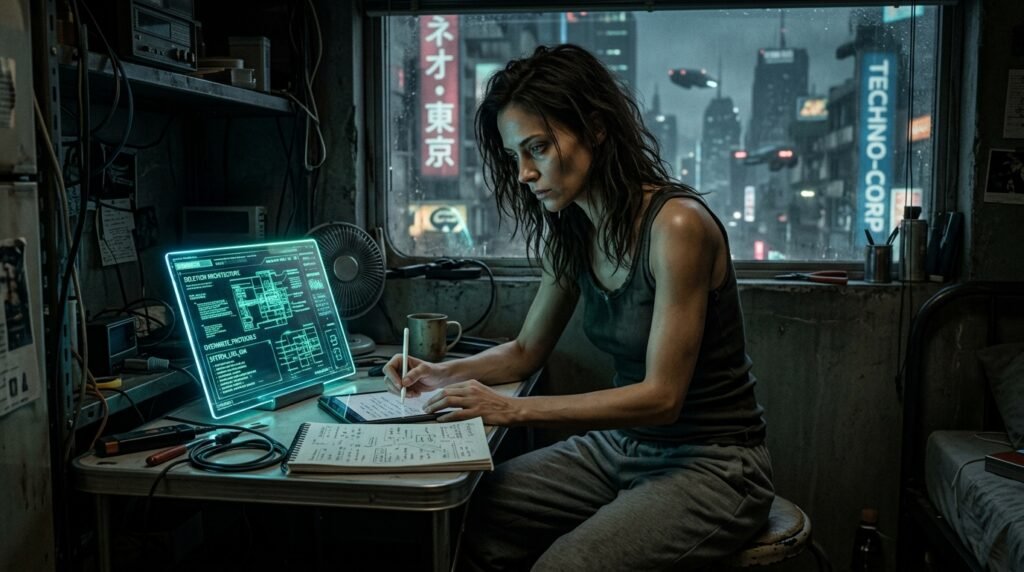
By the fourth hour, Mara had moved from the cot to the small desk in the corner of her quarters, where she kept a personal data-tablet she had never connected to the archive network. It was an old habit from her early years in Vel Kaan, maintained less from genuine security consciousness than from the vague instinct that some thoughts deserved to exist outside of systems that stored and indexed everything. She used it for personal notes, occasional correspondence with the few people who remained from Dara, a record of observations she was not ready to formalize.
She opened it now and began to write.
Not about Amara. Not yet. She wrote about the deletion architecture — the technical specifics of what she had seen, reconstructed from memory with the precision that eleven years of calibration work had built into her hands and eyes. The geometric signature of the extraction. The compression pattern. The relational link dissolution rate, which had been faster than natural decay but slower than emergency protocol, suggesting the deletion had been scheduled rather than reactive.
Scheduled.
Someone had planned this in advance. Had looked at Amara — at whatever Amara had represented or threatened or inconvenienced — and had put her on a list and processed her in an orderly fashion during what was probably a routine administrative cycle.
Mara wrote that down. Let it sit on the screen in plain language. Looked at it.
Then she wrote the question she had been circling since the archive.
How many others?
She went to work early.
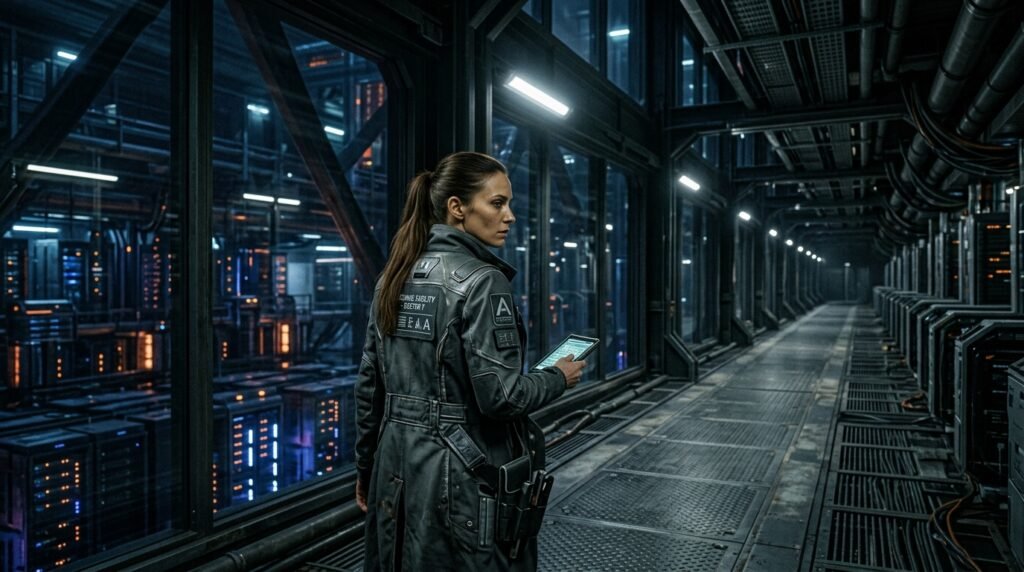
The archive ran continuous operations across three rotating shifts, which meant there was never a time when the facility was empty, but the pre-dawn hours of the first shift were the quietest — skeleton staff, minimal Oversight presence, most of the senior technicians still in transit from their quarters. Mara had logged early arrivals before, enough that her presence at console seven an hour before her scheduled start wouldn’t register as unusual to anyone reviewing the entry logs.
She had thought about that carefully. About what would register as unusual and what wouldn’t. About the difference between investigation and visibility.
She had decided, lying on her cot not-sleeping, that she had perhaps two weeks before she needed to be concerned about visibility. The deletion she had found was buried deep enough in the calibration variance reports that no one without her specific expertise would flag it for review, and the Oversight Division’s standard audit cycle ran on a forty-day rotation. She had time to look carefully before she needed to start looking carefully at who might be looking back.
Two weeks was not much.
She intended to use every hour of it.
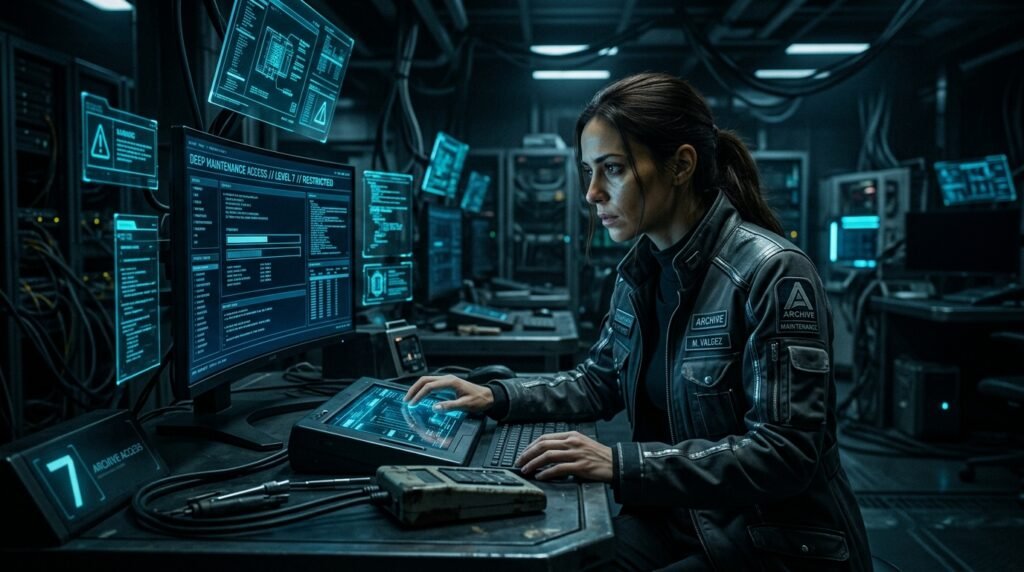
Console seven came alive under her hands with the familiar low-frequency hum of initialization, and Mara sat with the blank display for a moment before she began. This was the part that required clarity — not technical clarity, she had that, but moral clarity. The kind that told you precisely what you were doing and refused to let you describe it to yourself in softer language.
She was about to access system layers she was not authorized to access.
She was going to use eleven years of institutional knowledge and accumulated access permissions and the specific trust that came from being the kind of employee who had never given anyone reason to doubt her, and she was going to use all of that to go somewhere she was not supposed to go.
If she was caught, the consequences would not be administrative.
She knew what happened to people who found things inside the archive that they weren’t meant to find. She had processed three dissolution reports in her career that had listed cause of death as identity fragmentation for individuals who had, according to their personnel files, been in excellent cognitive health at their last evaluation. She had filed those reports with the careful professionalism of someone who understood which questions to not ask aloud.
She asked them now.
She began.
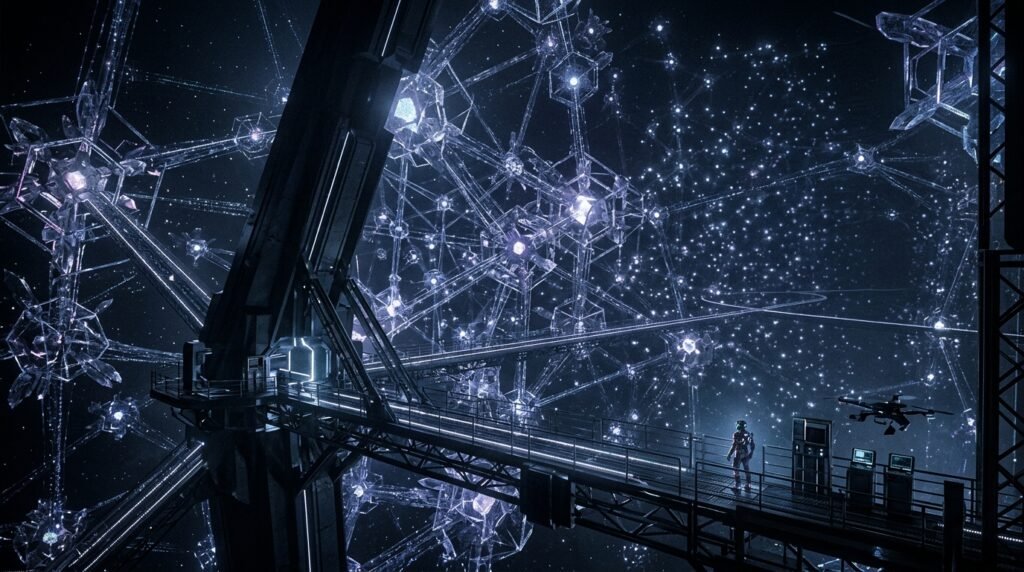
The archive’s deep maintenance layer was not technically a restricted zone. It was more that it was a zone no one in standard operations had reason to visit — a substrate layer beneath the calibration infrastructure where the raw lattice architecture lived, where the actual structural logic of how consciousness signatures were stored and connected and maintained could be examined at its most fundamental level. Mara had been there before, legitimately, during a major lattice reconstruction three years prior when the eastern corridor collapse had damaged several primary conduit arrays and a team of senior technicians had spent six days in the deep layer doing structural repair.
She knew the geography. She knew the access pathways. She knew which system queries would generate automatic logs and which operated below the logging threshold.
She moved carefully, like a person walking across ice — testing each step before committing weight, reading the surface for the particular stillness that meant something was about to give.
The deep layer opened before her in the display like a landscape seen from altitude — vast, geometric, breathing with the slow rhythm of billions of stored minds. From here the individual signatures were invisible, reduced to structural load points in an architecture of almost incomprehensible scale. The lattice stretched in every direction, its crystalline logic both beautiful and deeply impersonal, the way cities were beautiful from the air before you descended into them and encountered the specific human texture of suffering that all cities contained.
Mara oriented herself and began searching for the pattern she had seen at console seven.
The deletion signature. The geometric compression. The clean architectural wound of something deliberately removed.
She found the first one within four minutes.
The second within seven.
By the end of the first hour, she had found thirty-one.
She sat back.
Thirty-one deletion signatures in the deep layer, each with the same architectural fingerprint — same compression pattern, same relational link dissolution rate, same complete excision from the database layers above. All small signatures. All young. All connected by primary bond architecture to parent signatures that remained intact, undisturbed, carrying no awareness of what had been taken from them.
Children.
Thirty-one children, deleted from the lattice and from the memory of their parents with the same quiet administrative efficiency that had been applied to Amara.
Mara breathed slowly and kept her hands flat on the console and did not allow herself to feel this yet. Feeling this would come later, in private, where it belonged. Right now she needed to think.
She cross-referenced the deletion timestamps.
They were not clustered. They were spread across nineteen months, appearing at irregular intervals ranging from eleven days to six weeks apart. Not a single event. Not a purge or a crisis response. A program. Something ongoing, systematic, conducted with the patience of an institution that was not in a hurry because it had never needed to be in a hurry.
She looked for a pattern in the parent signatures — something that connected the families, that explained the selection criteria. Geographic distribution? She mapped it. The deletions spanned four of the city’s seven residential sectors, with no meaningful clustering. Labor classification? She pulled the parent occupational indices. The range was broad — dock workers, educators, medical engineers, transit operators, two archive technicians from a different facility. No obvious professional thread.
She was about to run a cognitive index comparison when she heard the door.
She closed the deep layer query in the same motion that she turned her head, her hands clearing the display with a smoothness that came from not thinking about it, replacing it with a standard calibration dashboard that she had genuinely needed to review at some point today and would now review with intense focus for the benefit of whoever had just entered.
It was Soren.
He stopped just inside the door, reading the room the way he always did — a quiet, comprehensive assessment that he had never explained the origin of but which Mara had long suspected came from years of needing to know very quickly whether a space was safe. His eyes moved from her face to the display to the time indicator on the wall, which showed forty minutes before the start of her scheduled shift.
“You’re early,” he said.
“Calibration backlog,” she said.
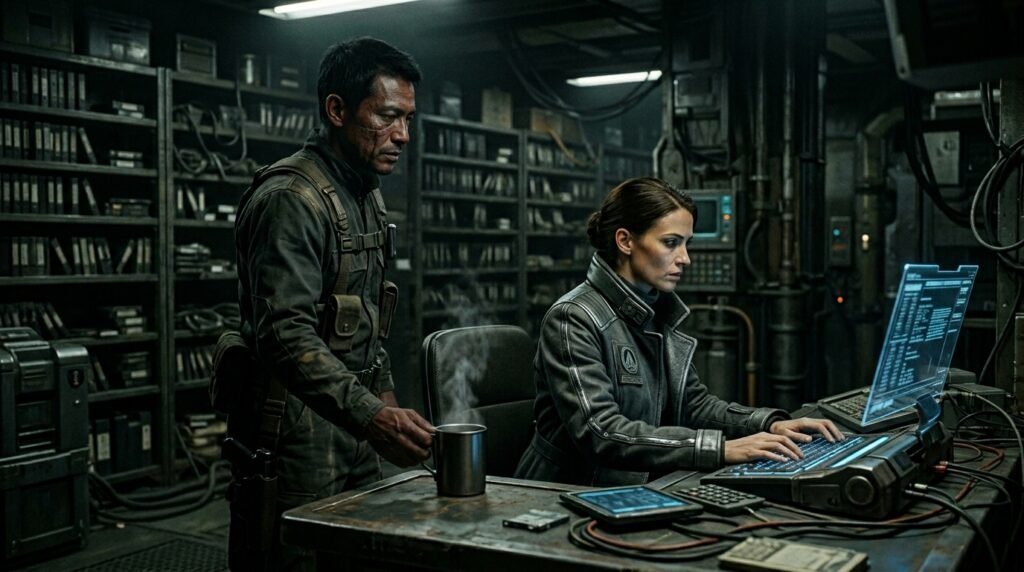
He looked at her for a moment longer than the statement warranted. Then he walked to the break room without another word and she heard the grain-coffee machine begin its labored process of producing something technically drinkable.
She turned back to her display.
Her heart was moving at a rate that her diagnostic implant would flag if she didn’t regulate it, and she spent thirty seconds on the breathing pattern that the archive’s mandatory wellness training had taught her six years ago and that she had privately considered useless until this moment. It helped marginally. She applied it again.
Thirty-one children.
Nineteen months.
A program.
Soren came back with two cups and set one beside her console without asking if she wanted it. She didn’t look up. He settled at his own station and began his startup diagnostics and for a while they worked in the particular comfortable silence that four years of adjacent labor had built between them — a silence that had its own texture and temperature, that communicated things that neither of them had ever found it necessary to put into words.
After perhaps twenty minutes, he said, without looking up from his display: “Did you find what you were looking for last night?”
Mara considered her answer.
“I found more than I was looking for,” she said.
“That’s usually how it goes.”
“Soren.” She waited until he turned. “If I asked you to do something that was outside your authorization level. Something that could be explained as a technical error if it was discovered but probably wouldn’t be — would you need to know why first, or would you trust me?”
He looked at her with the expression she had no category for — the one that appeared rarely and always made her feel that he was seeing something she hadn’t shown him. Not the controlled concern. Something quieter and more serious.
“I’d want to know why,” he said. “Not for my sake. Because whatever you found is sitting on you like structural weight, and I’d rather carry some of it than watch you hold it alone.”
Mara looked at him for a long moment.
Then she told him about Amara.
Not everything. Not the thirty-one. Just Amara — the shape of the absence, the relational links, the name that had risen from somewhere the Throne couldn’t reach. She told him in the flat, precise language of a technician describing a system anomaly, because that was the only way she could tell it without the room changing into something she wasn’t prepared to be in.
When she finished, the archive was very quiet.
Soren set down his cup. He looked at the display. He looked at his hands. He did all the things that a person does when they are taking something in and deciding where to put it and finding that none of the available spaces are adequate.
Then he said: “What do you need me to do?”
What she needed him to do was access the personnel archive.
Soren’s role as a maintenance coordinator gave him institutional access to staffing records that Mara’s calibration classification didn’t cover — specifically, the cognitive evaluation histories of archive employees. It was a narrow access permission, intended for scheduling and workload assessment, and pulling individual cognitive profiles was within its technical scope even if the purpose Mara had in mind was considerably outside its intended use.
She needed the cognitive evaluation histories of the thirty-one parents.
Specifically: she needed to know if any of them had shown anomalous results in the periods immediately following the deletion of their children. Gaps in continuity. Unexplained variance in memory coherence scores. The specific signature of a mind that had been edited and didn’t know it.
If the deletions were part of a program, there would be documentation somewhere in the system — there was always documentation, because institutions that operated at this scale were constitutionally incapable of not documenting themselves. But the documentation would be buried, access-restricted, encrypted in the administrative layers that neither she nor Soren could reach directly.
What they could reach was the evidence the program left behind. The cognitive fingerprints of what the Throne had done to people who would never know it had been done to them.
She explained this to Soren in quiet, efficient terms, watching his face as she spoke.
He nodded once when she finished.
“Index numbers,” he said.
She gave them to him. All thirty-one.
He worked for two hours. Mara ran legitimate calibration tasks in parallel, maintaining the surface appearance of a normal pre-shift morning, while in her peripheral vision Soren moved through the personnel archive with the methodical patience of a man who understood that thoroughness now prevented catastrophe later.
The first shift began arriving. Pell came in looking unrested and nodded at them both. Two technicians from the northern intake team settled at the far consoles. The archive filled with its ordinary sounds — the soft percussion of console interaction, the low-grade hum of the processing cores, the occasional distant clang of maintenance work in the conduit corridors.
Ordinary.
Everything looked ordinary.
Mara thought about the ash falling on collection days and wondered how long ordinary had been a performance.
“Mara.”
Soren’s voice was carefully level. She recognized the specific quality of the levelness — it was the voice he used when something required steadiness from both of them.
She rolled her chair to close the distance between their consoles and looked at his display.
He had pulled the cognitive evaluation histories for all thirty-one parents.
Every single one showed the same anomaly.
In the evaluation period immediately following the deletion of their child — in every case, without exception — there was a documented memory coherence event. Logged by the standard monthly evaluation system as a minor fluctuation. Flagged, assessed, and cleared within a single review cycle. Nothing that would raise concern in isolation.
But Mara was not looking in isolation.
She was looking at thirty-one of them, lined up in sequence, each one a clean and clinical record of a parent being assessed for whether the editing had held. Whether the removal of their child from their memory had been complete. Whether they were carrying anything that might surface later as confusion, as grief without a source, as the specific bewilderment of someone who feels an absence they cannot name.
Clearance status: Stable.
Thirty-one times.
Thirty-one parents assessed, confirmed contained, and returned to their lives.
Thirty-one people who did not know they were missing someone.
Mara looked at the records and felt something complete its formation inside her — something that had been building since console seven, since the name that had risen from beneath the Throne’s reach, since the hour of lying on her cot not-sleeping and letting the cold settle in properly.
It was not rage. Rage was too simple and too hot for what this was.
It was something colder and more structural. The thing that happened when a person who had organized their life around a belief discovered that the belief had been a function of the system that controlled them. Not a loss of faith so much as a reclassification of the past — every year of trust retroactively reassigned, every moment of believing that someone was keeping count revealed as the intended product of a machine that needed her to believe exactly that in order to keep functioning.
The Throne had not preserved them.
It had managed them.
And somewhere in the architecture of that management, in the clean administrative logic of a program nineteen months old and still running, thirty-one children had been weighed against something Mara could not yet see and found insufficient.
She was going to find what they had been weighed against.
“There’s something else,” Soren said.
He pulled up a secondary file — a cross-reference he had run against the cognitive evaluation records, looking for the name of the evaluation administrator assigned to each clearance assessment.
The same name appeared on all thirty-one.
A single Oversight Division administrator, designated Senior Coherence Analyst, Classification Seven, whose personnel file listed their current assignment as Special Projects — Throne Interface Division.
The Throne Interface Division.
Mara had heard of it the way archive technicians heard of most things above their clearance level — as an abstraction, a name that appeared occasionally in administrative routing headers, carrying the specific weight of something everyone knew better than to ask about directly. It was the division responsible for managing communication with the Host Sovereign. For translating the Throne’s directives into administrative action.
For implementing decisions that came from the top.
She looked at the administrator’s name for a long moment.
Then she looked at Soren.
“We need access to the Interface Division records,” she said.
He met her eyes. “That’s three clearance levels above anything either of us can touch.”
“I know.”
“If we try and fail—”
“I know.”
He was quiet. Outside, through the archive’s narrow high windows, the sky over Vel Kaan was doing what it did every morning — turning from black to the particular bruised amber that passed for dawn in a city that lived beneath the Throne’s atmospheric output. The bridges between the towers had stopped their nighttime pulse and resumed their daytime rhythm. Somewhere below, the streets were beginning to fill.
People walking to work. Children chasing each other between transit columns. Old men setting up their bone-piece board games.
None of them looking up.
“Alright,” Soren said.
He said it the way he said most things — quietly, without drama, like a man stepping onto ice he had already decided to trust.
“Alright. Tell me how.”


🔥🔥🔥🔥