

Ladies First 2026: The Ultimate Movie Review & World-Building Breakdown
Ladies First


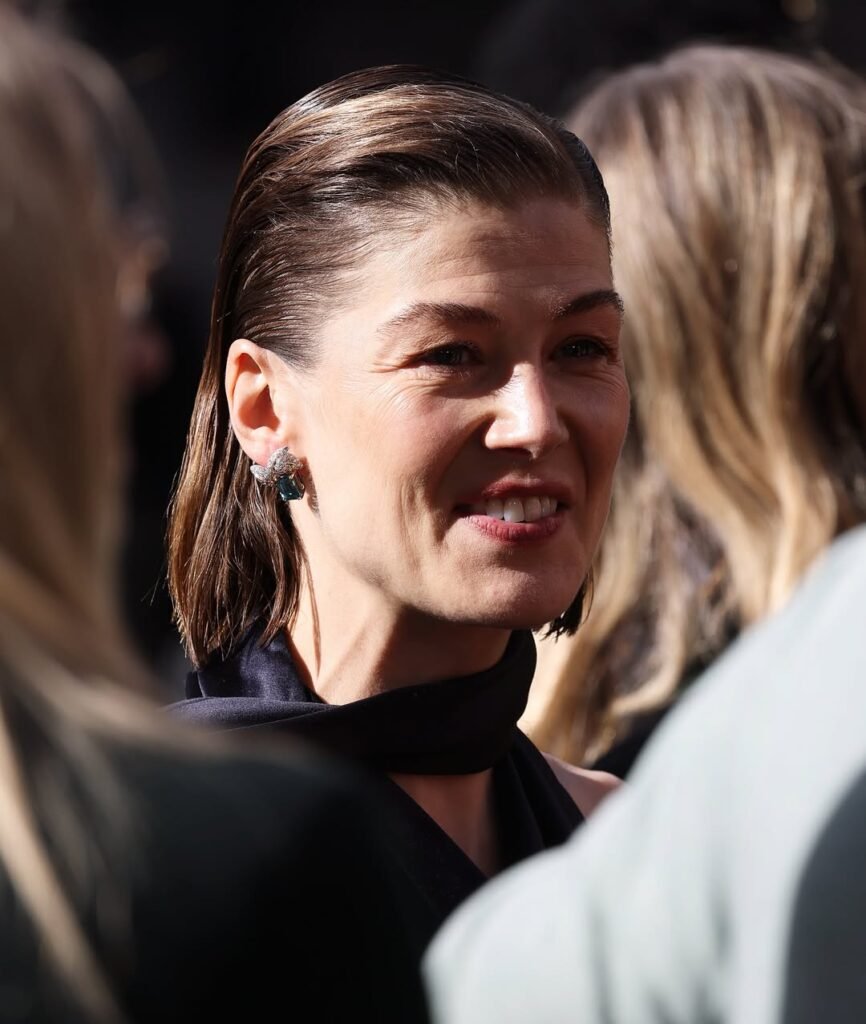




When 3DOT Productions announced the release of Ladies First 2026, audiences were immediately intrigued. Released to massive global streaming numbers and directed by Thea Sharrock, the film promised a hilarious, razor-sharp critique of modern gender dynamics wrapped in a high-stakes corporate comedy. Starring the always-provocative Sacha Baron Cohen and the chillingly brilliant Rosamund Pike, the film takes one of society’s most heavily debated topics—the patriarchy—and literally flips it on its head.
But does this ambitious, star-studded parallel-universe comedy actually stick the landing? As an elite piece of entertainment, Ladies First 2026 is a fascinating case study in world-building, satirical exaggeration, and the sheer power of actor chemistry. In this massive, comprehensive review, we are going to break down the core narrative of the film, examine the meticulously crafted parallel universe, analyze the cutthroat environment of Damien’s corporate world, and explore why this movie has deeply divided critics while completely dominating the cultural conversation.
The Setup: The Echo Chamber of Extreme Privilege
To truly understand the impact of the flipped reality in Ladies First 2026, we first have to understand the baseline reality the film establishes in its spectacular opening act. The movie does not waste time with subtle exposition; it punches the audience right in the face with the sheer, unadulterated toxicity of its protagonist.
The tone is perfectly set by the narrator, who introduces our lead with a blunt, unforgettable opening line: “This is a story about a man named Damien. Damien had it all—wealth, sex, power… because he was also an arsehole.”
Damien Sachs (Sacha Baron Cohen) is the quintessential “finance bro” aged up into a C-suite executive. The visual storytelling of his introduction is a masterclass in establishing character through environment. We see Damien in a crisp white suit, strolling past an infinity pool overlooking the ocean. He walks into a massive luxury bedroom where a woman is still fast asleep. In a display of what he likely considers “gentlemanly” behavior, he leaves her a designer shopping bag and casually mentions he bought her a new dress so she can travel home discreetly. He caps off his dismissive, transactional monologue with the deeply manipulative line: “Anything for the woman who took my virginity.”
He uses his massive wealth to cushion his complete lack of empathy. Damien believes that throwing money, clothes, and extravagant breakfasts at a woman absolves him of having to treat her with genuine human connection. The film quickly transitions into a montage of extreme, isolating wealth—yachts, open-roof luxury cars, and tropical islands—establishing that Damien’s privilege acts as an impenetrable fortress against the consequences of his actions.
The Corporate Crisis: Diversity as a Threat
Damien’s untouchable world faces its first real threat during a highly exclusive corporate gathering on a tropical island. He arrives with a distinguished, white-haired corporate veteran, played with effortless, intimidating authority by Charles Dance. The environment is instantly telling: the island building is filled with beautiful women who function solely as living set dressing for the wealthy men in attendance.
The satire sharpens when these top executives sit down with the company’s elderly CEO. The CEO drops a bombshell that threatens their comfortable, male-dominated ecosystem: the corporate board has mandated that the company desperately needs female representation at the executive level.
Because they are all men, the CEO felt it was necessary to fly them to the island to deliver the news face-to-face. This prompts a brilliant, cynical reaction from Charles Dance’s character, who narrows his eyes and asks: “Did you bring us all the way down here to fire us?”
This single line highlights the sheer paranoia of the entrenched executive class. To them, the mere suggestion of introducing a female voice into their ranks is not viewed as a step toward equality, but as an existential threat and a direct attack on their livelihoods.
The Desperate Lie and The “Diversity Hire”
It is in this high-pressure, panic-inducing moment that Damien’s corporate survival instincts take over. Without missing a beat, he interrupts the CEO and boldly declares that the company does not need to worry about the board’s mandate because he has already taken care of it.
He lies directly to the CEO’s face, claiming they already have a newly appointed Female Creative Director. He brilliantly covers his tracks by framing this phantom hire not as a desperate scramble for optics, but as a strategic business move, stating they hired her “not for optimism, but for performance.” It is a spectacular piece of corporate double-speak that saves the meeting.
The comedic payoff occurs shortly after. As Damien and Charles Dance walk together, Dance asks Damien to tell him more about this mysterious new director who was supposedly employed “last two weeks.” Damien, realizing the massive corner he has backed himself into, scrambles to adjust the timeline: “Ooh, did I say last week? I always have a problem remembering time… I meant this afternoon.”
This desperate lie forces Damien to frantically call his assistant to source and hire a Female Creative Director before he returns. Enter Alex Fox (Rosamund Pike), an exhausted, hyper-competent single mother who is brought into the company purely to serve as a human shield for Damien’s paycheck.
Waking Up in the Matriarchy

The desperate scramble to cover his tracks and the ensuing chaotic clash with his new “diversity hire” sparks the chain of events that leads to Damien’s reality-shattering accident. Following a massive head trauma, Damien is knocked unconscious. When he wakes up, the world as he knows it is gone.
The transition into the parallel universe in Ladies First 2026 is handled with a disorienting, visceral brilliance right on the streets of London. During a heated street argument where Alex Fox tells him to try empathy, Damien arrogantly walks forward, completely distracted, and crashes violently into a metal pole. He is knocked unconscious, and the film brilliantly signals the universe flip by turning the camera entirely upside down as it pans up to the skyscrapers.
When Damien regains consciousness, he is not in a hospital, but still lying on the wet pavement, being tended to by two female first responders. The immediate sensory changes are subtle but jarring. The women speak to him with a condescending, patronizing tone—the exact tone Damien himself used in the first act. One responder immediately infantilizes him by calling him “love” and asking if he is on medication, dismissively stating, “Side effects can be intense. Some men can’t handle it”.
As Damien stumbles back into the building, the sheer scale of the world-building begins to unfold. Director Thea Sharrock doesn’t just change who sits in the CEO chairs; she alters the entire fabric of society to reflect a world where women have historically held all physical, political, and economic power.
World-Building Brilliance: The Micro and Macro Aggressions
What makes the parallel universe in Ladies First 2026 so compelling is how it scales the satire. It addresses both the macro-level power structures and the micro-level daily aggressions.
On a macro level, the political landscape is dominated by women. News broadcasts playing in the background casually mention the female Pope and female world leaders engaging in aggressive, chest-thumping geopolitics. The history books have been rewritten to highlight maternal lineage rather than paternal.
But it is the micro-aggressions that provide the darkest comedy and the sharpest commentary. The street fashion has flipped entirely: women wear comfortable, practical, wide-shouldered suits that project authority and take up physical space. Men, conversely, are dressed in restrictive, brightly colored, heavily tailored outfits designed to accentuate their figures.
Damien, who previously navigated the world with absolute physical and social impunity, suddenly finds himself navigating a minefield of vulnerability. When he walks down the street, he is aggressively catcalled. Men in this universe are expected to be domestic. They worry incessantly about their “biological clocks,” and their worth is heavily tied to their youth and sex appeal. Damien is forced to undergo humiliating grooming rituals just to be considered presentable for a basic office job, forcing him to experience the crushing weight of a thousand tiny, daily indignities.
The Power Reversal: Alex Fox’s Ruthless Ascension
The absolute crown jewel of Ladies First 2026 is Rosamund Pike’s performance as the alternate-universe version of Alex Fox. In Damien’s original reality, Alex was an overworked pawn hastily hired to satisfy a board mandate. In the matriarchal reality, she is the apex predator.
Pike plays the CEO version of Alex with a chilling, sociopathic grace that echoes her legendary turn in Gone Girl. She isn’t just powerful; she is entirely unburdened by the need to be likable or accommodating. She manspreads in meetings. She speaks in absolute declarations. She objectifies her male subordinates with terrifying casualness.
When Damien finally makes his way back to the advertising agency in this new reality, he discovers that he is no longer an executive. He is a low-level assistant, and Alex is his terrifying, untouchable boss. The dynamic shift is electric. Sacha Baron Cohen plays Damien’s desperation perfectly, stripping away the bravado until all that is left is a confused, terrified man trying to survive in a corporate hierarchy that views him as completely disposable.
Alex uses Damien for her own amusement, promoting him not for his intellect, but because she finds him physically attractive and easily manipulated. The irony is thick and deliberate: Damien is forced to use his sexuality and submission to climb the corporate ladder, utilizing the exact same survival tactics he previously forced upon the women in his own reality.
The Heavy-Handed Satire: Genius or One-Joke Wonder?
Despite the phenomenal performances and the incredible production design, Ladies First 2026 has been a highly polarizing film among critics. Why the disconnect between the ambitious premise and the critical reception?
The primary criticism leveled against the film is that it relies on a “one-joke” premise. Critics argue that instead of offering a nuanced, deeply philosophical look into how a matriarchal society might uniquely function, the script settles for a lazy, literal 1:1 role reversal. Women simply act exactly like toxic men. There is no deep exploration of how female-led historical structures might have fundamentally altered economics or social welfare; the world is exactly the same, just with the genders swapped.
Furthermore, the heavy integration of real-world corporate branding—which drives the high-stakes advertising plots of both realities—has been heavily criticized as feature-length product placement. While intended to ground the corporate satire in reality, the constant brand dropping occasionally makes the film feel like a high-budget commercial.
However, general audiences have been far more forgiving. For many viewers, the lack of nuance is exactly the point. The film doesn’t want to be a subtle sociological thesis; it wants to hold up a giant, blindingly obvious mirror to modern society. By having women behave exactly like toxic men, the film highlights the sheer absurdity and cruelty of patriarchal norms. The literalness of the flip is what makes the comedy land for casual viewers. It is cathartic to watch a chauvinist endure the exact humiliations he has inflicted on others.
Final Thoughts on the World of Ladies First 2026
Ladies First 2026 is a bold, visually striking, and intensely provocative film. It may not be the most subtle piece of cinema ever created, but it is undeniably effective at forcing a conversation about gender dynamics in the modern corporate sphere. Sacha Baron Cohen’s commitment to his character’s degradation is phenomenal, and Rosamund Pike’s terrifyingly alpha performance is worth the price of admission alone.
The world-building is meticulous, the corporate satire regarding diversity mandates is biting, and the complete inversion of societal norms makes for a highly entertaining viewing experience. As a foundation for our deep dive into this cinematic universe, understanding the stark contrast between Damien’s reality and the Matriarchal Flip is essential.
But understanding the broad strokes of the world is just the beginning. To truly grasp the genius of this film, we have to zoom in on the specific rules, laws, and cultural shifts of this alternate reality.